Time Walk
Villas Behind the Brixton Road


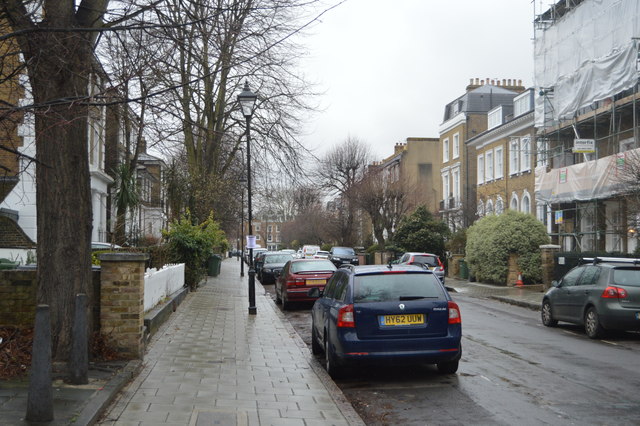
A barrister's death opened the way for a quiet street of villas behind Brixton Road. Walk it today and the eye catches stuccoed porches, paired houses, and the odd flank wall pushed forward into a shallow porch. Most of what stands here was built within a few decades of the road itself.
Beneath that calm run of early Victorian fronts lies a more particular story: a licence to build, and — a century later — a young architect's very first job.
Name Origin
From Grove Road to Groveway
Groveway was formerly known as Grove Road. The sources used here do not explain why either name was chosen, only that one replaced the other at some point in the street's history.
History
A Licence After a Death
Randle Jackson, a barrister-at-law and an expert on Indian affairs, began developing land for housing between what would become Groveway and Lorn Road, laying out terraces along Brixton Road between 1810 and 1840. A development of semi-detached townhouses called Grove Place, three storeys with attics, went up between the two roads in the same period.
Jackson died in 1837. After his death James P. Macdougall was granted licence to make roads — including Groveway and Lorn Road — on land at the back of the Brixton Road houses. Groveway and Lorn Road themselves were laid out about 1840. The junction of Stockwell Park Road and Groveway marked the eastern boundary of the old manor of Stockwell.
The houses that followed vary in detail but share a family likeness: mostly brick, two or three storeys over a semi-basement, with rendered ground floors. Several larger houses carry porticos, and some have their flank walls brought forward to form shallow porches. More than twenty of these early-to-mid-19th-century houses, including Nos. 4 and 6, No. 16, and the run from No. 24 to No. 47, were protected as Grade II listed buildings.
No. 36 Groveway, an early-mid-19th-century house, was much rebuilt after war damage — yet it still carries its Grade II listing alongside its unrebuilt neighbours.
Culture
A Brutalist's First Job
Among the row of 19th-century villas sits a quieter marker of a very different career: an early job for a man who would later shape very different buildings.
People
A Barrister, a Developer, an Architect
Randle Jackson was a barrister-at-law and an expert on Indian affairs, and his death in 1837 set the next stage in motion.
James P. Macdougall took up the licence that followed, building the roads themselves on land behind the Brixton Road houses. More than a century later, Owen Luder — born in 1928, later a leading brutalist architect and twice President of RIBA — designed houses at 26–28 Groveway in 1953, his work here predating the large civic and commercial buildings for which he became known.
On the Map
Groveway Then & Now
Frequently Asked Questions
Why is it called Groveway?
Groveway was formerly known as Grove Road. The sources consulted here do not explain the reasoning behind either name.
What is Groveway known for?
Groveway is known for its run of early-to-mid-19th-century villas, more than twenty of which are Grade II listed, and for houses designed in 1953 by the architect Owen Luder.
When was Groveway built?
Groveway was laid out about 1840, following a licence granted to James P. Macdougall after the death of the developer Randle Jackson in 1837.
Are there listed buildings on Groveway?
Yes. More than twenty houses, including Nos. 4 and 6, No. 16, and the run from No. 24 to No. 47, were given Grade II listed status on 9 August 1978.