Southwark London England About Methodology
Southwark · SE1 · Bermondsey

Grange Walk

The iron gate-hooks of a medieval monastery still protrude from the wall at number 7 — the last visible fragment of Bermondsey Abbey’s east gatehouse, incorporated into a row of 17th-century houses.

Name Meaning
Abbey Farm Road
First Recorded
Pre-1536
Borough
Southwark
Character
Historic residential
Last Updated
Time Walk

Iron Hooks and Old Stone

Grange Walk holds what is widely regarded as one of the prettiest and most historically layered streetscapes in Bermondsey. At its western end, the 17th-century houses at numbers 5, 6, and 7 conceal the remains of a medieval stone gatehouse. At number 7, a chamfered stone jamb is still visible, and two wrought-iron gate-hooks project from the brickwork — the hardware of a monastery gate taken down around 1760 but never fully erased.

2013
67 Grange Walk (geograph 4985894)
Wikimedia Commons · CC BY-SA 2.0
2021
15 Grange Walk, Bermondsey (West Face)
Wikimedia Commons · CC BY-SA 4.0
Historical image not found
Today
Demolition site on Grange Walk
Geograph · CC BY-SA 2.0

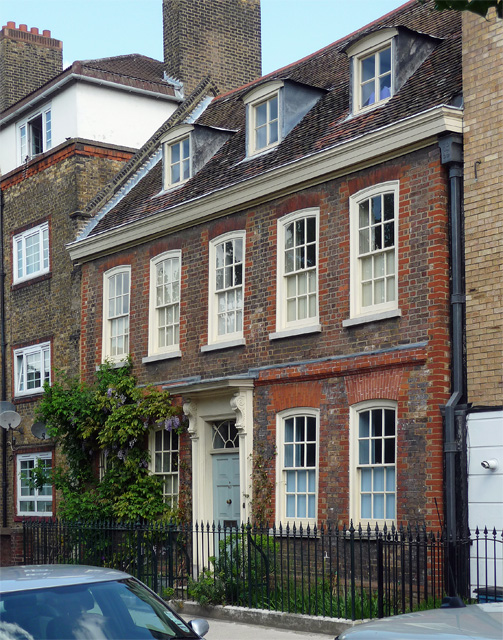
Further east, a Grade II* Queen Anne house at number 67 — double-fronted and dated to c. 1700 — stands alongside the former Bermondsey United Charity School for Girls, whose stone inscription from the 1830s remains legible on the corner of Grigg’s Place. The cobbled lane of Bridewain Street leads off towards the east, once a route to a dairy. That word “Grange” in the street name is the key to everything.

✦   ✦   ✦
Name Origin

The Farm at the Edge of the Abbey

A grange was not a grand country house. It was a working farm — specifically, the agricultural estate attached to a monastery where rents paid in grain were stored and corn was ground. The road takes its name directly from the grange of Bermondsey Abbey, the Cluniac monastery that dominated this corner of south London from 1082 until Henry VIII dissolved it in 1536. As documented by British History Online in the Victoria County History of Surrey, the street sat on pasture-ground belonging to the monastery, running eastward toward the building still known as Grange Farm well into the 19th century.

The word “grange” derives from the Old French grange and the Medieval Latin granica, both meaning a granary or barn. British History Online’s Old and New London records that the east gate of the monastery in Grange Walk — the gate through which farm labourers and grain wagons passed — was “pulled down about the middle of the last century” (i.e. the mid-18th century). The road’s earlier recorded name was Grange Road, becoming Grange Walk when a separate, more southerly Grange Road was established.

How the name evolved
pre-1536 The Grange (abbey farm)
c. 18th century Grange Road
mid–late 19th century Grange Road / Grange Walk
present Grange Walk
✦   ✦   ✦
History

From Abbey Pasture to Tan-Yard

Bermondsey Abbey was founded in 1082 by Alwinus Child, and within a decade had become a Cluniac priory through the arrival of four French monks from La Charité-sur-Loire. The land to its south and east — the ground on which Grange Walk now runs — was all open farmland worked by the monks and their tenants. Rents and tithes paid in grain were stored in barns here, and the abbey also owned corn mills for grinding flour. The east gatehouse, whose remains survive in numbers 5–7, was the functional entrance through which labourers and wagons passed daily.

Key Dates
1082
Abbey Founded
Alwinus Child founds a monastery at Bermondsey; four Cluniac monks arrive from France in 1089, establishing the priory.
1487
Royal Resident
Elizabeth Woodville, widow of Edward IV and mother of the Princes in the Tower, commences her residence at Bermondsey Abbey in February.
1536
Dissolution
Henry VIII dissolves Bermondsey Abbey. The site is granted to Robert Southwell in 1541; the farmland begins its long transition to streets.
c. 1700
Queen Anne Houses
Late 17th- and early 18th-century houses built along Grange Walk, incorporating the medieval stone gatehouse into numbers 5, 6, and 7.
c. 1760
Gate Demolished
The east gate of the monastery in Grange Walk is taken down, but the iron hooks on which the gates hung remain embedded in the wall.
1830s
Girls’ Charity School
The Bermondsey United Charity School for Girls opens at 15 Grange Walk; its stone inscription is still visible at the corner of Grigg’s Place.
1873
Walton’s Account
Edward Walton describes the road as running from monastery pasture-ground to Grange Farm and onward to the Neckinger, flanked by tan-yards.
Did You Know?

Elizabeth Woodville — mother of the “Princes in the Tower” and of Elizabeth of York, who became Henry VII’s queen — spent the last five years of her life at Bermondsey Abbey, dying there on 8 June 1492. The abbey whose east gate still stands in Grange Walk was her final home.

After the dissolution, the land passed through several hands before Bermondsey began its transformation from monastic estate to industrial suburb. By the 18th century, the area to the south and east of the former abbey was still largely open farmland; an illustration from 1812 shows a large farmhouse here owned in the late 18th century by the Rolls family. When the Victorian expansion came, it came hard. Writing in 1873, Edward Walton described the south side of Grange Road as characterised by tan-yards — “another of the numerous branches of trade arising out of the leather manufacture, which gives to Bermondsey so many of its characteristics.”

The leather trade had long shaped this part of Bermondsey. The proximity of the River Neckinger — the ancient watercourse that Grange Walk originally extended to — made the area ideal for tanning, which required large quantities of water. SE1 Direct notes the wider neighbourhood’s enduring identity as a working industrial district, with the transition from monastery pasture to leather manufacture playing out most visibly along the length of Grange Walk itself.
✦   ✦   ✦
Culture

Stone, Inscription, and the Queen’s Last Years

The buildings of Grange Walk are among the most architecturally significant on any residential street in Southwark. As Historic England’s listing records, numbers 5, 6, and 7 form a group of late 17th-century Grade II listed houses whose structure incorporates part of one side of the late medieval stone gatehouse of Bermondsey Abbey — including the chamfered south jamb of the gateway and two wrought-iron gate-hooks projecting from the wall at number 7. Number 67 is Grade II* listed, a double-fronted Queen Anne house of c. 1700 that retains medieval beams and stonework re-used from the demolished abbey buildings.

Nine Centuries of Masonry
The Gatehouse at Numbers 5–7

The partial east gatehouse of Bermondsey Abbey, built into the late 17th-century terrace at numbers 5–7, is the only substantial above-ground fragment of the abbey still standing. Excavations by MOLA (Museum of London Archaeology) have traced further abbey foundations below Bermondsey Square, but this Grange Walk gatehouse masonry — with its medieval stone jamb and surviving iron gate-hooks — remains the most tangible encounter with the monastery available to any visitor today.

The former Bermondsey United Charity School for Girls at 15 Grange Walk, built in the 1830s, carries its original stone inscription still clearly legible at the corner of Grigg’s Place. The Grade II listed building became a youth centre before conversion to residential use. Grange House, approached along a cobbled passageway, adds a further layer of architectural curiosity to a street that rewards slow attention more than most in SE1.

✦   ✦   ✦
People

A Queen in Retirement, a Tanner’s Daughter

Elizabeth Woodville, widow of Edward IV and mother of the “Princes in the Tower,” commenced her residence at Bermondsey Abbey in February 1487. Debate continues as to whether her withdrawal was voluntary or forced upon her by Henry VII. What is certain is that she remained within the abbey precincts for five years, dying in the Clare guest suite on 8 June 1492. She was the second queen consort to both retire and die at Bermondsey — the first being Katherine of Valois, widow of Henry V. The abbey whose grange gave this street its name was her last address.

Parish registers of St Mary Magdalene, Bermondsey record that a Jane Steel was born in Grange Walk in 1796, daughter of Thomas Steel, a leather tanner. The Steel family had lived in the street from at least the start of the 18th century, their presence one small trace of the generations of tanning families whose working lives shaped Bermondsey and whose surnames occasionally surface in local records.

“Grange Road, which was built on the pasture-ground belonging to the monastery, commences near the south-west corner of the square, and extends to what was till lately the Grange Farm.”
Edward Walton, writing in 1873
✦   ✦   ✦
Recent Times

Town Hall Conversion and the Eastern End

The far eastern section of Grange Walk has undergone extensive redevelopment with the construction of a large residential and retail scheme on a site adjoining the listed Bermondsey Town Hall. The Town Hall itself — an imposing civic building whose presence anchors the eastern end of the street — is being renovated and converted into flats as part of the wider scheme. The project represents one of the more substantial changes to the street’s character in recent decades.

The western end, where the most significant historic fabric survives, has remained relatively stable. The listed buildings at numbers 5–7 have attracted renewed attention in recent years after building works temporarily removed render from the façade of number 7, revealing the medieval stonework of the abbey gatehouse in remarkably good condition beneath.

✦   ✦   ✦
Today

Green Bermondsey: Parks Within Reach

Grange Walk today is primarily a residential street of historic character, running between Tower Bridge Road in the west and the line of the old Neckinger watercourse in the east. The cobbled passages, stone inscriptions, and surviving gatehouse masonry make it one of the most historically legible streets in Bermondsey — a place where the medieval past is not curated behind glass but built into the walls you walk past.

Several green spaces are within easy reach of the street.

5 min walk
Bermondsey Spa Gardens
A public garden on the site of a former 18th-century spa, with lawns and mature trees offering a calm retreat from the surrounding streets.
8 min walk
Leathermarket Gardens
A sheltered community garden behind the Victorian Leather Market buildings on Bermondsey Street, popular with local residents.
10 min walk
Potters Fields Park
A riverside park beside Tower Bridge, with sweeping views of the Thames, Tower of London, and the City skyline.
15 min walk
Southwark Park
One of London’s oldest public parks, opened in 1869, with a gallery, lake, and sports facilities in the heart of old Bermondsey.
✦   ✦   ✦
On the Map

Grange Walk Then & Now

National Library of Scotland — Ordnance Survey 6-inch, c. 1888. Hosted by MapTiler. Modern: © OpenStreetMap contributors.

✦   ✦   ✦

Frequently Asked Questions

Why is it called Grange Walk?
Grange Walk takes its name from the grange — the working farm — of Bermondsey Abbey, the Cluniac monastery that dominated this part of south London from 1082 until its dissolution by Henry VIII in 1536. The road was laid out on pasture-ground belonging to the monastery, and the farmhouse at its eastern end continued to be known as Grange Farm into the 19th century. The word “grange” derives from Old French and Medieval Latin, meaning a granary or barn. The road was originally called Grange Road before the current name distinguished it from the separate Grange Road to the south.
What remains of Bermondsey Abbey on Grange Walk?
The most tangible survival is the partial east gatehouse of Bermondsey Abbey, incorporated into the late 17th-century houses at numbers 5, 6, and 7. On number 7, a chamfered stone jamb from the medieval gateway is still visible, and two wrought-iron gate-hooks protrude from the wall — relics of the monastery gate taken down around 1760. The number 7 building carries a “Gatehouse” sign. Historic England lists numbers 5, 6, and 7 as Grade II. Number 67 — a Grade II* Queen Anne house of c. 1700 — also contains re-used medieval stonework and beams from the abbey buildings.
What is Grange Walk known for?
Grange Walk is known as one of the most historically rich residential streets in Bermondsey. Its western end preserves the partial medieval gatehouse of Bermondsey Abbey in the fabric of numbers 5–7, while number 67 is one of the finest Queen Anne houses in the borough. The former girls’ charity school of the 1830s retains its stone inscription on the wall. The abbey itself was famously the last residence of Queen Elizabeth Woodville, mother of the Princes in the Tower, who died there in 1492.