Southwark London England About Methodology
Southwark · SE21 · Dulwich

Gallery Road

The only road in London named after England’s oldest public art gallery — a building whose brickwork and skylights changed how the world displays pictures.

Name Meaning
Dulwich Picture Gallery
First Recorded
c. 1817
Borough
Southwark
Character
Leafy, parkside lane
Last Updated
Time Walk

A Lane Between Parkland and Masterpieces

Gallery Road is London’s only street that can claim to have the world’s first purpose-built public art gallery as its near neighbour. Running north from Dulwich Common and the South Circular Road to Dulwich Village, the road passes through a corridor of open space that feels deliberately preserved — Belair Park and the London South Bank University sports ground to the west, the Dulwich Picture Gallery grounds and Dulwich Park stretching away to the east. Cricket is still played here; the Lloyd’s Register Cricket Club has a ground on the road.

2010
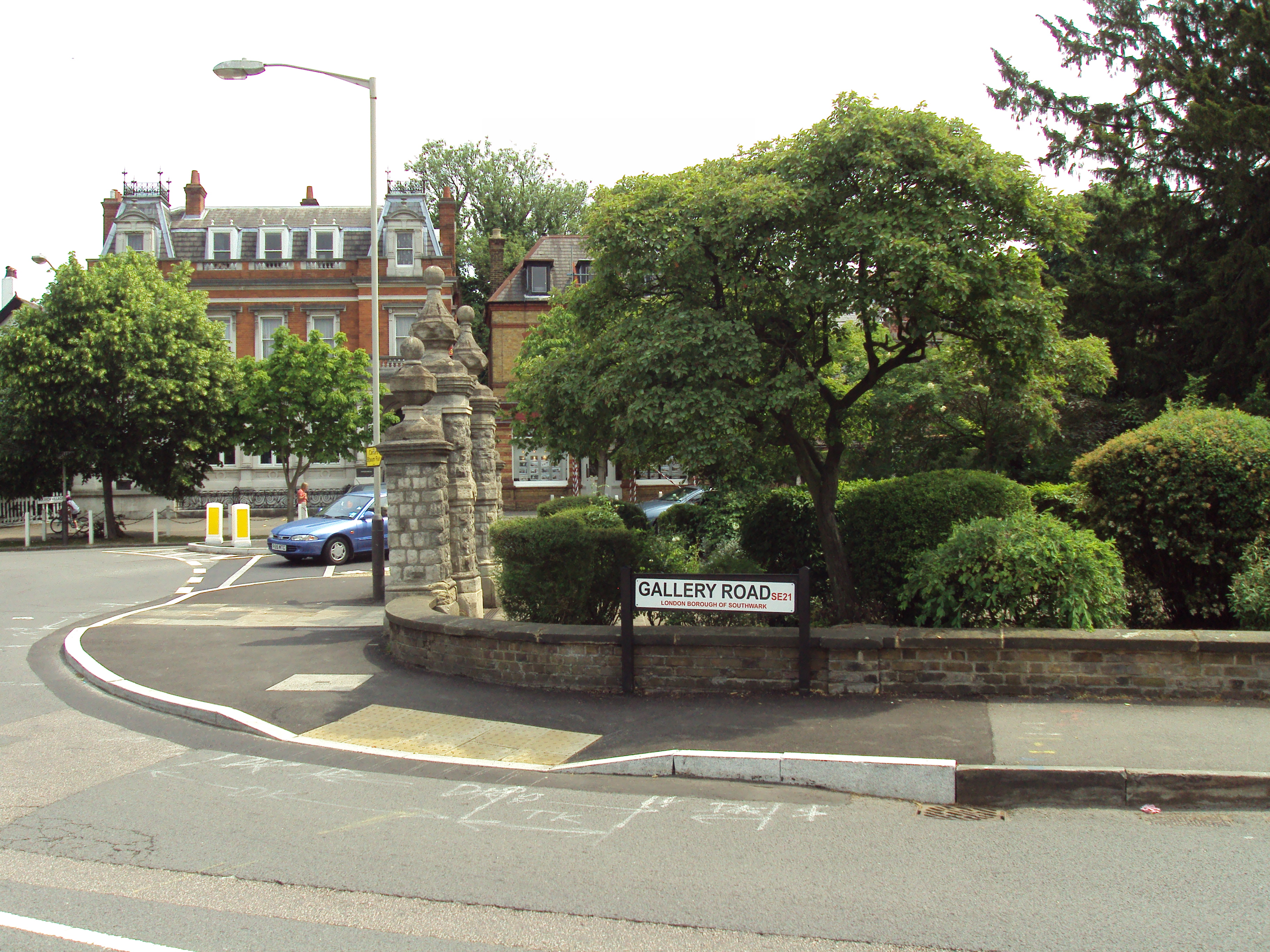
Gallery Road, Dulwich - DSC05987
Wikimedia Commons · CC BY-SA 3.0
2010
Gallery Road Roundabout, Dulwich - DSC05988
Wikimedia Commons · CC BY-SA 3.0
2022
Lodge to Belair House, Gallery Road, West Dulwich
Wikimedia Commons · CC BY-SA 2.0
Today
Gallery Rd — near Gallery Road
Geograph · CC BY-SA 2.0

The lane retains a secluded, almost collegiate atmosphere. The Old College Lawn Tennis and Croquet Club occupies the eastern side, successor to the social life that has clustered around the Dulwich Estate for centuries. That name — Gallery Road — was not always here. It came with a building, a bequest, and an architect’s vision that would change the way every subsequent gallery in the world was lit.

✦   ✦   ✦
Name Origin

Named for the Gallery That Changed Art

The road takes its name directly from the Dulwich Picture Gallery. As documented by the Dulwich Society, the street name derives from England’s first public picture gallery, designed by Sir John Soane and built in 1814–1817. As the gallery’s fame spread through the nineteenth century — its collection drawing copyists, students, and visitors from across London — the lane beside it acquired the name by which it has been known ever since. History Today observed that one might expect London’s only Gallery Road to run off Trafalgar Square; in fact it is a leafy lane beside a landmark that preceded the National Gallery by years.

The word “gallery” itself derives from the medieval Latin galeria, a covered walkway or portico — an apt root for a building whose interlinked rooms and arched passages created a new language for displaying art. Before the road bore this name, it is believed to have been an unnamed lane or track running through the Dulwich Estate; no earlier recorded street name has been found in available sources.

How the name evolved
pre-1817 Unnamed estate lane
c. 1817 onwards Gallery Road
present Gallery Road
✦   ✦   ✦
History

From Alleyn’s Manor to Soane’s Masterpiece

The land through which Gallery Road runs was shaped first by one Elizabethan actor and then, two centuries later, by one extraordinary bequest. In 1605, Edward Alleyn — one of the most celebrated performers of his age and a favourite of Queen Elizabeth I — purchased the manor of Dulwich. In 1619 he founded the College of God’s Gift, the charitable institution that would eventually govern the entire estate and, through it, the land on either side of this lane.

Key Dates
1605
Alleyn Buys Dulwich
Edward Alleyn purchases the manor of Dulwich, laying the foundations of the estate that would govern this road for centuries.
1619
College of God’s Gift
Alleyn founds the College of God’s Gift, today known as Dulwich College, in whose grounds the future gallery would be built.
1790
The Polish Commission
Art dealers Noël Desenfans and Francis Bourgeois are commissioned by Stanislaus Augustus, King of Poland, to form a royal collection of Old Masters.
1811
Bourgeois Bequest
Sir Francis Bourgeois dies and bequeaths his collection to Dulwich College for public inspection, effectively creating England’s first public gallery.
1817
Gallery Opens
The Dulwich Picture Gallery, designed by Sir John Soane, opens to the public — and the lane beside it begins to be known as Gallery Road.
1890
Dulwich Park Opens
Dulwich Park, formed from meadow land known as Five Fields and presented by the Governors of Dulwich College, opens adjacent to Gallery Road.
1944
Bomb Damage
A V-1 rocket strikes the Gallery, damaging the mausoleum and west wings. The building is subsequently rebuilt in replica.
Did You Know?

The collection that gave Gallery Road its name was originally assembled for a king who never received it. Noël Desenfans and Francis Bourgeois spent five years acquiring Old Masters for Stanislaus Augustus, King of Poland — but Poland was gradually partitioned and eventually ceased to exist as an independent state in 1795, leaving the two dealers with a royal collection and no buyer.

The history documented by British History Online makes clear that the gallery’s collection owed its foundation to a remarkable chain of events. Desenfans was a native of Douai in France who had settled in London first as a language teacher; his taste for art, allied to Bourgeois’s eye for quality, built a collection of European significance. When Bourgeois died in 1811, he left the pictures to Dulwich College with the condition that a mausoleum be built within the gallery to house his own remains and those of the Desenfans. Sir John Soane, a personal friend, designed both gallery and tomb without charging a fee.

Soane built the gallery in low-cost London stock brick — an unconventional choice then considered too humble for such a prestigious commission. His design of interlinked rooms flooded with natural light from overhead lanterns was entirely without precedent. As the architect Philip Johnson later declared, Soane had “taught us how to display paintings.” That building, and the road beside it, stood largely undisturbed until a V-1 rocket damaged the mausoleum and west wings in 1944; bones from the founders’ coffins were reportedly scattered across the front lawn. The gallery was rebuilt in replica and has been in continuous use since.
✦   ✦   ✦
Culture

The Canvas That Taught the World to Look

The building on Gallery Road did not simply house art — it redefined how art is seen. Historic England lists the Dulwich Picture Gallery and its mausoleum as Grade II* on the National Heritage List for England, recognising both the building and the tomb as structures of exceptional interest. Soane’s pioneering roof-lanterns — designed to diffuse a natural top light ideal for viewing paintings without artificial glare — influenced the design of virtually every major public gallery built after 1817.

Grade II* Listed — Architectural Landmark
Dulwich Picture Gallery & Mausoleum, Gallery Road

Designed by Sir John Soane and opened in 1817, the Gallery is England’s oldest public art gallery and the world’s first purpose-built public picture gallery. Its top-lit interlinked rooms set the template for gallery architecture globally. The attached mausoleum, lit through amber glass, holds the remains of the Gallery’s three founders. Both structures are listed Grade II* by Historic England.

The cultural pull of the Gallery radiated along this lane for over two centuries. John Constable, J. M. W. Turner, and later Vincent van Gogh all visited the collection. Charles Dickens sent Samuel Pickwick here in retirement in The Pickwick Papers. The collection’s most notorious canvas — Rembrandt’s Portrait of Jacob de Gheyn III — has been stolen four times and is listed in Guinness World Records as the most frequently stolen painting in the world, recovered on one occasion from under a bench in a Streatham graveyard.

✦   ✦   ✦
People

Dealers, Architects, and a King Who Never Came

Three figures above all others shaped the character of Gallery Road: Edward Alleyn, who created the estate; Sir Francis Bourgeois, whose bequest made the gallery possible; and Sir John Soane, who gave it architectural form. Alleyn’s foundation of the College of God’s Gift in 1619 established the Dulwich Estate’s unusual structure of managed land — a structure that kept this lane, and its surroundings, largely free from the Victorian terraced development that consumed so much of south London.

Bourgeois and his partner Noël Desenfans assembled their collection partly on the commission of Stanislaus Augustus, King of Poland, who in 1790 tasked them with forming a national collection of European art. Poland’s partition and eventual disappearance as an independent state left the collection stranded in London. Bourgeois eventually bequeathed it to Dulwich College in 1811 — on the advice, it is recorded, of the actor John Philip Kemble — and commissioned his friend Sir John Soane to design the building that named this road.

“Soane has taught us how to display paintings.”
Philip Johnson, architect, on Dulwich Picture Gallery
✦   ✦   ✦
Recent Times

Post-War Renewal and the Sports Pavilion

The Gallery was reopened after wartime bomb damage once rebuilding was complete, and its independence was formally established when, in 1995, a major reorganisation of the Alleyn’s College charity reconstituted Dulwich Picture Gallery as an independent registered charity. A further extension was added in 2000, designed by architect Rick Mather, to provide education facilities and modern amenities — expanding the footprint of the institution that names this road without compromising Soane’s original structure.

The sports grounds on Gallery Road also carry their own twentieth-century history. The sports pavilion now used by Dulwich Preparatory School — once the Lloyd’s Register Sports Club ground — was opened in 1936, as recorded by Historic England’s Played in Britain archive. The gallery marked its bicentenary in 2017 and continues to draw visitors to this quiet lane, still flanked by the open land that Alleyn’s foundation preserved.

✦   ✦   ✦
Today

Green Borders and the Gallery’s Long Shadow

Gallery Road today is framed almost entirely by open space. Belair Park to the west and Dulwich Park to the east — both generous, unhurried green spaces — mean that the road feels more parkland boundary than urban thoroughfare. The Old College Lawn Tennis and Croquet Club keeps a presence on the eastern side, its name a reminder of the collegiate character that has defined this corner of Dulwich for four hundred years.

West Dulwich railway station lies close to the southern end of the road, making the gallery accessible from Victoria and London Bridge in around twelve minutes. The gallery itself, housing more than 600 paintings, remains open to visitors and continues its programme of major loan exhibitions alongside its permanent Baroque collection. Gallery Road’s combination of green space, sport, and world-class art — all on a lane that barely registers on a London A-to-Z — is the unlikely legacy of a stranded Polish royal commission and a friendship between two men who loved pictures.

Adjacent (east)
Dulwich Park
Opened 1890 on land presented by Dulwich College governors. Expansive parkland with lake, café, and cycling paths.
Adjacent (west)
Belair Park
Former grounds of Belair House. Relaxed, locally loved park bordering the Gallery Road sports grounds.
10 min walk
Dulwich Village Green
The historic centre of Dulwich at the northern end of Gallery Road, with independent shops and village atmosphere.
15 min walk
Sydenham Hill Wood
Ancient woodland — one of the largest remnants of the Great North Wood that once covered this part of south London.
✦   ✦   ✦
On the Map

Gallery Road Then & Now

National Library of Scotland — Ordnance Survey 6-inch, c. 1888. Hosted by MapTiler. Modern: © OpenStreetMap contributors.

✦   ✦   ✦

Frequently Asked Questions

Why is it called Gallery Road?
Gallery Road takes its name from the Dulwich Picture Gallery, England’s oldest public art gallery, which stands on the eastern side of the road. Designed by Sir John Soane, the Gallery opened to the public in 1817 and as its fame grew throughout the nineteenth century, the lane beside it became known by the name of its celebrated neighbour.
Who founded the Dulwich Picture Gallery?
The Gallery was established through the bequest of Sir Francis Bourgeois, who died in 1811 and left his collection of Old Master paintings to Dulwich College with instructions that they be made available for public inspection. Bourgeois and his business partner Noël Desenfans had originally assembled the collection for Stanislaus Augustus, King of Poland, who was unable to accept it following the partition and disappearance of his country. Bourgeois commissioned his friend Sir John Soane to design the gallery building free of charge.
What is Gallery Road known for?
Gallery Road is best known as the address of the Dulwich Picture Gallery — England’s first purpose-built public art gallery, opened in 1817, whose Soane-designed skylights and interlinked rooms influenced gallery architecture worldwide. The road also borders Dulwich Park and Belair Park, and is home to the Old College Lawn Tennis and Croquet Club and the Lloyd’s Register Cricket Club, giving it a distinctly sporting and collegiate atmosphere alongside its artistic heritage.