Southwark London England About Methodology
Southwark · SE1 · Peckham

Elland Road

A Yorkshire mill town’s name transplanted to a Victorian terrace in Peckham — one of hundreds of northern place names scattered across south London’s rapidly expanding suburbs.

Name Meaning
River Land (Yorkshire)
First Recorded
c. 1880s
Borough
Southwark
Character
Victorian Terrace
Last Updated
Time Walk

Between the Rye and Nunhead’s Quiet Streets

Elland Road runs between Vermeer Gardens and Peckham Rye in the London Borough of Southwark, a short residential road of Victorian and Edwardian terraces close to the open grassland of Peckham Rye Common. The houses here are classic late-nineteenth-century stock: bay-fronted, brick-built, arranged in tight terraced rows that speak directly to the suburban optimism of a borough transformed by the railway age. Nunhead station lies under a mile away.

The street carries the air of a neighbourhood that filled up quickly and changed little since. Period conversions and owner-occupied terraces predominate. What the road lacks in monuments it compensates for in context: this corner of Peckham tells the story of how south London was built, one speculative terrace at a time. And the name itself turns out to have travelled further than you might expect.

2007
Junction of Elland Road and Peckham Rye, London
Wikimedia Commons · CC BY-SA 3.0
Historical image not found
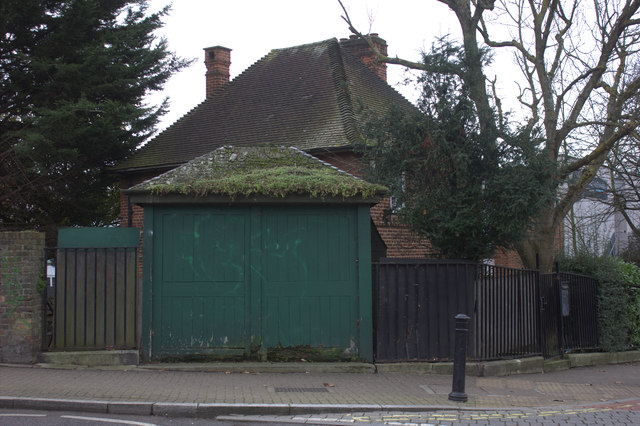
Today
Old tram shelter — near Elland Road
Geograph · CC BY-SA 2.0
✦   ✦   ✦
Name Origin

Calderdale in SE15

The name most likely derives from Elland, a market town in Calderdale, West Yorkshire. Victorian and Edwardian developers building out Peckham’s fields regularly named new streets after northern English towns — a practice well documented across Southwark. As noted in the street-name records consulted by SE1 Direct, this kind of commemorative place-name transfer was common across south London’s late-Victorian suburbs, where builders sometimes hailed from the named regions or simply borrowed recognisable topographical names. No primary document has been found specifically recording why Elland was chosen for this particular road.

Elland itself is attested in the 1086 Domesday Book as Elant. The name comes from the Old English words ēa (‘river’) and land (‘land’), relating to the settlement’s location on the south bank of the Calder. So the Peckham street, whether or not its builders consciously chose it, carries an Anglo-Saxon topographic meaning—‘river land’—encoded within a Yorkshire place name.

How the name evolved
1086 Elant (Domesday)
medieval Elland (Yorkshire town)
c. 1880s Elland Road (Peckham)
present Elland Road
✦   ✦   ✦
History

Fields, Rails, and Terrace Upon Terrace

Peckham was still largely agricultural at the start of the nineteenth century. At the beginning of the 19th century, Peckham was synonymous with Peckham Rye: a “small, quiet, retired village surrounded by fields.” The land south and west of Peckham Rye Common — where Elland Road would eventually be laid — remained open well into the mid-Victorian period.

Key Dates
1823
River Peck enclosed
The small stream that gave Peckham its name was covered over, clearing the way for development.
1851
Omnibus service
Thomas Tilling’s innovative horse-bus began running from Peckham to London, the first to use pre-arranged stops.
1865
Railway arrives
Peckham Rye station opened, making the district accessible to artisans and clerical workers and triggering rapid suburban expansion.
1868
The Rye preserved
The vestry of Camberwell St Giles bought Peckham Rye Common to keep it as common land, protecting the open space at the end of what would become Elland Road.
c. 1880s
Elland Road laid out
The street was most likely established during the wave of speculative terrace building that swept Peckham’s remaining fields in the 1870s–1890s.
1965
Southwark formed
The Metropolitan Borough of Camberwell was abolished; Peckham, and Elland Road with it, passed into the newly created London Borough of Southwark.
Did You Know?

Peckham’s streets were so rapidly built out after 1865 that the naming conventions of developers became almost haphazard — producing a patchwork of Yorkshire towns, Kentish villages, and classical references within a few hundred yards of each other. Elland Road sits in exactly this kind of toponymic jumble.

With the arrival of the railway and the introduction of horse-drawn trams about ten years later, Peckham became accessible to artisans and clerical staff working in the city and the docks. Housing for this socio-economic group filled almost all the remaining fields except the Rye. As documented by British History Online through the Survey of London and Victoria County History volumes on Surrey, Peckham’s development during this period followed a standard south London pattern: a landowner or small builder would acquire a parcel, lay out a street grid, erect terraces speculatively, and name the roads at will. The result was a neighbourhood built entirely within a generation, its character set before the twentieth century began.

Excavations carried out by MOLA (Museum of London Archaeology) across Southwark have established that the broader Peckham area has evidence of Roman-period activity, though no known Roman features lie directly beneath Elland Road. The street’s own ground is essentially Victorian: made ground, Victorian terrace foundations, and the urban fabric of a suburb built from scratch in under two decades.

✦   ✦   ✦
Culture

The Other Elland Road

The name Elland Road carries a double resonance that confounds any casual internet search. The famous Elland Road in Leeds — home of Leeds United since 1919, former host of Euro 96 matches, one of England’s largest football grounds — shares its name with this quiet Peckham terrace purely by coincidence of shared origin: both roads take their name from the same Yorkshire town. The Leeds stadium takes its name because it sits beside the A643 road that leads south-west towards Elland. The Peckham street, almost certainly, was named by a Victorian developer with northern connections or simply a taste for Yorkshire geography.

Topographical Double
Two Elland Roads, One Yorkshire Town

Both Elland Roads — the Peckham terrace and the Leeds stadium — derive their names from Elland in Calderdale. Elland is a market town in Calderdale, in the county of West Yorkshire, situated south of Halifax, by the River Calder and the Calder and Hebble Navigation. The coincidence of naming has produced generations of misdirected searches. As Historic England’s records confirm, the naming of streets after northern English towns was a well-established Victorian convention across south London’s expanding suburbs.

Peckham itself developed a strong cultural identity through the twentieth century. Muriel Spark’s 1960 novel The Ballad of Peckham Rye is set in the area. Peckham was the setting of the television sitcom Only Fools and Horses in its run as a regular series from 1981 to 1991. Elland Road sits within this deeply storied neighbourhood, a quiet residential thread in a much louder civic fabric.

✦   ✦   ✦
People

Artisans, Clerks, and the Railway Suburb

No verifiable individual with a named connection to Elland Road itself has been identified in the historical record. The street is typical of its type: built for, and occupied by, the artisan and lower-middle-class households that British History Online describes as the defining social constituency of Peckham’s Victorian expansion. During the 19th century, Peckham became the home for a predominantly lower middle and skilled working class. These were the households of clerks, craftsmen, and tradespeople who commuted to the City and the docks from Peckham Rye and Nunhead stations.

The broader Peckham neighbourhood produced or attracted notable figures across its history. In 1851 Thomas Tilling started an innovative omnibus service from Peckham to London — Tilling’s buses were the first to use pre-arranged bus stops, which helped them to run to a reliable timetable. Tilling’s enterprise helped make the suburban streets around Elland Road viable before the railway arrived. None of this, however, places any named individual on Elland Road itself.

✦   ✦   ✦
Recent Times

Regeneration on the Rye’s Edge

Peckham underwent significant change from the 1960s onwards. North Peckham was heavily redeveloped in the 1960s, consisting mainly of high-rise flats to rehouse people from dilapidated old houses. Elland Road, south of the main Peckham centre and closer to the Rye, was largely insulated from the most intensive post-war replanning. Its Victorian terrace stock survived intact. The postcode district around the street — SE15 — contains residential buildings constructed primarily before 1900 through to the early twentieth century, confirming the street’s essentially unaltered Victorian character.

By the early twenty-first century, Peckham’s cultural reputation had transformed. Bold Tendencies, an annual exhibition space in a former car park on Rye Lane in Peckham, has shown work by Simon Whybray, Jenny Holzer, and Derek Jarman. Peckham Library, designed by Will Alsop, won the Stirling Prize for modern architecture. The wider neighbourhood’s regeneration has brought renewed attention to Elland Road’s quiet terrace housing as a desirable residential corridor between Peckham Rye and Nunhead.

✦   ✦   ✦
Today

Terraces Between Two Stations

Elland Road today is a short residential street of Victorian terrace housing — predominantly bay-fronted mid-terrace houses and period conversions — running between Vermeer Gardens and Peckham Rye in the London Borough of Southwark. Elland Road links Vermeer Gardens and Peckham Rye and is located within the London Borough of Southwark Council’s jurisdiction. Nunhead station is the closest rail connection. The street sits within easy reach of Peckham Rye Common, one of south London’s most accessible open spaces.

Under 10 min walk
Peckham Rye Common
64 acres of open grassland and the adjacent Peckham Rye Park, preserved as common land since 1868.
15 min walk
Nunhead Cemetery
One of the ‘Magnificent Seven’ Victorian cemeteries, now a nature reserve managed by the London Wildlife Trust.
15 min walk
Burgess Park
Southwark’s largest park, created post-war on the site of the Surrey Canal and surrounding streets.
20 min walk
One Tree Hill
A protected Local Nature Reserve with panoramic views across London, managed by Southwark Council.

The street’s housing stock remains primarily owner-occupied and period, with no large-scale post-war replacement. Its location between Peckham Rye and Nunhead — two stations on the Overground network — makes it well-connected without being on any major thoroughfare. The street’s character today is one of settled Victorian domesticity, unremarkable from the outside but carrying, in its name, a quiet link to a West Yorkshire riverbank recorded in the Domesday Book nine centuries ago.

✦   ✦   ✦
Housing for this socio-economic group filled almost all the remaining fields except the Rye.
Wikipedia, Peckham — on the Victorian suburban expansion that built streets like Elland Road
✦   ✦   ✦
On the Map

Elland Road Then & Now

National Library of Scotland — Ordnance Survey 6-inch, c. 1888. Hosted by MapTiler. Modern: © OpenStreetMap contributors.

✦   ✦   ✦

Frequently Asked Questions

Why is it called Elland Road?
Elland Road in Peckham most likely takes its name from Elland, a market town in Calderdale, West Yorkshire. Victorian developers building out Peckham’s fields in the 1870s–1890s regularly named new streets after northern English towns. No primary document has been found to confirm why Elland specifically was chosen for this road. The Yorkshire town of Elland itself derives its name from the Old English ēa-land, meaning ‘river land’, and was recorded as Elant in the 1086 Domesday Book.
When was Elland Road in Peckham built?
Elland Road was most likely laid out during the Victorian suburban expansion of Peckham, which accelerated markedly after Peckham Rye railway station opened in 1865. The terraced housing stock in the area dates primarily from the late nineteenth and early twentieth centuries. The postcode district (SE15) confirms that residential buildings were constructed primarily before 1900, with some dating from 1900 to 1929.
What is Elland Road known for?
Elland Road in Peckham is a short residential street of Victorian terraces running between Vermeer Gardens and Peckham Rye, within the London Borough of Southwark. It is close to Peckham Rye Common and Nunhead station. The street shares its name — by shared origin rather than any direct connection — with the famous Leeds United football ground, Elland Road in Beeston, Leeds. Both roads derive their names from the same West Yorkshire market town of Elland.