Southwark London England About Methodology
Walworth · SE1

Dickens Square

From Union Square to a literary memorial, renamed to honour Charles Dickens and the Southwark that shaped his fiction.

Named After
Charles Dickens
Character
Literary Landmark
Borough
Southwark
Last Updated
Time Walk

A Victorian Square Reborn as Parkland

Dickens Square sits in the heart of Walworth, an inner London neighbourhood transformed by Victorian development and later social housing. The space occupies what was once a built square of yellow brick terraced housing, constructed in 1844 as part of the Brandon Trustees' vision for the area. Most of the original Victorian architecture was demolished during 1971–72 urban renewal, when the location became instead a public open space known as Dickens Square Park (or Dickens Fields). It remains a neighbourhood hub, home to open green space, playground facilities, and a small Islamic Cultural Centre.

2010
Dickens Square Park, Southwark
Wikimedia Commons · CC BY-SA 2.0
2015
Dickens Square park, London SE1 (geograph 4379522)
Wikimedia Commons · CC BY-SA 2.0
Historical image not found
Today
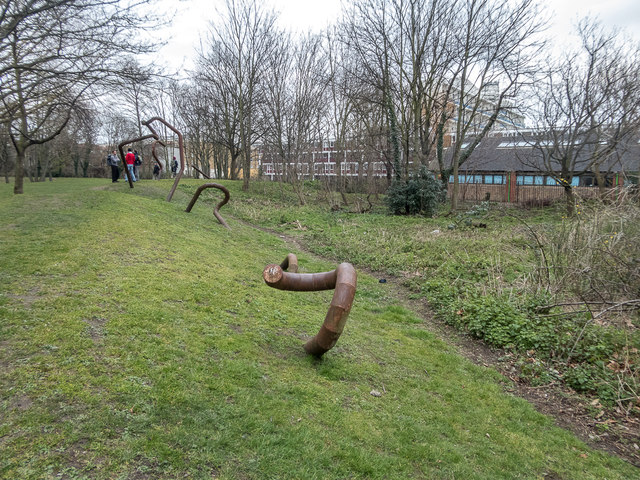
Dickens Square park, London SE1
Geograph · CC BY-SA 2.0

The name is not the square's original: it began as Union Square when first laid out in 1844. The renaming came as a deliberate act of literary commemoration—one of several streets in Southwark dedicated to Charles Dickens, whose childhood time here, working and living near his father's imprisonment in the Marshalsea Debtors Prison, shaped much of his later fiction.

✦   ✦   ✦
Name Origin

A Literary Tribute to Southwark's Most Famous Child

The square was originally called Union Square when constructed in 1844. The renaming to Dickens Square is most likely a tribute to Charles Dickens (1812–1870), whose formative years in Southwark profoundly influenced his writing. In 1824, aged 12, Dickens lodged in Lant Street after his father was confined to the nearby Marshalsea debtors’ prison. At the time, Charles was working in a blacking factory to bring funds into the family. This experience of poverty and social injustice became the emotional core of his mature novels.

Multiple Dickens placenames populate the neighbourhood: Quilp Street, Copperfield Street, and Dickens Square itself. These Dickensian names are not recent—they appear on Charles Booth's map of London poverty from 1899. The square's renaming was therefore part of a broader effort to commemorate the author's connection to the area and to anchor local identity in his literary legacy.

How the name evolved
1844 Union Square
c. 1900 Dickens Square
✦   ✦   ✦
History

From Brandon Trustees to Public Open Space

Unlike most parts of the Walworth Manor Estate, Dickens Square with adjacent houses in Harper Road and Ralph Street was planned as a unit by the Dean and Chapter of Canterbury and the Brandon Trustees. The actual work was carried out in 1844 by local builders—John Willson, John James, James Cooper, Richard Davis, and William Broadbent.

Key Dates
1844
Construction
Union Square built with two and three-storey yellow brick terraced houses by Canterbury and Brandon Trustees.
c. 1900
Renaming
Square renamed Dickens Square to commemorate the author's Southwark connections.
WWII
Survival
Original Victorian houses survived German bombing, unlike areas nearby.
1971–1972
Redevelopment
Original Victorian housing demolished; area redesignated as Dickens Square Park public open space.
Did You Know?

The park was built on an area partly destroyed by a V2 rocket in the Second World War. Despite this nearby devastation, the Victorian terraces of the square themselves stood through the Blitz, only to be cleared for 1970s urban renewal.

The two and three-storey yellow brick terraced houses linked by cornices and by plain stone bands at first-floor level are in no way remarkable, and the central grass plot has been concreted over, but the square retains a quiet if decayed Dickensian aspect in an area now almost entirely given over to four-, five-, and six-storey blocks of flats. Most of these original houses were demolished in 1971–2 because of a designation of the area as Public Open Space Dickens Park. The park now includes a Butterfly Walk conservation area and an adventure playground managed by the Rockingham Estate Play Association.

✦   ✦   ✦
Culture & Character

Walworth’s Literary Legacy

Dickens Square is part of a constellation of streets in Walworth that deliberately memorialise Charles Dickens and his novels. The broader neighbourhood is marked by this literary geography: Copperfield Street (after David Copperfield), Quilp Street (after The Old Curiosity Shop), Clennam Street (after Little Dorrit), and Dorrit Park itself. These names were not afterthoughts but were inscribed on maps by the 1890s, establishing the area as a Dickens pilgrimage destination.

Living Memory
Charles Dickens School

Just along the street at Lant Street stands Charles Dickens Primary School. The school was built in 1877 and renamed in honour of Dickens—the building itself a physical anchor of his literary presence in the neighbourhood. Today it serves local families and carries forward the association between the author and this working-class London landscape.

The area itself remains relatively quiet, a pocket of green space in a densely built borough. Visitor interest tends to focus on the themed street signs and the nearby blue plaque commemorating Dickens on Lant Street, rather than architectural spectacle. Yet the renaming and preservation of these street names represents a conscious choice to let Dickens shape how Southwark remembers itself.

✦   ✦   ✦
Today

From Housing to Park

Dickens Square exists today primarily as open public space. Dickens Fields has recently been regenerated with a play area and a park with seating. The site is managed by local agencies and serves the Rockingham Estate neighbourhood. Unlike many of Southwark's heritage streets, Dickens Square is defined not by buildings but by absence—the deliberate removal of Victorian housing to create green space during the post-war period.

For those interested in Dickens's Southwark, the square remains a waypoint on a larger literary geography. It sits within walking distance of the Marshalsea site on Borough High Street, Lant Street (where Dickens lived as a boy), and the several museums and plaques that mark his connection to the neighbourhood. The naming is the street's primary claim to heritage; the space itself has been fundamentally altered since 1844, reflecting changing attitudes towards urban living and green space in London.

10 min walk
Little Dorrit Park
Adjacent to Marshalsea site; named after Dickens's novel and featuring trees and seating honouring the literary connection.
8 min walk
Burgess Park
Larger urban greenspace with lake, sports facilities, and woodland area; major amenity for the surrounding residential area.
Onsite
Butterfly Walk
Conservation area within Dickens Square Park dedicated to native wildflowers and pollinator habitat.
15 min walk
St George’s Gardens
Historic church burial ground with mature trees and benches; adjoins St George the Martyr Church.
✦   ✦   ✦
On the Map

Dickens Square Then & Now

National Library of Scotland — Ordnance Survey 6-inch, c. 1888. Hosted by MapTiler. Modern: © OpenStreetMap contributors.

✦   ✦   ✦

Frequently Asked Questions

Why is it called Dickens Square?
The square was originally called Union Square when built in 1844. It was renamed Dickens Square as a tribute to Charles Dickens, the author who spent formative time in Southwark as a child when his father was imprisoned in the Marshalsea Debtors Prison. The square is one of several local streets (including Copperfield Street and Quilp Street) named after Dickens and his works, reflecting his profound influence on how the area is remembered.
When was the original housing built?
Dickens Square was constructed in 1844 by local builders John Willson, John James, James Cooper, Richard Davis, and William Broadbent. The development was planned by the Dean and Chapter of Canterbury and the Brandon Trustees. The original Victorian two and three-storey yellow brick terraced houses survived World War II but were demolished in 1971–72 to create Dickens Square Park.
What is Dickens Square known for?
Today, Dickens Square is known for its connection to Charles Dickens's literary legacy and Southwark's heritage. The surrounding area has been redeveloped as Dickens Square Park, featuring green space, playgrounds, and a Butterfly Walk conservation area. It remains a focal point for those exploring Dickens's personal history and the working-class Southwark that inspired his novels, particularly his experiences of poverty and social injustice.