The Street Over Time
A Victorian terrace sheltering a community identity rooted in Charles Dickens’ most autobiographical novel.
Copperfield Street is a mixed commercial and residential street tucked behind Union Street in The Borough, one of Southwark’s oldest neighbourhoods. The street preserves a distinctive Victorian character from the 1870s—a period when the area was being rebuilt as a respectable middle-class district. Hidden behind the famous Union Street, Copperfield Street is a short passage containing a row of maybe 8–9 houses set around small community gardens, creating a pocket of relative quietness amid the larger urban landscape.
The street gained its name from Charles Dickens, whose literary influence shaped the entire character of this quarter. But it wasn’t always called Copperfield Street.
Copperfield Street takes its name from the novel David Copperfield by Charles Dickens, by association with Dickens Square. The street’s dedication to the author reflects a deliberate naming strategy in this part of Southwark, where multiple streets were christened after Dickens characters and works. The name was created from the English words copper and field by the author Charles Dickens, who used it for the title character in his novel David Copperfield (1850). The street was previously called Orange Street, a far more mundane designation that offered no literary resonance. The renaming appears to have occurred during the Victorian era, when The Borough was being actively reshaped as a respectable neighbourhood worthy of such literary associations.
Copperfield Street emerged during one of Victorian London’s most ambitious episodes of urban renewal. The street was built in 1870 in what was then a destitute and dangerous area of Southwark, when slums and prisons still dominated much of The Borough landscape. The Marshalsea Prison—where Dickens’ father had been confined for debt, the harrowing experience that shaped the novelist’s sensibility—had only been demolished a few decades earlier. By naming the new street after his most autobiographical work, developers were making a statement about transformation: this was no longer a place of despair, but a neighbourhood of redemption.
A cast iron bollard survives on the south-east corner with Pepper Street, marked with ‘Clink 1812’, a reminder that the Clink Prison—that other symbol of Southwark’s darker past—stood nearby. The original purpose of these bollards was to prevent vehicles from crossing paved streets without authorisation.
The creation of Copperfield Street thus represented not mere domestic development but a conscious rebranding of The Borough as a place of literary heritage and moral progress. The choice to invoke Dickens’ fictional protagonist—a character who survives hardship through perseverance and ultimately reaches prosperity—was symbolically apt for a neighbourhood determined to transcend its reputation for crime, disease, and poverty.
The street’s name connects it to a broader pattern of Dickensian geography in The Borough. Nearby streets bear the names of Dickens characters and works: Dorrit Street and Little Dorrit Court commemorate the author’s novel set partly in the Marshalsea. This constellation of literary streets represents a distinctive kind of urban memorialisation—not of a person or event, but of a literary imagination deeply rooted in Southwark’s own traumatic and redemptive history.
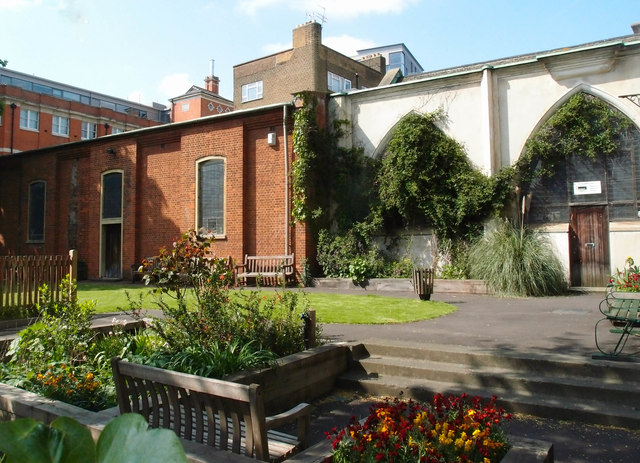
The Winchester Cottages of 1893–95 provided by the Church Commissioners were inspired by Octavia Hill. The small park opposite occupies the site of All Hallows Church which was bombed. These cottages exemplify Victorian philanthropy and the model of reformist housing that attempted to rescue the poor from degradation through purposeful design and community care.
The street’s persistence as a mixed residential and commercial space reflects the complex economics of inner-city London. Today, the area containing Copperfield Street consists predominantly of flats, which is common in inner cities, student neighbourhoods and poorer suburban settings, continuing a tradition of modest, working housing that has characterised The Borough for centuries.
National Library of Scotland — Ordnance Survey 6-inch, c. 1888. Hosted by MapTiler. Modern: © OpenStreetMap contributors.