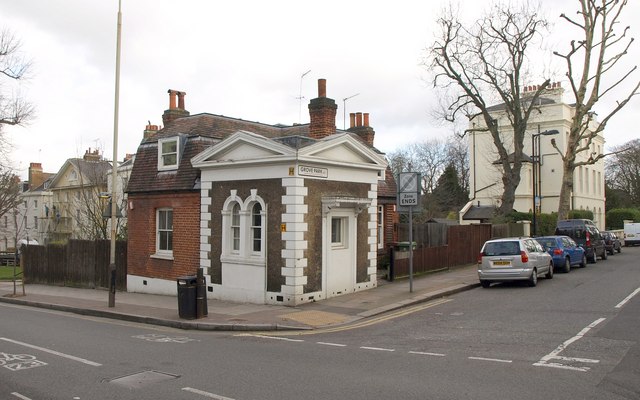
In the mid-1770s, when Camberwell was still a rural village, the dilapidated manor house was demolished and the surrounding land subdivided and sold. The first four houses, still standing today (numbered 79–85), were built by speculators at the northern end as a terrace shortly afterwards. These Grade II-listed properties set the tone for the street’s future character—solid, respectable, and fashioned for the professional classes attracted by Camberwell’s healthy air and proximity to London.
c. 1775–80
Manor Demolished
The Tudor manor house demolished; land subdivided and sold to developers.
1776–85
First Terraces Built
Speculators build the northern terrace (nos. 79–85) and southern properties (nos. 33–45).
1800s
Lettsom Estate Broken Up
Dr. John Coakley Lettsom's villa demolished; The Hermitage (no. 220) survives. Estate razed when subdivided.
1819
Grove Chapel Built
David R Roper designs and builds Grove Chapel, a Grade II-listed structure.
1860s
Railway Below
South London and East London lines built by London, Brighton and South Coast Railway; pass below street in tunnel and cutting.
1889
Booth Survey
Victorian social researcher Charles Booth assesses residents; northern end 'fairly comfortable', southern end 'wealthy'.
1940s
War Damage
Houses damaged by bombing in WWII; demolished. Site rebuilt as flats (nos. 100–138).
Did You Know?
In 2012, the street was the subject of an episode of the BBC series The Secret History of Our Streets, based on the work of Victorian social researcher Charles Booth.
John Coakley Lettsom (1744–1815) was a noted 18th century Quaker physician and herbalist, friend of Benjamin Franklin, Dr. Johnson, Boswell and other intelligentsia of the day. He commissioned a villa on the southern rise of Camberwell Grove, where a side-street, Lettsom Street, Lettsom Gardens, a community garden, and a nearby housing estate are named in his honour. One of his cottages, The Hermitage (number 220), survives, at the junction with Grove Hill Road. A number of other buildings on the street, including Grove Chapel (built 1819, by David R Roper) and the Georgian crescent terrace of eight houses forming Grove Crescent, are also listed.
The railways transformed the street's landscape. The South London and East London railway lines, built by the London, Brighton and South Coast Railway in the 1860s and now operated by Southeastern and London Overground, pass below the street (in a tunnel to the west and cutting to the east), just east of Denmark Hill station. In the 20th century, some of the houses on the grove were damaged by bombing in World War II, and subsequently demolished. The site is now occupied by the flats numbered 100–138. In the 1960s, a proposal to build an elevated motorway across the grove, above the railway, in the style of the Westway, was opposed and eventually overturned by local residents.