Time Walk
Between a Cemetery and a Railway Bridge


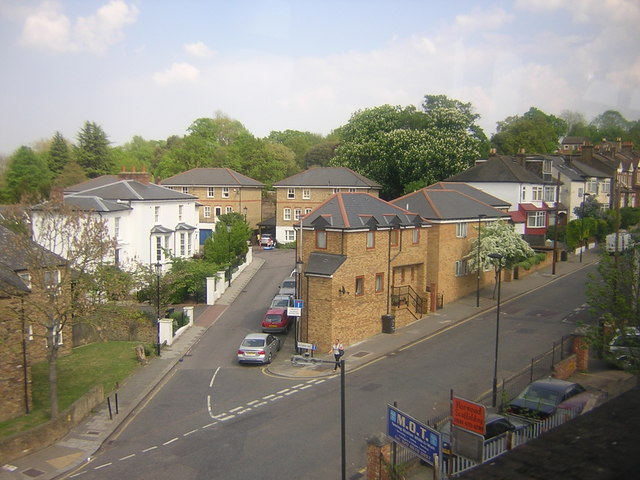
A back gate to one of London's great Victorian cemeteries once opened straight onto this short West Norwood street. Walking it today, three things stand out: a pair of old stuccoed houses, a run of newer housing behind them, and a railway bridge striding over the road on brick arches. At the corner stands the Hope, an old pub with a Victorian front.
Underneath the modern mix lies an older layer: cottages built two centuries before the street itself. That contrast — ancient cottages, a Victorian estate, and later infill — is what makes Pilgrim Hill worth a second look. The name itself is where the trail runs cold.
Name Origin
A Name Without an Explanation
Pilgrim Hill's name is not explained in the sources used here. No surviving record ties the name to a person, a route, or a landmark. The street is first attached to a named resident, John Davies "of Pilgrim Hill," in an 1864 development record, which gives the earliest dated use of the current name found in these sources.
History
Cottages Before the Street, Villas After
Two of Pilgrim Hill's oldest buildings predate the road by two centuries. A 1977 survey recorded them and proposed including houses in Pilgrim Hill within the new West Norwood conservation area.
Development proper came in 1864, when Charles Blake and his associate John Davies, a resident of Pilgrim Hill, began building what became known as the Blake Estate. Nos. 1 and 2 Pilgrim Hill, a stuccoed pair, were later protected as a listed building.
Two of the buildings on Pilgrim Hill — a stuccoed pair of about 1640 and a brick cottage of about 1650 — are older than the street that now runs past them.
People
A Solicitor and His Neighbour
Charles Blake was a solicitor who, in 1864, teamed up with John Davies, who lived on Pilgrim Hill, to develop what became the Blake Estate. Davies's own influence outlasted the partnership: houses built to the same design as Blake's Lancaster Villas still stand in nearby Auckland Hill, close to where Davies himself lived on Pilgrim Hill.
Recent Times
Drawing a New Boundary
In 1999 new housing went up in the grounds of the Grade II listed villas at Nos. 1 and 2 Pilgrim Hill. By 2003 Lambeth proposed removing that new development from the conservation area, deciding it did not merit protected status and that it no longer had a physical relationship with West Norwood Cemetery. The change was approved that year.
Today
Old Pairs, New Infill
Pilgrim Hill today mixes eras within a few hundred yards. The listed pair at Nos. 1 and 2 stands near newer housing at Nos. 4–18, built in a style meant to sit comfortably alongside it. No. 20 adjoins the properties at Nos. 41 and 43 Norwood High Street. Overhead, a railway bridge and its brick arches still give the street its distinctive skyline.
On the Map
Pilgrim Hill Then & Now
Frequently Asked Questions
Why is it called Pilgrim Hill?
The sources used here do not explain the name. The earliest dated use of "Pilgrim Hill" found in these records is from 1864, naming a resident, John Davies, as living there.
What is Pilgrim Hill known for?
Its mix of building ages: a 17th-century cottage and stuccoed pair, an 1864 Victorian estate, a listed Regency pair at Nos. 1 and 2, and a railway viaduct overhead.
What is the Blake Estate?
A development begun in 1864 by solicitor Charles Blake and his associate John Davies, who lived on Pilgrim Hill. Houses built to the same design survive nearby in Auckland Hill.