Time Walk
A Street That Changed Its Name Twice


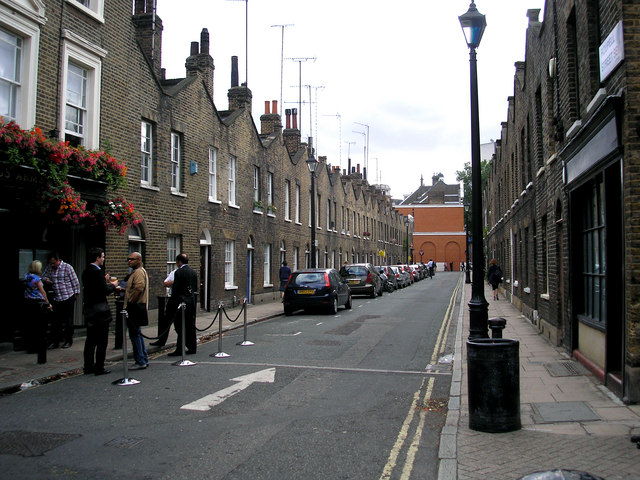
This short street has worn three different names on three different maps. Walking it now, the south and west sides feel almost domestic — garden walls and dark painted garage doors — while the north side carries older, mostly 19th-century warehouse buildings.
That split is no accident: the two sides belong to different halves of the street's history. Beneath the quiet walls, the street has been relabelled more than once, and that shifting identity is the place to start.
Name Origin
John Street, Palmer Street, Theed Street
The name "Theed Street" is not explained in the sources used here. What the maps do show is a street that kept being renamed. By 1878 it was recorded as "John Street". By 1894 the main stretch had become "Palmer Street", while only its east end, where it turns south, carried the name "Theed Street".
Eventually the Theed Street name spread to cover the whole run. The street was part of the Lambeth Estate, developed between 1820 and 1840 by John Palmer Roupell, a gold refiner whose own name survives nearby in Roupell Street.
History
From Roupell's Estate to a Listed Row
The street began as part of a single developer's scheme. John Palmer Roupell laid it out, along with the surrounding streets, between 1820 and 1840. At the east end, a row of early-mid 19th-century cottages went up, numbers 1 to 9, given Grade II listed status on 27 August 1976. The east side also carries terraced housing of a similar standard to that on neighbouring Whittlesey Street, and these buildings too are listed.
Recent Times
Warehouses Turned Offices
By 2007, the former industrial and warehouse buildings lining Theed Street had been converted for office and residential use. The street's north side sits within the Waterloo Conservation Area, which is bounded to the south by Alaska Street, Theed Street and Roupell Street — the point where the Waterloo and Roupell Street conservation areas meet.
Today
A Seam Between Two Areas
Theed Street still reads as a seam rather than a single piece. It forms the northern boundary of the Roupell Street Conservation Area, while its own north side belongs to the Waterloo Conservation Area. At the corner with Windmill Walk, two iron bollards still mark the junction.
Two iron bollards still stand at the corner of Theed Street and Windmill Walk, noted in the 2007 conservation area survey of the street.
On the Map
Theed Street Then & Now
Frequently Asked Questions
Why is it called Theed Street?
The origin of the name "Theed" is not explained in the sources used here. The street was earlier shown on maps as "John Street" (1878) and "Palmer Street" (1894), before the Theed Street name spread across the whole length.
What is Theed Street known for?
It is known for its mixed character — quiet garden walls and garages on one side, 19th-century warehouse buildings on the other — and for sitting on the boundary between the Roupell Street and Waterloo conservation areas.
Who developed Theed Street?
John Palmer Roupell, a gold refiner, developed the street as part of his Lambeth Estate between 1820 and 1840, alongside the neighbouring Roupell Street.
Are any buildings on Theed Street listed?
Yes. Nos 1 to 9 Theed Street, a row of early-mid 19th-century cottages, were first listed Grade II on 27 August 1976, and terraced housing on the east side is also listed.