Time Walk
Behind the Pleasure Gardens' Back Fence
This narrow street once marked the fence line of London's most famous pleasure gardens. Walking north from Kennington Lane today, the road tightens almost at once. On one side buildings rise hard off the pavement; on the other, post-war blocks sit back in lawns and parking courts. At the north end, allotments and farm buildings replace the terraces.
Beneath this quiet mix lies the eastern boundary of Vauxhall Gardens, swept away and built over within five years of its 1859 closure. That buried edge is the key to what came after — a church, a school of art, and eventually a city farm, all pressed into the ground the gardens left behind.
Name Origin
From Miller Lane to St Oswald's Place
The street was formerly known as Miller Lane. It marks the eastern edge of what had been Vauxhall Gardens, the pleasure grounds that once stretched toward Kennington Lane and Goding Street. The sources used here do not explain why or when the lane became St Oswald's Place, or the origin of the later name itself.
History
Building Over the Gardens
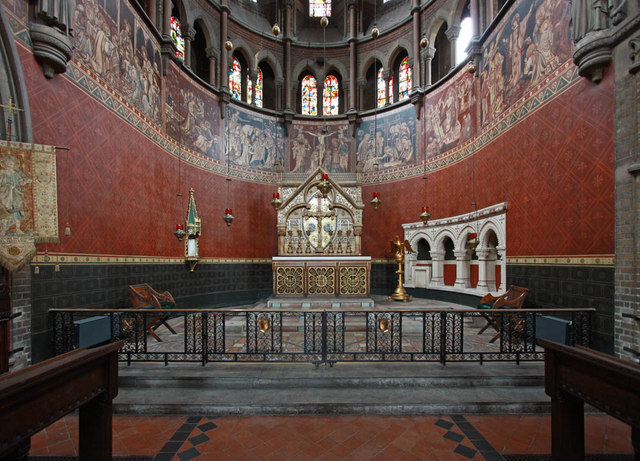
Vauxhall Gardens closed in 1859, and its grounds were built over within the following five years, bounded by Goding Street, Vauxhall Walk, Leopold Walk, St Oswald's Place and Kennington Lane. At the corner of St Oswald's Place and Kennington Lane rose St Peter's Church, designed by John Loughborough Pearson — one of the earliest of his many churches — and consecrated in 1864.
Alongside the church came a school. The Lambeth School of Art, founded in 1854 by Rev. Robert Gregory as part of his philanthropic work among the local poor, moved onto St Oswald's Place in new premises for which the Prince of Wales laid the foundation stone in 1860. The building that housed it, No. 34, went up as a school of art between 1857 and 1861, with a second storey added in the 1930s. Next door at No. 32 stands a four-storey warehouse-style building. Both buildings belong to the protected St Peter's School group, also designed by Pearson and built between 1857 and 1861.
Culture
From Pottery Design to Fine Art Degrees
The school's identity shifted repeatedly on the same ground, moving over the decades toward Fine Art.
People
A Reverend, a Potter, and an Architect
Rev. Robert Gregory founded the school as charitable work among the local poor. Henry Doulton joined its board in 1863, putting students' experimental designs to use for his firm. John Loughborough Pearson designed both the church and the schools beside it.
Recent Times
A Farm on a Vacant Plot
In 1976 a group of squatting architects established Vauxhall City Farm on a small vacant plot at St Oswald's Place, one of the Jubilee City Farms. The farm is based partly in the rear buildings of St Peter's Church and School, which stand between Tyers Street and St Oswald's Place. At the north end of the street a sympathetic modern row now provides the farm's facilities, with apartments built above.
Today
Two Sides, Two Eras
The street still reads as two different streets side by side. One side, protected since 2016, keeps its intimate scale, with the Gothic former St Peter's Schools lining the pavement. The other side is dominated by five-storey post-war blocks set in lawns and parking courts. At the top, allotments and the rears of Tyers Street's houses give the farm end its own quieter interest. A place first carved from a pleasure garden's edge, it has gone on being divided ever since.
St Oswald's Place was once called Miller Lane, before it took its present name as the land of Vauxhall Gardens was built over in the 1860s.
On the Map
St Oswald's Place Then & Now
Frequently Asked Questions
Why is it called St Oswald's Place?
The street was formerly called Miller Lane. The sources used here do not explain why or when it was renamed St Oswald's Place.
What is St Oswald's Place known for?
It is known for St Peter's Church, designed by John Loughborough Pearson and consecrated in 1864, and for housing the Lambeth School of Art — later the City and Guilds of London Art School — from 1860 onward.
Was St Oswald's Place part of Vauxhall Gardens?
It marks the eastern edge of what had been Vauxhall Gardens. The gardens closed in 1859 and the site was built over within the following five years.
What is Vauxhall City Farm's connection to the street?
The farm was established in 1976 by squatting architects on a small vacant plot at St Oswald's Place, and is based partly in the rear buildings of St Peter's Church and School.