Time Walk
From Pleasure Garden Entrepreneur to Council Estate

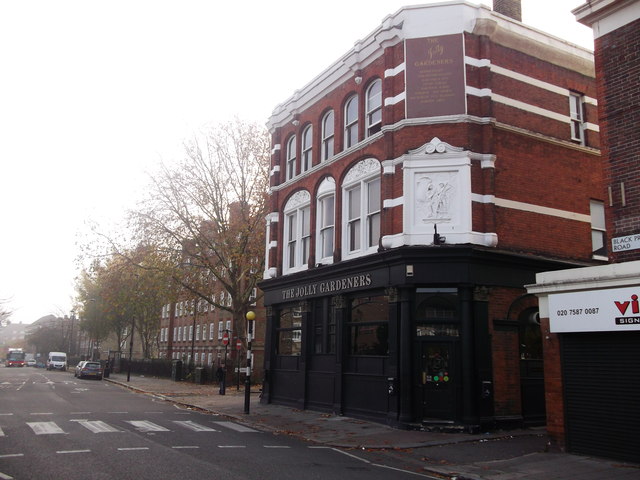
A street named for a man who sold fireworks and concerts to Georgian London now runs past a 1930s council estate. Walking it today, three things stand out: the rounded, Odeon-style corners of the estate flats, a Victorian corner pub, and a pair of small iron bollards outside it.
Beneath the 1930s brick lies an 18th-century pleasure resort and the Victorian streets that replaced it. The name is the clue to both layers.
Name Origin
The Tyers Family of Vauxhall Gardens
The street is named after Jonathan Tyers and his son, also Jonathan, who managed the Vauxhall Pleasure Gardens from 1729. Sheila Fairfield's The Streets of London: A Dictionary of the Names and Their Origins (1983) gives the same explanation, noting that father and son ran the gardens for much of the 18th century. Nearby Jonathan Street carries the father's first name.
History
A Pub Survives, a Terrace Falls
The John Bull public house at No. 64 was built in 1830 and rebuilt in 1870, a Victorian corner building in brick and stucco. Its licence was transferred in 1871, not long after the rebuilding.
In the 1930s the houses behind the pub were cleared to make way for the London County Council's Vauxhall Gardens Estate, built between 1935 and 1939. The John Bull itself was kept standing through the rebuilding. The most distinctive flats on the estate, built 1936–1938, have rounded Odeon-style brick corners and tall white rendered bay windows.
A pair of cast iron bollards outside No. 64, dated 1813 and inscribed "BORO MARKET", still stand beside the John Bull pub.
Culture
An LCC Architect's Estate
It sits among the blocks with the rounded Odeon-style corners and full-height bay windows that mark the estate's most distinctive 1936–1938 phase.
People
The Showman Behind the Name
Jonathan Tyers managed the Vauxhall Pleasure Gardens from 1729, with his son of the same name continuing the business, and between them the family ran the gardens for much of the 18th century.
Recent Times
New Builds at the Terrace End
Nos. 111, 113 and 115 Tyers Street sit at the end of a small terrace. No. 115 was built in the 1990s, No. 113 has been much extended and altered in recent years, and No. 111 is a new build of very contemporary design.
Today
Pub, Estate and New Infill
Tyers Street now mixes three eras in one short walk. The John Bull still stands at No. 64 with its 1813 bollards outside, the LCC's rounded 1930s flats line much of the street, and contemporary infill has filled a small terrace further along. The Tyers name, given for a Georgian pleasure-garden manager, has outlasted the gardens, the Victorian terraces, and much of what replaced them.
On the Map
Tyers Street Then & Now
Frequently Asked Questions
Why is it called Tyers Street?
It is named after Jonathan Tyers and his son, who managed the Vauxhall Pleasure Gardens from 1729. The family also gave their first name to nearby Jonathan Street.
What is Tyers Street known for?
It is known for the Vauxhall Gardens Estate, a London County Council development of 1935–1939 with distinctive Odeon-style flats, and for the John Bull pub at No. 64, a Victorian building that survived the estate's construction.
What is the John Bull pub on Tyers Street?
The John Bull at No. 64 was built in 1830 and rebuilt in 1870. It is a Victorian classical corner pub in brick and stucco, and was kept standing when the surrounding houses were cleared in the 1930s.
What do the bollards outside No. 64 mean?
A pair of early 19th-century cast iron bollards marked "1813 BORO MARKET" stand outside the John Bull pub at 64 Tyers Street.