Time Walk
The Road to a New Bridge


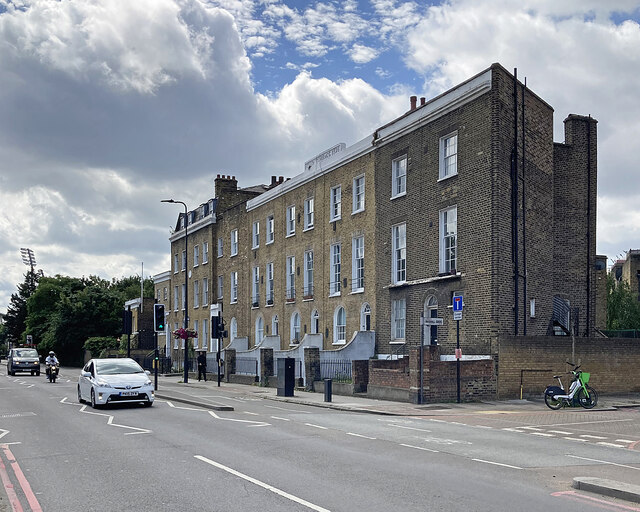
This road was built to get Londoners onto a new bridge, not to serve a town that already existed. Walking it today, you pass a Georgian school still teaching children, a terrace with its date spelled out above the door, and a garden grown from a derelict yard.
Underneath the terraces lies open farmland that belonged to the manors of Kennington and Vauxhall, cut through in 1818 so that traffic from the new Vauxhall Bridge could reach Camberwell. That purpose explains why the street still runs as a through-route rather than a settled square — and why it was named for a family who never lived here at all.
Name Origin
A Buckinghamshire Manor on a Lambeth Map
The road is named after Harleyford, a manor in Buckinghamshire. It was the country seat of the Clayton family, who held the lease on the demesne lands of Kennington that the new road crossed.
The naming had nothing to do with any event on the street itself. The Claytons gave their name to the road simply because they held the ground it crossed — a landlord's name stamped onto a public thoroughfare built under statute in 1818.
History
From Turnpike to Terrace
Harleyford Road was formed in 1818 under an Act of Parliament, alongside Harleyford Street and Camberwell New Road, to carry traffic from the foot of the newly opened Vauxhall Bridge towards Camberwell. Land belonging to the Mawbey estate had stood undeveloped until this new road opened it up. The road also came to mark, roughly, the old boundary between the Manor of Kennington to the north and Vauxhall Manor to the south, and a sluice on Vauxhall Creek once stood near its junction with the Oval.
Building followed quickly. The Parade, at Nos. 58 and 60, went up in 1821, its central oval plaque still bearing the name and date. Nos. 56–60 followed the same year, with Nos. 62–66 added around 1831 and Nos. 70–82 built between 1828 and 1831. Clun Terrace, at Nos. 48–54, carries a date of 1826 worked into its plasterwork. Across the road, Nos. 43–55 form a terrace of seven houses under a central pediment.
St Mark's School opened its boys' room on 6 December 1824 and its girls' room in March 1825, built by Pledge, Chart and Mason to a design costing £2,500. By June 1825 it held 180 boys and 120 girls, all over six years old, taught by Isaac Hitchen and Rebecca Marchant. The building was sold to its Trustees in 1860, and it remains one of the oldest church schools still in use in London.
Industry arrived later in the century. William Higgs bought land here in 1870 for Crown Works, a builders' yard with workshops for carpenters, stone-masons and blacksmiths, a timber store, and stabling for twenty horses; the firm became Higgs and Hill after a merger in 1873. Crown Baths, built on adjoining land in 1875, had its pools heated by waste steam from the yard's beam engine.
Culture
The End Everyone Wanted to Defend
The Harleyford Road Community Garden was created in 1986 on a derelict site, grown out of an earlier vegetable patch planted by local residents, and today it links the road to nearby Bonnington Square.
People
A Sculptor's Studio, A Soldier's Birthplace
Nathaniel Hitch (1845–1938), an architectural sculptor, lived at No. 21 Harleyford Road in 1880, having been apprenticed around 1860 to the sculptors Farmer and Brindley. He kept a studio at another address on the road from 1891 until 1926, during a career carving altarpieces and church furniture that ran from 1871 to 1935, alongside studies at Borough Polytechnic between 1894 and 1901.
John Oliver Brook Hitch was born on Harleyford Road in 1887. He became an architect and British Army officer, was awarded the Military Cross, and later designed the Shoreham war memorial, opened in 1920, and the chalk memorial at Cross Field, Shoreham, opened in 1921. He died on 15 September 1953.
Recent Times
Repair and Replanting
By the 1970s the 1820s houses needed attention. Lambeth Council carried out a comprehensive refurbishment of a number of these properties, stripping out later alterations and restoring lost details. A relief road linking Harleyford Road to Wandsworth Road had already opened in 1938 as part of a new traffic system at Vauxhall Cross.
St Anne's Settlement, a post-war building of 1951, stands on the road and carries a memorial relief to William F Brown, Bishop of Pella from 1862 to 1951. Crown Works, the builders' yard that had occupied the street since 1870, closed in 1967; the derelict ground it left behind was later turned into the community garden of 1986.
During wartime, Higgs and Hill's Crown Works on Harleyford Road turned from house-building to munitions and aircraft parts, employing a large female workforce to assemble fabric coverings for aircraft wings.
On the Map
Harleyford Road Then & Now
Frequently Asked Questions
Why is it called Harleyford Road?
It is named after Harleyford, a manor in Buckinghamshire that was the country seat of the Clayton family, lessees of the Kennington demesne lands the road was cut through in 1818.
What is Harleyford Road known for?
It is known for St Mark's School, one of London's oldest church schools still in use, its 1820s listed terraces, and for the Harleyford Road end of Kennington Oval, which featured in five 19th-century FA Cup finals.
When was Harleyford Road built?
The road was formed in 1818 under an Act of Parliament as an approach to Vauxhall Bridge, with most of its surviving terraces built between 1821 and 1831.
Who lived on Harleyford Road?
The sculptor Nathaniel Hitch lived and worked there between 1880 and 1926, and the architect and soldier John Oliver Brook Hitch was born there in 1887.