Time Walk
A Street Built Over a Manor's Edge

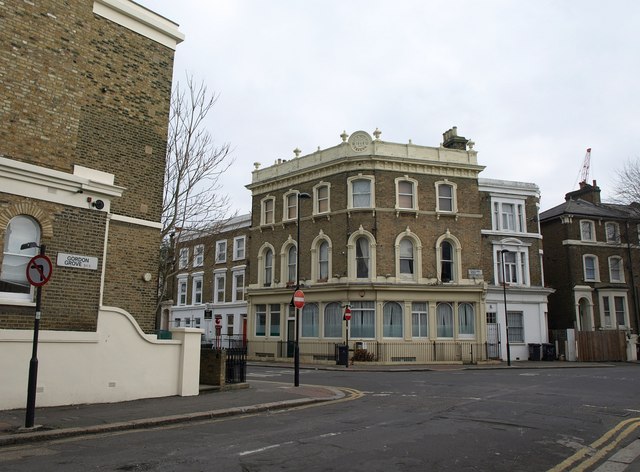
A railway once tore through this street before it had even settled into its final shape. Today Flaxman Road is a quiet residential run, its most eye-catching building a former corner pub with curved brickwork.
Beneath the pavements lies older ground still: part of this road was carved from the last parcel of a manor estate that once stretched toward Coldharbour Lane. That older boundary explains why the street sits where it does — a line laid down long before any house along it was built.
Name Origin
An Unexplained Name
The sources used here do not explain why the street was named Flaxman. No reference to the name's origin appears among the records consulted for this page.
History
Manor Land, a Church Offer, and a Railway's Toll
Flaxman Road sits on ground once belonging to Lambeth Wick Manor. The manor's third and smallest parcel lay against the north-west side of Coldharbour Lane, and that land is now covered in part by Lilford Road, Flaxman Road and Kenbury Street.
At the corner of Coldharbour Lane and Flaxman Road, the Ecclesiastical Commissioners offered a site for a permanent church. The record gives no further detail on what came of the offer, but it marks the corner as one the Commissioners judged worth a church.
In 1872 a spur built by the Crystal Palace and South London Junction Railway cut through the area and led to the demolition of a number of houses in Flaxman Road. It is the earliest dated event the records give for the street, and it shows Flaxman Road already standing, with houses enough to lose, before that date.
At No. 58 stood a grand corner pub in Italianate style, its curved corner carried on timber pilasters beneath a plain fascia and cornice. The ground floor kept original arched windows, though some doors were later filled in. Above, the upper floors carried arched first-floor windows with ornamental surrounds, and second-floor windows with their own decorative frames.
People
A High Wire Act's London Base
At 24 Flaxman Road lived two performers whose work took them around the world. High wire walker Ella Zuila and aerial gymnast George Loyal were based at the address between 1894 and 1904, the years in which they travelled internationally performing their acts. Flaxman Road was, for them, a fixed point between long stretches on the road.
A high wire walker and an aerial gymnast shared a single address on Flaxman Road for a full decade while touring the world performing their acts.
On the Map
Flaxman Road Then & Now
Frequently Asked Questions
Why is it called Flaxman Road?
The sources used for this page do not give an explanation for the name. No record of the naming has turned up in the Survey of London, Lambeth Council or Layers of London material consulted here.
What is Flaxman Road known for?
It sits on former Lambeth Wick Manor land, lost houses to an 1872 railway spur, had a grand Italianate corner pub at No. 58, and was home to touring circus performers Ella Zuila and George Loyal from 1894 to 1904.
What happened on Flaxman Road in 1872?
A spur built by the Crystal Palace and South London Junction Railway led to the demolition of a number of houses in Flaxman Road, the earliest dated event recorded for the street.