Time Walk
A Street Named for a Poet, Built for Clerks and Lodgers


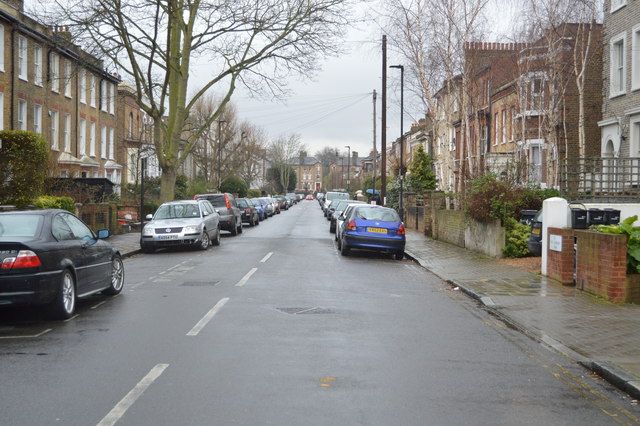
A famous pianist once ran a hairdressing salon here, long after she had played for the Queen. Walking along today, the eye catches gault-brick terraces, a fine poplar tree behind one garden wall, and a plaque marking that salon.
Beneath the terraces lies a farm. Chaucer Road was cut across the southern part of Effra Farm in 1855, built on a humbler scale than grander roads nearby, and named for the poet whose name it carries — a story Name Origin takes up next.
Name Origin
One of Four Poets on Effra Farm
The road takes its name from Geoffrey Chaucer. It was laid out in 1855 by the Westminster Freehold Land Society, alongside Spenser Road, Shakespeare Road and Milton Road, on the southern portion of Effra Farm — between what is now Dulwich Road and the footpath that later became Railton Road. The four streets together formed a more modestly built section of the estate than its northern part.
History
From Farmland to a Street of Newcomers
Demand for housing here grew quickly. By the 1870s, people moving to London from the countryside to find work were competing for new houses on Chaucer Road. The 1871 census shows how far some had travelled — residents came from Ipswich, Winchester, Macclesfield, Cornwall and Scotland, as well as from older parts of north Lambeth such as Kennington and Stockwell.
Ten years later, the 1881 census records a street of modest working lives: a commercial traveller, a lodging house keeper, a clerk, a milliner, a button maker, a plasterer, a lace presser. Among the earliest houses were Nos. 65 and 67, built around 1855, and grander still was Chaucer House at No. 51, with a double-height bay and decorated panels between its first-floor windows.
Culture
A Pianist's Second Career on the Street
Winifred Atwell was a child prodigy, playing piano from the age of four. She studied in New York before moving to Britain in 1946 and training at the Royal Academy of Music.
People
A Pianist and a Major
Major William Echlin Turney lived at No. 29 with his family in 1891, as the census of that year records. Decades later, Winifred Atwell's salon brought a very different kind of fame to the street she had settled in.
Recent Times
Remembering Winifred Atwell
The street's most recent chapter is a plaque. On 18 December 2020, the Nubian Jak Community Trust and the Arhag Housing Association unveiled it on the side wall of 69 Chaucer Road, marking the site of her salon.
Winifred Atwell's address on Chaucer Road is recorded two ways in the sources — as 82d and as 69 — likely reflecting renumbering of the building over the decades before the 2020 plaque fixed it at No. 69.
Today
Still a Humble, Named Street
Chaucer Road remains what it was built as: a modestly scaled Victorian street, its gault-brick terraces and one grander house still standing from the 1855 layout. The plaque at No. 69 keeps Winifred Atwell's name beside Chaucer's on the street she once called home.
On the Map
Chaucer Road Then & Now
Frequently Asked Questions
Why is it called Chaucer Road?
It was named after the poet Geoffrey Chaucer when laid out in 1855 on Effra Farm, one of four streets here — with Spenser Road, Shakespeare Road and Milton Road — named for English poets.
What is Chaucer Road known for?
Its early Victorian houses, built from 1855 on former farmland, and a plaque at No. 69 marking the hairdressing salon opened in 1956 by the pianist Winifred Atwell.
Who lived on Chaucer Road?
Residents in the 1870s and 1880s included clerks, milliners and lace pressers who had moved to London from across England and Scotland. Major William Echlin Turney lived at No. 29 in 1891, and Winifred Atwell ran a salon here from 1956.