Explore London England Scotland Wales About API
Southwark · SE16

Pioneer Street

A Victorian working-class street born of the Surrey Docks’ insatiable hunger for labour — its name a declaration of the spirit that built this corner of South London.

Name Meaning
One who goes first
First Recorded
c. 1870s
Borough
Southwark
Character
Post-docklands residential
Last Updated
Time Walk

Timber, Toil and Terraced Brick

Pioneer Street sits in the heart of what was once the most intensively worked dock peninsula in Britain. The Rotherhithe waterfront, dominated for two and a half centuries by the Surrey Commercial Docks, shaped every cobblestone and every household around it. The street forms part of the dense Victorian grid of Bermondsey-adjacent SE16 — two-storey terraces built for dock workers who unloaded timber from Scandinavia, grain from Canada, and general cargo from the far corners of the empire.

The docks have gone. Their filled-in basins are now the lakes at Russia Dock Woodland and the water at Canada Water. The warehouses have been converted or demolished, replaced by residential developments that climbed quickly through the 1980s and 1990s. What remains is the street grid itself, the brick and mortar of the old working community still legible beneath the newer facades. The name above the street sign — “Pioneer” — was chosen by someone, in some office or committee room, in the second half of the nineteenth century. It was not a casual choice.

2009
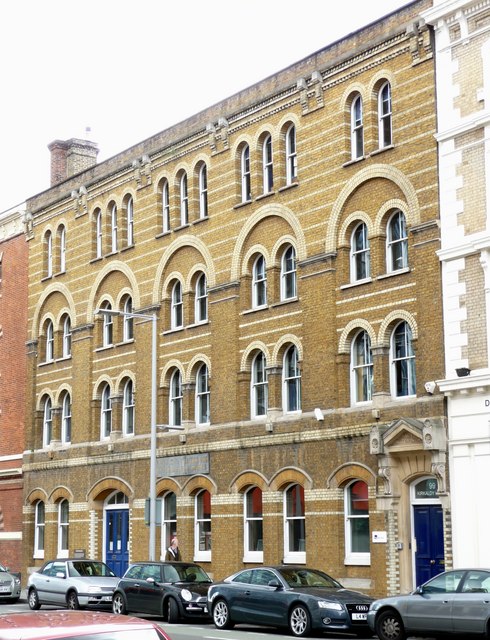
99 Southwark Street — near Pioneer Street
Wikimedia Commons · CC BY-SA 2.0
2015
Pioneer Centre, St Mary's Road, Peckham
Wikimedia Commons · CC BY-SA 2.0
Historical image not found
Today
A view from Peckham Library
Geograph · CC BY-SA 2.0
✦   ✦   ✦
Name Origin

What ‘Pioneer’ Meant to a Dock Worker

The word “pioneer” carries two distinct Victorian meanings, and on a street in SE16 both were alive at once. The first is familiar: a person who ventures first into new territory, who opens ground for those who follow. The word entered English from the French pionnier — originally a foot soldier sent ahead of an army to dig trenches, clear roads, and prepare the way. By the 1860s and 1870s, when the streets of the expanding Surrey Docks neighbourhood were being named and laid out, “pioneer” had also acquired a powerful civic resonance: the spirit of industry, progress and self-made effort that Victorian England held dear.

The second meaning was literal and local. A “pioneer” in military and engineering usage was specifically a labourer who prepared terrain — who dug, drained and built before others could follow. The men who constructed and expanded the Surrey Commercial Docks were exactly this: the physical pioneers of the modern port, breaking marshy ground with pick and shovel. No documentary record of the naming committee or decision has been found, but the street fits the pattern of aspirational Victorian nomenclature common across the docklands: streets named not for landowners or local dignitaries, but for virtues and ideals. In this neighbourhood, “pioneer” was a compliment and a statement of identity.

How the name evolved
pre-1870s Unnamed lane / dock workers’ row
c. 1870s Pioneer Street
present Pioneer Street
✦   ✦   ✦
History

Marshland, Masts and the Machine of Trade

The land beneath Pioneer Street was, not so long ago, waterlogged marsh. As British History Online records in its survey of Rotherhithe, the greater portion of the district between Rotherhithe and the Kent Road consisted of marshy fields before the dock era transformed the peninsula utterly. The Rotherhithe parish — “worthy of note as the first place where docks were constructed for the convenience of London” — began its industrial transformation with the opening of the Great Howland Dock around 1700, later renamed Greenland Dock as it became a base for Arctic whalers.

Key Dates — Pioneer Street & Its Neighbourhood
c. 1700
Great Howland Dock opens
The first enclosed wet dock in London opens in Rotherhithe, beginning the transformation of the marshy peninsula into Britain’s busiest timber port.
1807
Grand Surrey Canal
The Grand Surrey Canal opens, linking the docks to inland destinations and driving a wave of residential construction to house the swelling dock workforce.
c. 1870s
Pioneer Street laid out
The street is established as part of the dense residential grid built to house workers serving the expanding Surrey Commercial Docks and timber yards.
1889
The Great Dock Strike
London dockers, many from streets like Pioneer Street, walk out and win a rise to sixpence an hour — a landmark in British labour history.
1940
First night of the Blitz
On 7 September the Surrey Docks deal yards are set ablaze. Over 380,000 tons of timber burn in a single night, the most intense single fire ever recorded in Britain.
1969
Docks close
The Surrey Commercial Docks close for lack of trade, unable to handle containerised cargo. Rotherhithe becomes a derelict industrial wasteland almost overnight.
1981
LDDC established
The London Docklands Development Corporation begins the regeneration of the Surrey Docks, eventually building over 5,500 new homes and renaming the area Surrey Quays.
Did You Know?

By the eve of the Second World War, 85% of the entire Rotherhithe peninsula — some 460 acres — was covered by docks, timber ponds and dock infrastructure. Pioneer Street and its neighbours were essentially islands in a sea of industry. When the docks finally closed in 1969–70, the area became one of the largest stretches of derelict land in inner London.

The 19th-century expansion was relentless. By the mid-century, an influx of commercial traffic from Scandinavia and the Baltic — principally timber — and from Canada led to Greenland Dock being greatly expanded and new docks being dug across the peninsula. The Commercial Dock Company merged with competitors to form the Surrey Commercial Docks in 1865, and at its peak the complex covered 372 acres with nine docks, six timber ponds and a canal. The streets built for dock workers during this expansion — Pioneer Street among them — were densely packed, their terraces set close together in the manner of working-class housing built quickly to satisfy demand. Excavation work across the wider Rotherhithe area by MOLA (Museum of London Archaeology) has consistently revealed the pre-industrial landscape beneath: marsh deposits, tidal channels and the accumulated evidence of a waterfront community that long pre-dated the formal dock era.

The Great Dock Strike of 1889 rippled through every street in this neighbourhood. Dockers, most of them casualised labourers who gathered each morning at the dock gates hoping to be chosen for work, walked out across London’s wharves. Their demand was simple: sixpence an hour, a rise of roughly 30% for most men. They won. For the households of Pioneer Street, the “Dockers’ Tanner” represented the first meaningful security many families had known.
✦   ✦   ✦
Street Origin Products

Your listing has a better story than it’s telling

Pioneer Street sits within one of London’s most dramatically transformed neighbourhoods — two centuries of dock labour compressed into a single postcode. Here’s how to put that history to work.

Professional Edition
Street Pack
“Why this address matters.”

Buyers pay more for addresses with a story. The Street Pack gives estate agents and developers brochure-ready copy, prestige framing and a name origin panel — everything needed to make this address feel significant before a viewing is booked.

  • Brochure copy — 100 & 200 word versions
  • Prestige framing version
  • Name origin panel
  • Timeline strip
  • Buyer persona framing
For estate agents, developers & property portals
From £19
Get the Street Pack
Street Social Kit
“Why this place feels interesting.”

Airbnb guests choose atmosphere as much as amenities. The Social Kit gives you five ready-to-post tiles, story templates, captions, hooks and a Reel script — all built from this street’s actual history. Done for you, in minutes.

  • 5 ready-to-post social tiles
  • 3 Story templates
  • 5 captions & 3 hooks
  • 1 Reel script
  • Hashtag clusters
For Airbnb hosts, boutique landlords & small agents
From £9
Get the Social Kit
✦   ✦   ✦
Culture

Blitz, Labour and the Spirit of the Docks

The culture of Pioneer Street’s neighbourhood was forged by casualised labour and collective solidarity. Every morning in the dock era, men assembled at the dock gates and were picked — or not picked — for a day’s work. This system bred intense community bonds: mutual aid societies, pub networks, the dense familiarity of streets where everyone worked the same industry and shared the same precarity. The 1889 Great Dock Strike was as much a cultural event as an economic one. Dockers marched through the streets of Bermondsey and Rotherhithe with banners and bands, and the whole neighbourhood turned out to support them.

Fire That Changed London
The First Night of the Blitz, 7 September 1940

When the Luftwaffe targeted the Surrey Docks on the first night of the London Blitz, the deal yards around Rotherhithe produced the most intense single fire ever recorded in Britain. Over 380,000 tons of timber burned simultaneously, creating a firestorm visible from across southern England. Streets near Pioneer Street were devastated. The bombing paradoxically accelerated the eventual end of the docks by destroying infrastructure that was never fully rebuilt to pre-war capacity. Historic England records numerous surviving buildings in the area that bear the physical marks of this period.

The Scandinavian dimension of this neighbourhood’s culture is tangible even today. Because the Surrey Commercial Docks traded so heavily with Scandinavia and the Baltic — the timber ponds receiving wood from Norway, Sweden and Finland — the area attracted Scandinavian seafarers, merchants and settlers. SE1 Direct, which has long covered the Southwark and Bermondsey–Rotherhithe communities, notes the surviving Norwegian and Finnish churches in Albion Street as living evidence of this maritime connection. During the Second World War, Rotherhithe housed the Norwegian Government-in-Exile — an extraordinary footnote for a working-class dock neighbourhood.

✦   ✦   ✦
People

The Men Who Made the Dock World

Everything here is on so grand a scale the largest component part is diminished; the quay, broad enough to build several streets abreast… masts to the right, masts to the left, masts in front, masts yonder beyond the warehouses.
Victorian observer on the Surrey Docks, c. 1860s, quoted in Past in the Present

No verifiable individual has been recorded as living specifically on Pioneer Street who left a documented public trace. The street was a working-class residential address, and working-class Victorian lives are often invisible in the official record. What the census years would have shown, decade by decade, are dock labourers, stevedores, deal-porters, granary workers and their families — the engine of the Port of London reduced to rows of small houses and unremarkable names in a registration district.

Two men shaped the wider world in which Pioneer Street existed. James Walker (1781–1862), civil engineer, worked on the design and construction of Greenland Dock, and a memorial bust of him stands there still. The 19th-century dock expansion he helped engineer created the demand for working-class housing — and the occasion for street names like “Pioneer.” The 1889 Dock Strike produced no famous individual leader attached to this specific street, but its anonymous thousands — many living precisely in streets like this one — permanently altered the landscape of British labour.

✦   ✦   ✦
Recent Times

From Dereliction to Regeneration

The docks closed in 1969–70, unable to handle containerised cargo. The Surrey Docks became, almost overnight, one of the largest stretches of derelict land in inner London — a patchwork of filled-in basins, ruined warehouses and abandoned timber yards. The streets that had housed dockers suddenly housed the unemployed. In 1981 the Conservative government established the London Docklands Development Corporation to drive regeneration. The LDDC built over 5,500 new homes across the peninsula, constructed the Surrey Quays shopping centre in 1988, and oversaw the renaming of the area from “Surrey Docks” to “Surrey Quays.”

The Canada Water Masterplan — the current regeneration project focused on Canada Water and the wider Rotherhithe peninsula — proposes a further 3,500 homes, a new high street, town square and parks. The project will reshape the area around Pioneer Street again, continuing a cycle of reinvention that began when the first dock was dug over three centuries ago. For a street named after those who prepare the ground for others, the irony is instructive.

✦   ✦   ✦
Today

A Quiet Street at the Edge of a Changing Peninsula

Pioneer Street today is a residential address in a neighbourhood mid-transition. The Victorian terraces that survived the Blitz sit alongside post-war council housing and the newer apartment blocks of the LDDC era. Canada Water station, on both the Jubilee line and the London Overground, is within walking distance — a connectivity that was unimaginable to the dock workers who first lived here, for whom the world beyond Rotherhithe was reached by foot or river. The area’s Scandinavian associations have not entirely faded: the Norwegian and Finnish churches remain active just along Albion Street.

The neighbourhood’s green spaces are the transformed remains of the docks themselves. Russia Dock Woodland occupies a former basin and now holds woodland, wetland and a nature reserve. Southwark Park, opened in 1869 for the dock workers of the parish, remains one of the finest Victorian parks in south-east London. Both are within comfortable walking distance of Pioneer Street.

7 min walk
Southwark Park
63 acres of Victorian parkland designed for dock workers, with a bandstand (1884), lake and gallery. One of SE London’s finest green spaces.
10 min walk
Russia Dock Woodland
A former dock basin transformed into woodland and wetland nature reserve. The dock walls are still visible beneath the trees.
12 min walk
Stave Hill Ecology Park
A hill formed from canal spoil, topped with a relief map of the original dock layout. Panoramic views across SE16 and wildlife habitat.
15 min walk
Greenland Dock
The oldest enclosed wet dock in London, now a watersports centre and marina. The dock walls and lock gates date from the 19th-century rebuild.
✦   ✦   ✦
On the Map

Pioneer Street Then & Now

National Library of Scotland — Ordnance Survey 6-inch, c. 1888. Hosted by MapTiler. Modern: © OpenStreetMap contributors.

✦   ✦   ✦

Frequently Asked Questions

Why is it called Pioneer Street?
The name reflects the Victorian enthusiasm for progress and labour that defined the expanding Surrey Docks neighbourhood in the mid-to-late 19th century. “Pioneer” carried dual meaning in that era — both a person who leads the way into new territory, and a military or engineering labourer who prepares ground for others. In a community built by dockers and dock-construction workers, both senses would have resonated strongly. No definitive documentary record of the precise naming decision has been found, making the origin probable rather than fully verified.
When was Pioneer Street laid out?
Pioneer Street was most likely established in the second half of the 19th century, probably during the 1860s or 1870s, during the period of rapid dock expansion and associated residential development on the Rotherhithe peninsula. The Surrey Commercial Docks were greatly enlarged from the 1860s onwards, and new working-class streets were built quickly to house dock labourers and their families.
What is Pioneer Street known for?
Pioneer Street is a residential address in SE16, part of the Bermondsey and Rotherhithe neighbourhood once dominated by the Surrey Commercial Docks. Its character reflects the post-docklands regeneration of the 1980s and 1990s. The street sits close to Southwark Park, Russia Dock Woodland and the Canada Water transport hub, and within walking distance of the surviving Scandinavian churches — the Norwegian and Finnish — that remain the most visible legacy of the docks’ Baltic timber trade.