Time Walk
Two Villages, One Lane


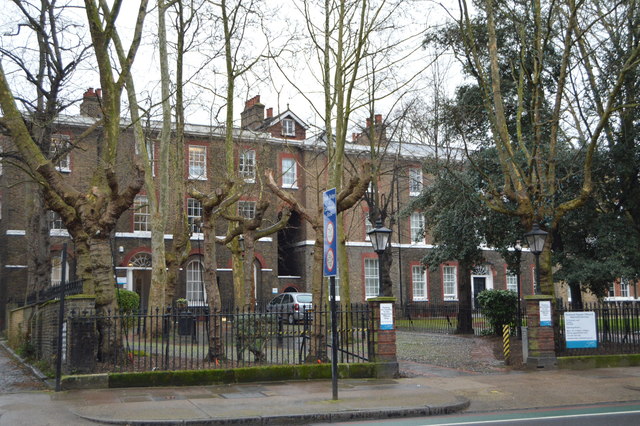
For centuries this road's one job was carrying people between two separate villages, Camberwell and Peckham. Walk it now and you pass Camberwell Town Hall's front, the entrance to Camberwell College of Arts, and the quiet doorway of the South London Gallery, all lining the same stretch.
Beneath the civic fronts lies the open farmland that once lay between Camberwell and Peckham, and the parish workhouse that stood at Havil Street. The road itself takes its name from a much older place, not from anything built along it.
Name Origin
A Village by a Hill
The road is named after Peckham, the village it leads to. Peckham, recorded locally as Peac-ham, is thought to mean "village by a hill". The road running towards Peckham from Camberwell inherited that older place-name rather than taking one of its own.
Today the same route carries two names: Peckham High Street near the station, and Peckham Road beyond its junction with Rye Lane.
History
From Farmland to Vestry Business
Fields once separated Peckham from Camberwell along this road. In the eighteenth century the land between the two villages was largely agricultural, with Peckham Road forming the main connection between them. By 1727 the Camberwell Vestry had built a parish workhouse at the junction with what is now Havil Street. Houses began to line Peckham Road itself from 1830, with smaller dwellings tucked into the less fashionable side streets. The London, Chatham and Dover Railway reached close to the road in the 1860s.
Civic philanthropy transformed the road at the end of the century. The South London Gallery, which had opened in 1891, ran into financial trouble by 1896, and the Camberwell Vestry, forerunner of Southwark Council, took it over. Passmore Edwards's money also built Camberwell Art School next door, raised between 1896 and 1898 and designed by Maurice Adams. Sir Edward Poynter opened it in 1898.
Havil Street, which meets Peckham Road beside the Town Hall, was once known as Workhouse Lane — a name taken directly from the parish workhouse the Camberwell Vestry built there in 1727.
The old workhouse was demolished in 1904 and replaced by a new building at 29 Peckham Road, now Grade II listed.
"Do today's work today"Inscription, 29 Peckham Road, 1904
Camberwell's old Vestry Hall was demolished in 1933 and replaced by Camberwell Town Hall, on the east side of Havil Street. It opened officially on 10 October 1934, when the mayor, Councillor S. E. Hall, performed the ceremony. Its front, facing Peckham Road, carries over the doorway a keystone carved as a ship's helm.
Culture
Art and Learning Settle In
Art and education define this stretch of road today. The gallery still stands here. Next door, the former Camberwell Art School is now Camberwell College of Arts, part of the University of the Arts London. The university's Creative Computing Institute shares the same road. Together they keep Peckham Road tied to art and learning.
People
An Actress's Last Address
One actress's death notice is the road's clearest personal trace. Mary Jane Seaman, an English actress born around 1837 in Salisbury, died at Peckham Road on 26 May 1888. She made her first appearance in 1863 as Mrs Malaprop in The Rivals at the Haymarket Theatre. In 1866 she married her fellow Haymarket actor, William Henry Chippendale.
The road's civic buildings carry other names too. Passmore Edwards, Maurice Adams and Sir Edward Poynter all have their names attached to the gallery and art school. Councillor S. E. Hall's name is linked to the Town Hall.
Recent Times
New Estates, Unbuilt Roads
Post-war housing and planning schemes reshaped the area nearby. In 1955 the Sceaux Gardens Estate was built nearby, a mixed development of flats, maisonettes and bungalows, named after Sceaux near Paris. The cluster of 18th-century buildings around the Town Hall in Peckham Road was recognised in 1968, when the Sceaux Gardens Conservation Area was designated; it was extended in 1977.
A different kind of change was proposed in the 1960s. Planners drawing up the South Cross Route once sketched a possible link from Peckham Road towards Denmark Hill station.
Today
Still Joining the Same Places
The road still joins the places it always has. Camberwell Town Hall, now offices for Southwark Council, still faces the street. Camberwell College of Arts remains nearby. The South London Gallery remains open. Even the listed railings outside numbers 30–34 survive. From agricultural lane to civic high street, Peckham Road has kept its old job: linking Peckham to Camberwell.
On the Map
Peckham Road Then & Now
Frequently Asked Questions
Why is it called Peckham Road?
The road is named after Peckham, the village it leads to. Peckham — recorded as Peac-ham — is thought to mean "village by a hill". The road carried that older name westward because it led travellers from Camberwell towards the village, not because of anything built along the road itself.
What is Peckham Road known for?
It is known for its cluster of civic and cultural buildings: the South London Gallery, open since 1891; Camberwell College of Arts, which grew from the same philanthropy; and Camberwell Town Hall, completed in 1934 and still used as council offices today.
What stood on Peckham Road before the Town Hall?
A parish workhouse occupied a site at the junction with Havil Street from 1727. It was demolished in 1904 and replaced by the building at 29 Peckham Road, and the Vestry Hall that later stood nearby was itself demolished in 1933 to make way for the Town Hall.