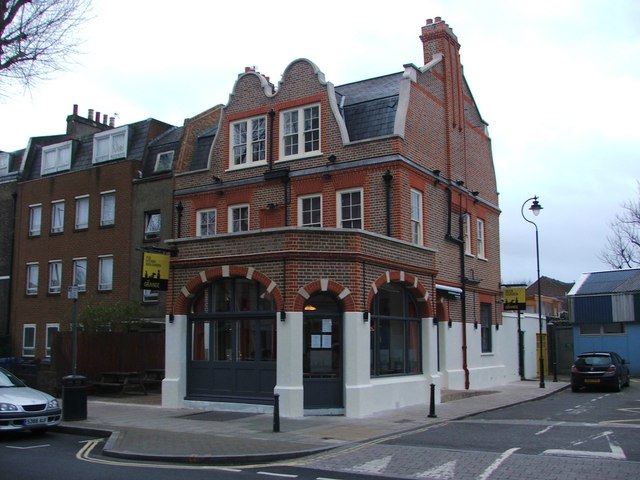
Bermondsey Abbey was a Cluniac foundation established in the late 11th century, and its grange occupied the farmland to the south-east. The monks farmed this ground for centuries; the Bermondsey Priory gained independence from its French mother house in 1381, when Robert Downton became the first English prior, and was elevated to an abbey in 1399. After the Dissolution, the land was sold on and the farm persisted — an 1812 illustration shows a substantial farmhouse still standing here, owned in the late 18th century by the Rolls family.
c. 1082
Abbey Founded
Cluniac monks establish Bermondsey Priory; the grange farm to the south-east becomes monastic property.
1381
English Independence
Robert Downton becomes the first English prior, severing the monastery’s formal allegiance to Cluny in France.
c. 1538
Dissolution
Henry VIII dissolves Bermondsey Abbey. The grange land passes into private hands; the farm continues under lay ownership.
c. 1750
Blue Anchor Road
The road is known as Blue Anchor Road. Tanneries and leather works begin to colonise the surrounding lanes.
c. 1869
Alaska Fur Factory
C.W. Martins & Co builds a large fur-processing factory at No. 61, specialising in Alaskan seal fur — giving the complex its enduring name.
1932
Art Deco Rebuild
The main factory block is rebuilt to a design by Wallis, Gilbert & Partners, the architects behind the Hoover and Firestone factories.
1939–45
War Work
Martin’s workers prepare 450,000 sheepskins for RAF flying suits and coats; the factory is damaged by wartime bombing and later restored.
1990s
Warehouse Conversion
The Alaska Building is converted into loft apartments — one of the earliest such conversions in SE1 — setting the template for Bermondsey’s regeneration.
Did You Know?
During the Great Plague of London, terrified city-dwellers fled to Bermondsey’s tan-pits believing the noxious smell of tanning had medicinal protective properties. The stench that drove most people away was, for some, their best hope of survival.
After the Great Fire of 1666, Bermondsey briefly attracted wealthier residents and took on a garden-suburb character along the line of Grange Road. That gentility did not last. The tanning and leather trades that had always occupied the surrounding lanes — fed by the tidal ditches and streams crossing the ground — spread and intensified. By the early 19th century, the road was flanked by tan-yards on virtually every approach. William Curtis, the pioneering apothecary and botanist, lived near Grange Road around 1770 and collected and described indigenous plants from the surrounding area — a reminder of how recently this had been open land.
The Victorian period brought rapid population growth. As recorded by British History Online, Bermondsey’s population rose from 29,741 in 1831 to 81,323 by 1901 — an almost threefold increase driven by factory employment and tenement-house building. Grange Road held a Georgian streetscape at its core, but the early Victorian decades filled every gap with small terraces. By 1900, this was an entirely working-class street of grocers, corn dealers, tanners, fur merchants, pawnbrokers, and coffee rooms.