Southwark London England About Methodology
The Borough · SE1

Emerson Street

Named after a 16th-century charitable founder whose property shaped the streets of Bankside.

Named After
Thomas Emerson
First Recorded
c. 1880
Borough
Southwark
Character
Residential
Last Updated
Time Walk

A Short Street in the Heart of Bankside

Emerson Street is a short residential street in The Borough neighbourhood of Southwark, lying between Park Street and Sumner Street on the south bank of the Thames. The street runs just south of what was once the riverside warren of Bankside, an area once famous for its theatres, bear-baiting pits, and watermen’s stairs leading down to the river. Today the northern part of the street has been renamed New Globe Walk, a transformation that speaks to how completely this once-industrial corner has become a destination for culture and tourism.

2014
Emerson Street
Emerson Street
Wikimedia Commons · CC BY-SA 2.0
2025
London - Southwark - Bankside - Park Street x Emerson Street - 2025-11-21
Wikimedia Commons · CC BY-SA 4.0
Historical image not found
Today
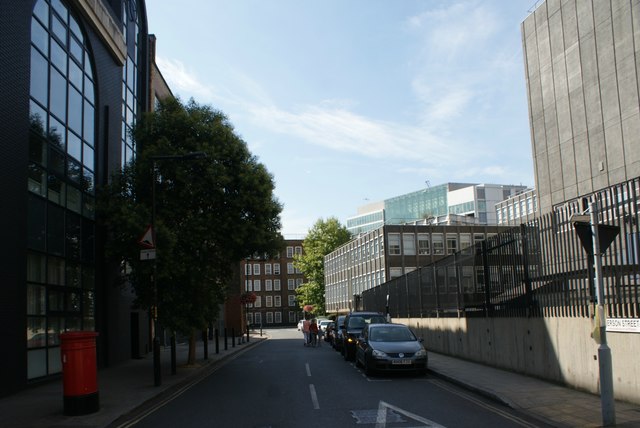
View down Emerson Street from Park Street
Geograph · CC BY-SA 2.0

The street itself is modest in scale—less than 86 metres long according to modern measurements—but its name carries a story that connects the pavements of today back to the property owners and benefactors of the Tudor and Stuart eras. To understand why it is called Emerson Street, you must look not to Victorian developers or nineteenth-century speculators, but to a family of merchants and charitable founders who shaped this precinct four centuries ago.

✦   ✦   ✦
Name Origin

Charity and Property in Elizabethan Southwark

During the reign of Elizabeth, part of Axe Yard was the property of the Emerson family. William Emerson, senior, died in 1575. His monument in Southwark Cathedral has the succinct epitaph, “he lived and died an honest man.” His son, Thomas (d. 1595), founded one of the parish charities and gave his name to Emerson Street. Thomas Emerson’s role as a parish benefactor—establishing a charity to clothe poor children and fund their apprenticeships—meant his name became synonymous with the area around the family property. When the street name stabilised in the nineteenth century, it took Emerson as its permanent designation.

Emerson Street is the name on the 1895 Ordnance Survey map, however earlier than this, there seems to be a dual use of Emerson and Thames Street back to around 1880, with Thames Street being the name used prior to 1880. The transition from Thames Street (a more generic riverside reference) to Emerson Street thus occurred in the final decades of the nineteenth century, transforming the street’s identity from a simple topographical description to a memorial of its Elizabethan proprietors.

How the name evolved
before 1880 Thames Street
c. 1880–1895 Emerson & Thames Street
1895–present Emerson Street
✦   ✦   ✦
History

From Axe Yard to Urban Transformation

The land on which Emerson Street stands was formerly part of Axe Yard, a precinct that developed from the yard surrounding the Axe Inn—one of Southwark’s many coaching inns. During the Elizabethan period, William Emerson had acquired property here, building houses and establishing himself as a significant landowner in this dense and bustling riverside district. The exact boundaries of the original Emerson holdings are difficult to fix, but records confirm that his son Thomas inherited substantial property in the area and devoted his resources to founding a parish charity.

Key Dates
1575
William Emerson Dies
William Emerson senior, property owner in Axe Yard, dies with the epitaph "he lived and died an honest man" recorded on his monument in Southwark Cathedral.
1595
Thomas Emerson’s Charity
Thomas Emerson, son of William, founds one of the parish charities. His charitable work and property holdings ensure the Emerson name remains attached to the locality.
1618
Emerson Property Documented
A plan of Bankside drawn in support of a lawsuit clearly labels a rectangular plot “Mr Emmerson’s”, confirming the family’s continued property ownership on the riverside.
c. 1880
Name Transition
The street begins a transition from Thames Street to Emerson Street. Both names are used interchangeably during the early 1880s.
1895
Ordnance Survey Records
Emerson Street appears as the official name on the Ordnance Survey map, establishing it as the permanent designation.
mid-1990s
Northern Section Renamed
The northern part of Emerson Street is renamed New Globe Walk as part of the cultural regeneration of Bankside around Shakespeare’s Globe Theatre.
Did You Know?

William Emerson built houses on St. Margaret’s Hill, and within a few years this probably resulted in the Southwark Fair market being moved from St. Margaret’s Church into Borough High Street. The Emerson family’s real estate development directly shaped the commercial geography of medieval Southwark.

By the early modern period, Southwark had become densely built and the original distinction of individual properties had blurred. Yet as streets received formal names in the nineteenth century, the Emerson name endured—a testament to how deeply the family’s charitable reputation had impressed itself upon local memory. When the northern section of Emerson Street was renamed New Globe Walk in the mid-1990s, it reflected not a forgetting of the old name but a rebranding of the area in line with the opening and reconstruction of Shakespeare’s Globe Theatre.

✦   ✦   ✦
Culture

Bankside’s Living Heritage

Emerson Street lies at the heart of one of London’s most historically significant and now culturally vibrant districts. The Bankside of the sixteenth and seventeenth centuries was a libertine precinct outside the jurisdiction of the City’s puritanical authorities. Bear-baiting rings, brothels, and theatres—including the Rose and the Globe—packed the area. The Thames itself bustled with wherries and barges, and the stairs dotting its banks provided access to the river for the watermen, fishmongers, and ordinary Londoners who depended on it.

Historic Connection
Emerson Stairs

The street once had its own set of riverside stairs giving access to the Thames. References to Emerson Stairs appear in coroners’ records and historical documents as part of the infrastructure of the Bankside waterfront. These stairs are now lost, but their names persist in archives, recording the extent of urban density and riverside life in this area.

Today, the renamed northern section—New Globe Walk—has become a pedestrian thoroughfare oriented entirely towards the cultural institutions that have since been implanted here: Shakespeare’s Globe Theatre, the Tate Modern, the Millennium Bridge, and the South Bank complex. This transformation from a working-class riverside street to a curated cultural precinct has erased much of the nineteenth- and twentieth-century character. Yet the street’s name, or what remains of it, still carries echoes of the Elizabethan merchants and benefactors whose property and charity shaped the social landscape of medieval Southwark.

✦   ✦   ✦
Today

A Transformed Waterfront Quarter

Emerson Street (and New Globe Walk) is now a fully integrated part of the Bankside cultural and residential precinct. The nearest Tube station is London Bridge, approximately 600 yards away. The street connects to Park Street, Sumner Street, and New Globe Walk. Office development and conversion of former industrial buildings have dominated the area in recent decades, transforming what was once a congested manufacturing and warehousing quarter into an aspirational residential and leisure destination.

Walking this street today reveals little physical evidence of the Elizabethan merchants and seventeenth-century theatregoers who once passed through. The character is contemporary—modern brick and glass, café culture, tourists on their way to the Globe. Yet the name, where it persists on street signs and maps, anchors memory to the Emerson family and their charitable works, a reminder that urban transformation, however complete, rests always upon older layers of property ownership, social obligation, and the ambitions of those who came before.

8 mins walk
Jubilee Park
Green space between Southwark and Bermondsey. A modern intervention offering views over London Bridge and the Thames.
10 mins walk
Thames Path
Riverfront walk connecting to London Bridge and Millennium Bridge. The South Bank pathway and recreation areas.
12 mins walk
Potters Fields Park
Public green space south of Tower Bridge Road. Seating and views over the river and St. Thomas Street skyline.
15 mins walk
Borough Market Green
The market area and surrounding Borough High Street precinct provides urban greenery and pedestrian space.
✦   ✦   ✦
On the Map

Emerson Street Then & Now

National Library of Scotland — Ordnance Survey 6-inch, c. 1888. Hosted by MapTiler. Modern: © OpenStreetMap contributors.

✦   ✦   ✦

Frequently Asked Questions

Why is it called Emerson Street?
The street is named after Thomas Emerson (d. 1595), who founded one of the parish charities in Southwark. His father, William Emerson, had owned property in the area during the Elizabethan period. Although the street was originally known as Thames Street until around 1880, the Emerson name—a tribute to the family’s charitable legacy—eventually became the official designation.
What was the street called before Emerson Street?
Before 1880, the street was known as Thames Street, a name that directly reflected its proximity to the River Thames. A period of dual naming existed around 1880, after which Emerson Street became the standard and permanent name, appearing on the 1895 Ordnance Survey map.
What is Emerson Street known for?
Emerson Street is known as a short residential street in The Borough neighbourhood of Bankside, transformed in recent decades from a working-class riverside precinct into part of a major cultural quarter. The northern section was renamed New Globe Walk in the mid-1990s as part of the regeneration around Shakespeare’s Globe Theatre. Today it connects to Park Street and the surrounding network of Bankside galleries, theatres, and restaurants.