Southwark London England About Methodology
Southwark · SE1 · Bermondsey

East Lane

Charlie Chaplin called it East Lane — and the name that only south Londoners used may have given the world one of cinema’s most beloved films.

Name Meaning
East of Walworth Road
First Recorded
1787 (as East Lane)
Borough
Southwark
Character
Street Market
Last Updated
Time Walk

The Lane That Refused to Change Its Name

East Lane is one of the few streets in London whose unofficial name outlasted its official one. The street runs through Bermondsey in the London Borough of Southwark, cutting east from Walworth Road towards the Old Kent Road, and for most of its history the market here was the beating heart of a densely settled working-class neighbourhood. Today the stalls are still trading — fruit and vegetables, Caribbean food, clothing, household goods — and on Saturdays the market expands to more than 250 stalls.

The official address is East Street. But ask anyone from the area and they will call it “The Lane.” That loyalty to an older name is not mere stubbornness. It carries a long history, a famous ghost, and a naming puzzle that connects a Bermondsey street market to Hollywood’s silent era. The name “East Lane” appears on maps before the street had anything like its current form — and that is where the story begins.

2007
East Dulwich Deli, 15-17 Lordship Lane, London SE22 8EW
Wikimedia Commons · CC BY-SA 2.5
2009
Lordship Lane
Lordship Lane — near East Lane
Wikimedia Commons · CC BY-SA 2.0
2014
East Dulwich, Lordship Lane Post Office
Wikimedia Commons · CC BY-SA 2.0
Today
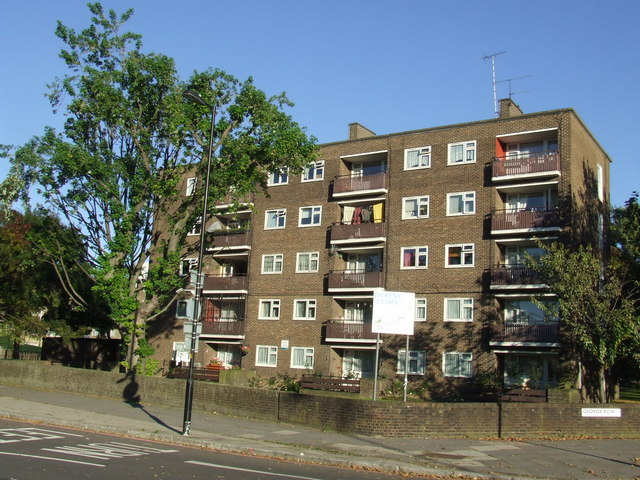
Dickens Estate, Bermondsey — near East Lane
Geograph · CC BY-SA 2.0
✦   ✦   ✦
Name Origin

A Name on Maps Before the Street Existed

The name “East Lane” predates the market and very nearly predates the street itself. According to research by the Walworth Society, a legal document from 1780 records the sale of land — then occupied as a flower nursery by the Driver family — that led to the creation of a public highway connecting Walworth Road with the Kent Road. That road appears on a map of 1787 already named “East Lane.” The name most likely describes the lane’s position: it ran east from the Walworth Road, the main north–south artery. The word lane was standard for a secondary rural track, and this was still open country in the 1780s.

The name was later formalised as “East Street,” but as British History Online records in its survey of Bermondsey parish, East Lane was among the streets listed in the area at the beginning of the 18th century, suggesting the lane-name had deep roots before the official renaming. The old name never died. As Chaplin historian David Robinson observed, calling East Street by the name “East Lane” was “a very south London thing to do” — and Chaplin himself used it throughout his life, including in his own autobiography, where he stated he was born in “East Lane.” The market also features in local records as “East Lane Market” well into the 20th century, carried forward by a community who simply never adopted the newer official form.

How the name evolved
early 1700s East Lane
1787 East Lane (mapped)
c. 1880s East Street (official)
present East Lane / East Street
✦   ✦   ✦
History

From Drover’s Common to the Costermonger’s Kingdom

Street trading in Bermondsey and its southern neighbour Walworth stretches back to the 16th century. Farmers from Kent and Surrey drove livestock north along the Old Kent Road toward the city, resting their animals overnight on Walworth Common. People bought produce directly from the drovers, and a tradition of open-air trading took root. The land through which East Lane now runs was in the 17th century still rural fields. The area to the north was known as Lock’s Field — described as late as 1878 as “a dreary swamp” — and to the south lay the common itself.

Key Dates
16th C
Drover Tradition
Farmers from Kent and Surrey rest livestock on Walworth Common; locals buy produce directly from drovers.
1780
Street Created
A legal document records the sale of flower-nursery land, creating East Lane as a public highway.
1787
First Mapped
East Lane appears by name on a published map for the first time.
1875
Tram Displaces Market
The electric tram runs down Walworth Road, forcing market traders into side streets including East Lane.
1880
Market Established
East Lane Market officially opens; traders operate without fixed pitches, rushing for spots at 8am each day.
1889
Chaplin Born
Charlie Chaplin is most likely born on East Street. No birth certificate exists, but Chaplin himself named East Lane as his birthplace.
1927
Licensing Introduced
The chaotic morning rush for pitches ends; a formal licensing system allocates fixed stalls to traders.
1948
Post-War Low
The market is described as “a drab, dead thing, infinitely remote from the cockney tradition” following wartime disruption.
Did You Know?

The market once boasted, according to local tradition recorded by the Walworth Society, that you could buy anything “from a hat pin to an elephant” in East Lane. The claim was a standard piece of market-trader braggadocio — but on Sundays, with over 250 stalls running, it was not entirely implausible.

By the 1770s, the Driver family cultivated land near the Old Kent Road junction as a flower nursery. Their sale of that land in 1780 created the street as a formal highway. By the 1860s, London was expanding rapidly and Walworth Common was built over. The old Walworth Road market moved into the side streets, and when the electric tram arrived on Walworth Road in 1875, traders were pushed permanently onto East Lane, Westmoreland Road, and Draper Street. Of those three, East Lane alone survived: Draper Street was demolished for the Elephant and Castle development in the 1960s, and Westmoreland Road declined after the construction of the Aylesbury Estate.

The original market was ungoverned and combative. Each morning, no trader could take a place until a policeman blew a whistle at 8am — at which point there was a sprint for the best pitches. Shop owners on the lane claimed the patches outside their own front doors as a matter of precedent. This ended in 1927 when a licensing system was introduced. As documented by SE1 Direct and local Southwark histories, the market then settled into the form recognisable today, though its fortunes dipped sharply during and after the Second World War.

✦   ✦   ✦
Culture

The Tramp’s Wardrobe and the Telly’s Title Sequence

Two pieces of popular culture are directly connected to East Lane. The first is Charlie Chaplin’s 1917 short film Easy Street. The connection was first suggested in 1928 in the film The Life Story of Charlie Chaplin by Harry B. Parkinson and was later confirmed as significant by Chaplin biographer David Robinson, whose introduction to the most recent edition of Chaplin’s autobiography argues that the title echoes “East Lane” — the name Chaplin himself used for his birthplace. The official Chaplin database notes that "the name ‘Easy Street’ suggests ‘East Street,’ the street of Chaplin’s birthplace." Beyond the title, historians have suggested the iconic Tramp costume — the oversized trousers, the battered bowler, the worn boots — may have been inspired by the everyday clothes Chaplin observed on the market as a child.

Screen Heritage
Only Fools and Horses — The Title Sequence

East Lane Market features in the iconic title sequence of the BBC sitcom Only Fools and Horses, the series that made Del Boy and Rodney Trotter household names. The market’s visual identity as a working-class south London street market — its stalls, shopfronts, and character — made it the perfect location to establish the world of the Trotters. The sequence helped cement East Lane in the national imagination as an emblem of cockney market culture.

The market’s cultural identity has always been tied to migration and change. In its Victorian heyday it was the domain of the costermonger — the barrow-pushing fruit and vegetable seller who was a fixture of south London life. As MOLA archaeological work across the Southwark area has documented, the whole district developed rapidly from the 1780s as new housing swallowed the market gardens and common land. East Lane market evolved with every new wave of arrivals: post-war migrants, Caribbean communities, African families. The “cockney tradition” mourned in 1948 was not lost — it was translated.

✦   ✦   ✦
People

Born Above a Shop, Raised on the Lane

Charlie Chaplin is the name that haunts East Lane. He was born on 16 April 1889, most likely above a shop on East Street, though no birth certificate has ever been found. He grew up in extreme poverty in the area, and the street market he would have known as a child — which he consistently called East Lane throughout his life — left marks that lasted. The oversized clothes of the Tramp costume, historians believe, were drawn from the second-hand clothing stalls of this very market. Chaplin himself wrote in his autobiography that he was born in “East Lane, Lambeth” — the south Londoner’s instinctive use of the older name, noted by his biographer David Robinson as characteristic of the community he came from.

As Historic England records in its designation work across Southwark, the area contains buildings and sites directly connected to the waves of working-class life that shaped streets like East Lane. The market’s Baptist church, which still stands on the lane, served generations of traders and their families. Alongside Chaplin, the lane was frequented by figures known locally but not nationally — the street bookie, the pie-and-mash seller, the “White Horse Oil” boxer who sold embrocation outside the church — characters recalled in community oral histories collected by the Walworth Society.

✦   ✦   ✦
Recent Times

Estates, Redevelopment, and the Fight to Stay Open

The market’s two sister markets — on Westmoreland Road and Draper Street — did not survive the 20th century. The Aylesbury Estate, built from the 1960s onward, displaced the Westmoreland Road traders. Draper Street was demolished entirely as part of the Elephant and Castle development. East Lane survived partly by geography and partly by stubbornness. It remained the one side-street market with enough length, footfall, and local identity to resist the waves of demolition that reshaped everything around it.

In 2015 the market was the subject of several immigration enforcement raids, which generated national press coverage and debate about the treatment of traders and the impact of policing on a diverse community market. Traders and vendors have also voiced concern about the implications of ongoing redevelopment — the Heygate Estate clearance and the Aylesbury Estate rebuild have moved thousands of residents out of the catchment area, reducing the market’s core customer base. The Walworth Society has run animated historical tours of East Lane to document the market’s past and build support for its future.

“A drab, dead thing, infinitely remote from the cockney tradition.”
Contemporary description of East Lane Market, 1948, following wartime decline
✦   ✦   ✦
Today

250 Stalls, 120 Languages, One Lane

East Lane market opens Tuesday to Sunday — closed Mondays — with Saturday drawing over 250 stalls including a weekly plant market. A Sunday flea market operates near Nursery Row Park toward the Old Kent Road end. The goods on offer range from cassava and courgettes to sheep’s heads and cow hooves, from Caribbean spices to low-cost power tools. Southwark has the highest proportion of African-born residents of any borough in the UK, and the market reflects that: its stalls are as diverse as the community they serve.

The postcode SE17 takes in the market proper, though the street straddles the boundary between the East Walworth and Faraday wards. Six Southwark councillors represent its two sides. The nearest station is Elephant and Castle. And the name “East Lane” — never on any official sign — is still the one that local people use, still carrying the memory of a flower nursery sold in 1780, a market established in 1880, and a boy born above a shop who went to Hollywood and took the name of his lane with him.

10 min walk
Burgess Park
Southwark’s largest park, 56 acres of open space created from cleared industrial land, with a lake, BMX track and community gardens.
5 min walk
Nursery Row Park
A small neighbourhood park at the Old Kent Road end of the market street, adjacent to the Sunday flea market.
12 min walk
Geraldine Mary Harmsworth Park
The grounds of the Imperial War Museum, open to the public and containing mature trees and a sensory garden.
15 min walk
Southwark Park
London’s first municipal park, opened in 1869, with a gallery, lake, and formal gardens just north of the Old Kent Road.
✦   ✦   ✦
On the Map

East Lane Then & Now

National Library of Scotland — Ordnance Survey 6-inch, c. 1888. Hosted by MapTiler. Modern: © OpenStreetMap contributors.

✦   ✦   ✦

Frequently Asked Questions

Why is it called East Lane?
The name East Lane most likely describes the lane’s position east of Walworth Road. A legal document from 1780 records the creation of the street as a public highway, and it appears on a map of 1787 already named “East Lane.” The word “lane” was standard for a secondary rural track, which this still was in the late 18th century. When the official name was changed to “East Street,” the old name survived in local use — and still does today.
Was Charlie Chaplin really born on East Lane?
Chaplin himself stated in his autobiography that he was born in East Lane, Lambeth, on 16 April 1889. No birth certificate has ever been found to confirm or contradict this. The connection is widely accepted by Chaplin historians: biographer David Robinson noted that calling East Street by the name “East Lane” was a specifically south London habit, and that Chaplin’s use of the name was itself evidence of his local roots. The 1917 film Easy Street is believed to take both its title and street aesthetic from East Lane.
What is East Lane known for?
East Lane — formally East Street — is known for its street market, one of the oldest and largest in South London, officially established in 1880 though trading on the site stretches back to the 16th century. On Saturdays it expands to over 250 stalls. It is also famous as the probable birthplace of Charlie Chaplin and for featuring in the title sequence of Only Fools and Horses. Today the market reflects Southwark’s extraordinary ethnic diversity, offering produce from across the Caribbean, Africa, Latin America and beyond.