Southwark London England About Methodology
Southwark · SE1

Chatham Street

Built from scratch in 1876 by a single Walworth builder, this Victorian terrace street carries the name of a Kentish dockyard town — and still holds a Grade II listed church used today by a Nigerian Pentecostal congregation.

Name Meaning
Chatham, Kent
First Recorded
c. 1876
Borough
Southwark
Character
Victorian Residential
Last Updated
Time Walk

Fields to Terraces in a Single Generation

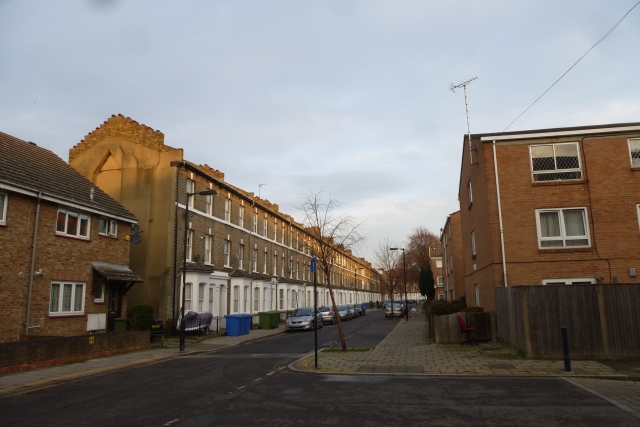
Chatham Street sits in the heart of Walworth, a few minutes’ walk from the Walworth Road. The street is lined with Victorian terraced housing that, as recorded by SE1 Direct and local census data, has been predominantly residential since its construction—today largely divided into flats, typical of inner south London. Lady Margaret Church, a red-brick Gothic building on the north side, anchors the streetscape and is hard to miss.

2012
London Chatham and Dover Railway crest
Wikimedia Commons · CC BY-SA 2.0
2016
Chatham Street
Chatham Street
Wikimedia Commons · CC BY-SA 2.0
2016
Chatham Street Park
Chatham Street Park
Wikimedia Commons · CC BY-SA 2.0
Today
Chatham Street
Chatham Street
Geograph · CC BY-SA 2.0

The uniformity of the terrace hints at a single act of construction. Every house on the street was built at the same moment, as part of one estate development, when Walworth was still being stitched together out of former market gardens and open common. The name on the street sign comes from that same moment of creation—and points, perhaps unexpectedly, to a dockyard town on the Thames estuary in Kent.

✦   ✦   ✦
Name Origin

A Kentish Dockyard, a Railway, and a Builder’s Choice

The name most likely commemorates Chatham, the historic dockyard town on the Medway in Kent. Victorian developers across Walworth regularly named new streets after English towns and counties, and the Yates family firm—who built this street in 1876—followed that convention across several of their local estates. No primary document recording the specific reason for the choice has been found, so this origin must be treated as probable rather than certain. According to British History Online, developers Henry Penton and Edward Yates were among the key builders who transformed Walworth in the later nineteenth century, shaping its street pattern and naming conventions.

An additional association may have reinforced the name. The London, Chatham and Dover Railway passed through the broader Walworth area, as documented in contemporary gazetteers, and the railway’s corporate identity made “Chatham” a familiar word to every local resident. Historic England’s listing records also note the street was at one point designated “Chatham Road” before settling on its current form as Chatham Street—evidence of a slight early uncertainty in the name’s form, even if not its reference.

How the name evolved
c. 1876 Chatham Road
later 19th c. Chatham Street
✦   ✦   ✦
History

From Common Land to Bricklayer’s Blueprint

Before 1876, the land that Chatham Street now occupies was part of the undeveloped hinterland of Walworth. As noted by local history sources drawing on British History Online, Walworth and Newington are largely mid-nineteenth-century creations: the roads predated the buildings, and speculative builders moved in once the trunk routes were established. The whole street was built by George Yates, of the family firm founded by Edward Yates, in a single campaign of works in 1876.

Key Dates
1086
Domesday Walworth
The area appears in the Domesday Book as Waleorde, held from Archbishop Lanfranc of Canterbury—fields and meadow, no streets.
c. 1750s
Roads Arrive First
New Kent Road and London Road are laid out, turning the Elephant & Castle crossroads into a transport hub and opening Walworth to development.
1876
Street Built
George Yates of the family building firm constructs Chatham Street and neighbouring Darwin Street in a single campaign, part of a wave of Walworth estate development.
1888–9
Lady Margaret Church
A mission church for the new residents, designed by architect Ewan Christian, is built on the north side of the street—Grade II listed and still standing.
1983
Church Made Redundant
Lady Margaret Church ceases to function as a Church of England parish church after nearly a century of use.
1986
New Congregation
The Cherubim & Seraphim Church (Mount of Salvation) takes a lease on the building, beginning a new chapter for the street’s landmark.
Did You Know?

The same builder, George Yates, constructed Larcom Street, Aldbridge Street, and Darwin Street—the street directly behind Chatham Street—all as part of the same mid-Victorian estate push that filled in the last remaining market gardens of Walworth.

The neighbourhood these streets replaced had its own grim history: a note preserved in local accounts records that near the Heygate Estate flyover—a short walk from Chatham Street—a Lock Hospital for lepers once stood on “Locks Fields,” deliberately placed away from the medieval city. By the 1870s those fields were gone entirely, absorbed into the expanding south London suburb. The terraces George Yates built were respectable working-class housing for the growing population drawn by the railways and by industry along the Old Kent Road.

✦   ✦   ✦
Culture

A Mission Church That Outlived Its Mission

Lady Margaret Church defines the cultural identity of Chatham Street more than any other feature. Built in 1888–9 as a mission church for the newly-settled working-class parish, it was originally known as St John’s College Mission—one of dozens of Victorian collegiate missions sent from Oxford and Cambridge into the urban poor of south London. As recorded by Historic England, the building is Grade II listed: red brick with stone dressings, in the Early English style, with a steeply pitched slate roof that runs continuously from nave to chancel and wraps around an apsidal east end. Its “candle snuffer” bell cote marks the division between nave and transepts.

Congregation in Continuity
Lady Margaret Church—from Mission to Mount of Salvation

Designed by the ecclesiastical architect Ewan Christian and built 1888–9, the church served as an Anglican parish church until it was made redundant in 1983. Since 1986 it has been leased to the Cherubim & Seraphim Church (Mount of Salvation), a Yoruba-origin Nigerian Pentecostal denomination—a vivid example of how Walworth’s religious landscape has been reshaped by post-war migration. The Grade II listing protects the building’s Early English brick-and-stone exterior.

The transition from Anglican mission to African Pentecostal congregation is not merely a curiosity of tenure—it maps directly onto Walworth’s demographic transformation across the twentieth century. The parish records held at London Metropolitan Archives, including registers of baptisms and marriages from 1886 onwards, document the earlier community’s life in rich detail. The building that once served navvies and factory workers now rings on Sundays with a very different expression of Christian worship, in a building whose Victorian bones remain entirely intact.

✦   ✦   ✦
People

Builder, Architect, and the Firm That Shaped a Neighbourhood

Chatham Street owes its physical existence to two identifiable individuals. George Yates was the builder who constructed the street in 1876, a member of the family firm founded by his father Edward Yates, whose offices were at 205 Walworth Road. The Yates firm, as confirmed by local historian sources and by British History Online’s coverage of Walworth’s Victorian estate developers, shaped a significant portion of the neighbourhood’s residential fabric in a single generation.

Ewan Christian designed Lady Margaret Church on the north side of the street in 1888–9. Christian was one of the most prolific ecclesiastical architects of the Victorian period, serving for many years as architect to the Ecclesiastical Commissioners. His output ran to hundreds of churches and restorations across England. Lady Margaret Church is a characteristic late example of his work—austere, expressive, brick-built—and one of the few of his buildings still in active religious use today.

✦   ✦   ✦
Recent Times

Regeneration at the Edges, Continuity at the Core

Chatham Street sits within the North Walworth ward, an area that has been on the edge of one of London’s most consequential regeneration schemes—the demolition of the Heygate Estate and the broader Elephant and Castle renewal. As SE1 Direct has reported extensively over two decades, the transformation of Elephant & Castle has brought new housing, commercial development, and shifting demographics to the wider area, with effects felt across all of north Walworth.

Chatham Street itself has remained predominantly residential throughout, its Victorian terrace stock now largely converted into flats. Land Registry data records 48 property sales on the street since 1995—a sign of a stable, if constantly turning, residential community. The church continues to serve its Cherubim & Seraphim congregation; the Grade II listing ensures the fabric of the street’s most distinctive building will not be lost to development pressure.

✦   ✦   ✦
Today

Walworth’s Victorian Grid, Still Intact

Chatham Street remains a quiet residential road within walking distance of Elephant & Castle station and the bustle of the Walworth Road market. Excavations in the wider borough have deepened understanding of what lay beneath these streets long before the builders arrived: as MOLA (Museum of London Archaeology) has demonstrated through its Southwark-wide fieldwork, the area south of the Thames contains significant Roman and medieval deposits at shallow depth, and the Victorian building boom that created streets like Chatham Street buried rather than destroyed much of that earlier landscape.

The nearest green spaces offer some contrast to the dense terrace fabric surrounding the street. Burgess Park, Geraldine Mary Harmsworth Park, and Kennington Park are all within easy reach, each preserving open land that was far more extensive before George Yates and his contemporaries got to work in the 1870s.

10–15 min walk
Burgess Park
Southwark’s largest park, 56 hectares, created from cleared Victorian housing in the 1950s–70s. Lake, sports facilities, and café.
8 min walk
Kennington Park
A historic open space in Lambeth, formerly a common and place of public execution. Formal gardens and open grass.
12 min walk
Geraldine Mary Harmsworth Park
The grounds of the Imperial War Museum; a tranquil formal park in the heart of Southwark.
5 min walk
Elephant & Castle Open Space
New public realm created as part of the Elephant & Castle regeneration, offering pockets of green at the northern end of Walworth Road.
✦   ✦   ✦
On the Map

Chatham Street Then & Now

National Library of Scotland — Ordnance Survey 6-inch, c. 1888. Hosted by MapTiler. Modern: © OpenStreetMap contributors.

✦   ✦   ✦

Frequently Asked Questions

Why is it called Chatham Street?
The street is most likely named after the city of Chatham in Kent, following a common Victorian convention in Walworth of naming new residential streets after English towns. The Yates family firm, who built the street in 1876, used this approach across their local estate developments. The London, Chatham and Dover Railway, which passed through the wider area, may have reinforced the familiarity of the name. No primary document definitively records the builder’s specific reason for the choice.
Who built Chatham Street in Walworth?
Chatham Street was built in 1876 by George Yates, a member of the Yates family building firm founded by Edward Yates and based at 205 Walworth Road. The same firm built several surrounding streets, including Larcom Street, Aldbridge Street, and Darwin Street (directly behind Chatham Street), as part of a concentrated programme of estate development across Walworth in the 1870s.
What is Chatham Street known for?
Chatham Street in Walworth is best known today for Lady Margaret Church on its north side—a Grade II listed Victorian Gothic church designed by Ewan Christian and built 1888–9. Originally established as St John’s College Mission, it was made redundant as a Church of England building in 1983 and has since been leased to the Cherubim & Seraphim Church (Mount of Salvation). The street itself is one of the better-preserved examples of a single-builder Victorian estate in North Walworth.