Southwark London England About Methodology
Southwark · SE1

Chambers Street

Named after a wharf that handled Thames cargo into the 1960s — a street that did not exist until after the Blitz reshaped Bermondsey’s riverfront.

Name Meaning
From Chambers Wharf
First Recorded
Post-1940
Borough
Southwark
Character
Post-war residential
Last Updated
Time Walk

Blank on the Map Until the Bombs Fell

Chambers Street occupies a slice of Bermondsey’s riverside that simply did not exist as a named road before the Second World War. Maps from 1895 show no such street here, and the 1940 Bartholomew’s Atlas of Greater London confirms it was still absent. What stands in its place today—low-rise social housing and access roads threading between the Thames and Jamaica Road—is entirely a post-war creation, laid over ground cleared by bombing and redevelopment.

The street runs close to Bermondsey Wall West, within earshot of the river, in a neighbourhood that still bears the industrial bones of old Bermondsey: warehouses adapted as flats, the ghost lines of vanished docks, and a few surviving riverside structures. The name overhead belongs to a wharf—and that wharf has a story older than the street itself.

2012
Town Hall Chambers (7327438278)
Wikimedia Commons · CC BY 2.0
2015
Lancaster Town Hall Chambers
Wikimedia Commons · CC BY 3.0
2023
Southwark , Montague Chambers
Wikimedia Commons · CC BY-SA 2.0
Today
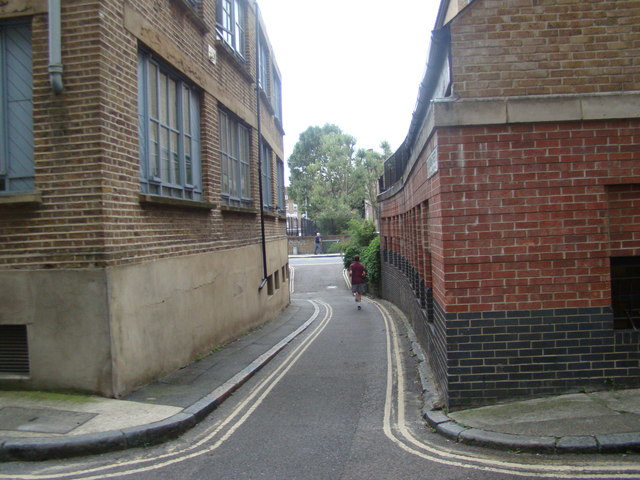
View down Flockton Street from Bermondsey Wall East — near Chambers Street
Geograph · CC BY-SA 2.0
✦   ✦   ✦
Name Origin

The Wharf That Named the Street

The street is most likely named after Chambers Wharf, the historic Thames wharf that stood—and whose listed building still stands—at 29 Bermondsey Wall West, yards from the street’s northern end. The wharf was a significant riverside cargo-handling site well into the twentieth century, and as Historic England records, the surviving structure at the site retains its Grade II listing. When the post-war street was laid out on cleared ground nearby, it took the wharf’s name.

The identity of the original “Chambers” for whom the wharf was named is not definitively recorded. The surname itself derives from the Old French chambre, meaning a private room or apartment, and was an occupational name for a servant or officer who managed a lord’s private chambers. As documented by British History Online’s survey of Bermondsey parishes, the riverside in this area was occupied by rope-makers, anchor smiths, and boat-builders alongside general cargo wharfingers—any one of whom might have borne the Chambers name.

How the name evolved
pre-1895 Chambers Wharf
post-1940 Chambers Street
present Chambers Street
✦   ✦   ✦
History

From Abbey Farmland to Cargo Crane

The ground beneath Chambers Street was shaped first by monks. As British History Online’s Victoria County History records, Bermondsey’s parish became important through the influence of Bermondsey Abbey, which probably reclaimed, embanked, and cultivated the low-lying riverside land from at least the eleventh century. The abbey controlled this stretch of the Thames shore until the Dissolution of the Monasteries in 1538.

Key Dates
c. 1082
Abbey Founded
Bermondsey Abbey established as a Cluniac priory; monks begin reclaiming and cultivating the riverside marshland.
1538
Dissolution
Henry VIII dissolves Bermondsey Abbey. The riverfront gradually passes to private owners and trade interests.
c. 1750
Industrial Riverside
Rope-makers, anchor smiths, and boat-builders occupy the waterside. Two small docks operate in the parish.
pre-1895
Chambers Wharf Active
Chambers Wharf established on Bermondsey Wall West as a Thames cargo wharf; no street called Chambers Street yet exists.
1940
Still Absent
Bartholomew’s Atlas of Greater London confirms no Chambers Street on this site; the area is still pre-war housing and industry.
1961
Wharf at Full Capacity
The 1961 Bermondsey Borough Guide carries a full-page advertisement for Chambers Wharf, showing large cargo ships and cranes at the berth.
post-1940s
Street Created
Chambers Street is laid out on ground cleared by bomb damage and post-war redevelopment, taking its name from the adjacent wharf.
Did You Know?

The 1895 Ordnance Survey map shows no Chambers Street in Bermondsey at all — and neither does the 1940 edition of Bartholomew’s Atlas of Greater London. The street is younger than most of its neighbours, a product of post-war rebuilding rather than Victorian expansion.

By the mid-eighteenth century, as the Victoria County History notes, the Bermondsey waterside supported rope-makers, anchor smiths, stave merchants, and boat-builders, alongside general wharfingers handling cargo from the Thames. This was not a genteel neighbourhood: these were working trades, noisy and malodorous, occupying every inch of accessible riverbank. The tanning industry further inland made Bermondsey notorious across London for its smell—by 1832 it had outgrown the Leadenhall leather market entirely, and a dedicated leather market was erected in Weston Street.

Chambers Wharf persisted as an active cargo site long after many Bermondsey industries declined. The 1961 Borough Guide’s full-page advertisement depicted large ships moored alongside the wharf’s cranes—a scene that would have been entirely familiar a century earlier. The old warehouse was only demolished in more recent decades, though the listed building that replaced it preserves the site’s riverside character. Excavations in the wider Bermondsey riverside area by MOLA (Museum of London Archaeology) have uncovered evidence of the area’s long history of riverine occupation, from medieval reclamation works to post-medieval industrial structures.

✦   ✦   ✦
Culture

The Crane, the List, and the Tideway

The Grade II listing of the Chambers Wharf structure on Bermondsey Wall West—yards from the street that shares its name—makes it one of very few surviving industrial riverside buildings in this part of SE1. As Historic England’s national register records, the building at 29 Bermondsey Wall West retains its listed status, a recognition that the cargo-handling past of Bermondsey’s riverfront deserves preservation in the modern townscape.

Wharf on the Register
Chambers Wharf, 29 Bermondsey Wall West — Grade II Listed

The building at the Chambers Wharf site on Bermondsey Wall West is listed Grade II on the National Heritage List for England. The site operated as a working Thames cargo wharf into the 1960s, when a large cargo ship and cranes were still a fixture. It stands as one of the last material connections between Chambers Street’s name and the river trade that generated it.

The street also sits within the footprint of the Thames Tideway Tunnel project—the “super sewer” driven beneath the Thames from the 2010s onwards. Bermondsey Wall East and West were substantially affected by the works, with the tunnel’s route passing beneath the riverbed directly in front of the Chambers Wharf site. As reported by SE1 Direct, which covers Southwark and Bankside, the Tideway construction divided Bermondsey Wall into eastern and western sections, reshaping the street layout around Chambers Street itself.

✦   ✦   ✦
People

The Crane Driver and the Family Name

No individual of historical record is currently confirmed as having lived or worked on Chambers Street itself—the street is too recent for Victorian trade directories or parish records to contain entries under this name. The wharf, however, has personal memories attached to it. One documented account records a man working as a crane driver at Chambers Wharf during the Second World War, one of many ordinary workers whose labour made the riverside cargo trade function into the mid-twentieth century.

The question of who “Chambers” was—the original namesake of the wharf—remains open. One family tradition, recorded in correspondence held by local historians, suggests a possible connection to a John Chambers who operated a boat-building concern from the late nineteenth century. This connection is unverified in primary sources and should be treated as family tradition rather than established fact. The surname “Chambers” was not uncommon among Thames-side tradesmen, and the wharf may simply have passed through the hands of a Chambers family without any single individual claiming clear precedence.

✦   ✦   ✦
Recent Times

Super Sewer, New Bermondsey

Chambers Street and its immediate surroundings were among the Bermondsey riverside locations most visibly affected by the Thames Tideway Tunnel construction, which began in earnest in the mid-2010s. The Chambers Wharf site was selected as one of the tunnel’s main worksites, bringing years of heavy construction activity to the riverfront directly adjacent to the street. Bermondsey Wall was divided into east and west sections as a direct result of these works, altering the local road network.

The wider Bermondsey neighbourhood has undergone substantial regeneration since the 1990s, with former warehouses converted to residential and commercial use. The area around Chambers Street remains predominantly residential post-war housing stock, though the pressure of the broader Bermondsey regeneration—documented extensively by SE1 Direct—has brought rising land values and new development to formerly overlooked corners of this part of SE1.

✦   ✦   ✦
Today

Riverside Bermondsey After the Tideway

Chambers Street today is a short residential access road in Bermondsey, formed from post-war housing that replaced the bomb-damaged and cleared riverside fabric of the 1940s and 1950s. The Thames is close—Bermondsey Wall West and the riverfront path are within a short walk. The Grade II listed Chambers Wharf building nearby is the most tangible physical link to the name above the street sign.

The neighbourhood retains a working character despite the regeneration pressures visible on nearby Bermondsey Street. Green space is accessible within a short walk in several directions.

10 min walk
Southwark Park
Victorian public park covering 63 acres in Bermondsey, with lake, gallery, and sports facilities — one of the largest green spaces in inner south London.
8 min walk
Bermondsey Spa Gardens
A local park occupying the site of the 18th-century Bermondsey Spa, a fashionable pleasure garden. Now a community green space with playground and lawns.
12 min walk
Potters Fields Park
Open riverside park on the north bank beside Tower Bridge, offering views of the Thames and the Tower of London — accessible via the riverside path.
River Access
Thames Path (South Bank)
The National Trail runs along the riverbank adjacent to Chambers Wharf, connecting west to Southwark and east past Rotherhithe.
✦   ✦   ✦
On the Map

Chambers Street Then & Now

National Library of Scotland — Ordnance Survey 6-inch, c. 1888. Hosted by MapTiler. Modern: © OpenStreetMap contributors.

✦   ✦   ✦
“The crane and the pulley seem never to be idle” — a Victorian observer on the Bermondsey riverside whose wharves gave Chambers Street its name.
Old and New London, Vol. VI — via British History Online

Frequently Asked Questions

Why is it called Chambers Street?
Chambers Street in Bermondsey most likely takes its name from Chambers Wharf, the historic Thames cargo wharf at 29 Bermondsey Wall West, which operated into the 1960s. The street itself did not exist before the Second World War; it was created during post-war rebuilding of the Bermondsey riverside and was named after the adjacent wharf. The surname “Chambers” derives from the Old French chambre, an occupational name for one who managed private chambers, though the specific individual who gave the wharf its name is not recorded in surviving primary sources.
When did Chambers Street in Bermondsey first appear?
Chambers Street did not exist in 1895 — no such street appears on the Ordnance Survey maps of that date — and was still absent from the 1940 Bartholomew’s Atlas of Greater London. It is a post-war street, most likely laid out during the rebuilding of Bermondsey’s bomb-damaged and cleared riverside in the late 1940s or 1950s.
What is Chambers Street known for?
Chambers Street in Bermondsey is a post-war residential street notable chiefly for its proximity to Chambers Wharf — the Grade II listed wharf building at Bermondsey Wall West, which handled Thames cargo into the 1960s. The street runs through a neighbourhood shaped by over a millennium of history, from Bermondsey Abbey’s riverside reclamation in the eleventh century through centuries of tanning and riverside trade, to its transformation by Blitz damage and the more recent Thames Tideway Tunnel construction works centred on the Chambers Wharf site itself.