Southwark London England About Methodology
Bankside · SE1

Cardinal Cap Alley

London’s narrowest public alley, squeezed between the Globe and Tate Modern, echoes with the laughter and scandal of Elizabethan Bankside’s most notorious brothel.

Named After
Cardinal’s Hat Brothel
First Recorded
c. 1360
Borough
Southwark
Character
Georgian Terrace
Last Updated
Time Walk

A Sliver of Medieval Bankside

The alley is barely wide enough for two people to pass. A narrow channel between Georgian terraces, running from Bankside down to the river’s edge, Cardinal Cap Alley is one of Southwark’s oldest surviving public highways. Said to date back to circa 1360, it is squeezed today between the reconstruction of Shakespeare’s Globe Theatre and the vast modernist mass of the Tate Modern. From the mouth of the alley, the Thames lies ahead; St Paul’s Cathedral rises across the water to the north.

2011
Cardinal Cap Alley, Cardinal's Wharf
Wikimedia Commons · CC BY-SA 2.0
2020
Cardinal's Wharf (49 Bankside) and Cardinal Cap Alley, Bankside, River Thames, London
Wikimedia Commons · CC BY-SA 4.0
Historical image not found
Today
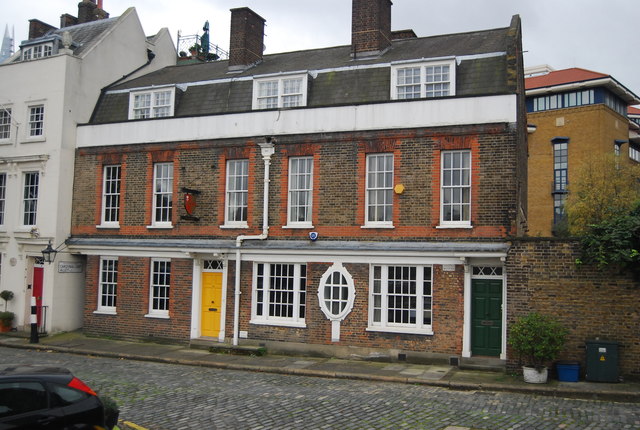
51, 52, Bankside — near Cardinal Cap Alley
Geograph · CC BY-SA 2.0

The alley has been gated since the 1990s, making it inaccessible to the public. Yet the name that marks it on the street sign—Cardinal Cap Alley—still carries the echo of what stood here five centuries ago, and why it mattered enough to Bankside residents that the memory outlasted the building itself.

✦   ✦   ✦
Name Origin

A Brothel Named for a Bishop

The name comes directly from a building: the Cardinal’s Hat, a brothel that operated on the site from the 16th century. Local tradition says it was named because it had been owned by Henry Cardinal Beaufort, the Bishop of Winchester, who had paraded here wearing his red hat after being appointed a cardinal by the Pope. However, this origin story has a fatal flaw in its dating. Cardinal Beaufort died in 1447, and the original Cardinal's Hat was not built till many years later. The site was described in 1470 as ‘a void piece of ground’. It is possible that it was named after Cardinal Wolsey who was Bishop of Winchester from 1529–30, although no buildings are mentioned in a sale of the site in 1533.

What is certain is that John Stow mentions the Cardinal’s Hat brothel in his Survey of London, listing it along with seven other brothels. Until the English Civil War, Bankside was known as a centre for entertainment, its pubs and its brothels, and it is mentioned by Samuel Pepys in his Diary. John Taylor, the water poet, recalls having supper with ‘the players’ at the Cardinal’s Hat on Bankside.

How the name evolved
c. 1500 Cardinal’s Hat
c. 1570 Cardinal’s Cap / Hat Alley
present Cardinal Cap Alley
✦   ✦   ✦
History

From Monastery Ground to Entertainment Hub

Until the time of the Reformation the Abbot of St Mary Overy, which is now Southwark Cathedral, owned a large part of the area of Southwark, and Cardinal Cap Alley undoubtedly had connections with the Abbey. At some point way back in history, certainly long before 1533, the Abbot built a house on the site of the Alley, which, at the dissolution of the monasteries was seized by the Crown. It is not known whether this house remained standing or a new building was erected but shortly after Henry VIII had rid himself of Papal connections the site was taken over by an inn known as the Cardinal’s Hat.

Key Dates
c. 1360
Alley Origins
Cardinal Cap Alley said to date from this period, making it one of Southwark’s oldest surviving public highways.
1470
Vacant Ground
The site is recorded as ‘a void piece of ground’, awaiting redevelopment.
c. 1500–1546
Stew Houses Licensed
The Cardinal’s Hat operates as one of up to twelve licensed brothels on Bankside under royal permission from Henry VII. In 1546, Henry VIII banned all stewhouses by proclamation.
1579
Documented Tenancy
Thomas Mansfield recorded as tenant of the Cardinal’s Hat. The wardens of St Saviour’s church dine at the premises this year.
c. 1710
House Built
No. 49 Bankside, the current Grade II listed building marking the entrance to Cardinal Cap Alley, is constructed in the early 18th century.
1966–1967
Rediscovery
Architectural critic Ian Nairn highlights the alley in his guidebook. The following year it appears in the documentary The London Nobody Knows.
1989
Gated
A swing barrier is installed across the public highway at the northern entrance, eventually followed by a permanent gate.
Did You Know?

Shakespeare refers to the pub in Henry VI Part II. His contemporary and the founder of Dulwich College, the Elizabethan actor Edward Alleyn, also dined at the pub. The alley that bears the pub’s name became a stage for the actors, playwrights, and courtesans of Tudor London without ever hosting a performance.

Bankside, as the southern side of the Thames was called, was outside the jurisdiction of the City of London and was notorious for activities that were frowned upon in the City. Each stew had the name of the establishment painted on the wall facing the Thames, as a form of advertisement or, perhaps, as a two-fingered gesture to the prudes on the other side of the river. The Cardinal’s Hat sat in this landscape of defiance. The brothel itself may have closed after Henry VIII’s 1546 proclamation, though evidence suggests illicit occupation continued. The freehold was sold to Thomas Hudson in 1667. The older part of the present house was built in the early 18th century. It was bought later in the 18th century by the Sells family who lived there until 1830, if not until 1841.

✦   ✦   ✦
✦   ✦   ✦
Culture

Shakespeare and the Stews

For three centuries, the Cardinal’s Hat was embedded in the life of Southwark’s entertainment quarter. Before the house at No 49 was built in the early 18th century, the site was home to the pub known as the Cardinal’s Hat. The establishment straddled the boundary between respectable tavern and illicit house. It was a place where Samuel Pepys might have passed an evening and where the Lord Chamberlain’s Men gathered between performances at the Rose or the original Globe.

Literary Connection
Shakespeare’s Bankside

The Cardinal’s Hat appears in Shakespeare’s Henry VI, Part II, mentioned in the context of the Bishop of Winchester’s hypocrisy. The alley itself stands on land that was part of the Bishop’s fee—he collected rent from the theatres and the brothels alike, a paradox that did not escape the Bard’s notice.

After 1546, when Henry VIII issued his proclamation against the stewhouses, the Cardinal’s Hat persisted as a tavern, a name and a reputation. At one time, Cardinal Cap Alley was freely accessible. In the mid-1970s, it was still an ordinary alley, typical of the many alleys that ran back from the water front, between the houses that faced the river. But Cardinal Cap Alley is now gated.

✦   ✦   ✦
People

Residents and Visitors of Note

The alley and its associated buildings have housed people of interest across five centuries. When the wardens of St Saviour’s dined at this inn in 1579 Thomas Mansfield was in occupation of the tenancy and a few years later Thomas Browker was the owner. Later, Christopher Gibbs, the antiques dealer and ‘King of Chelsea’ (1938–2018), lived at No. 49 at some point in the 1960s. The house continues to be a private residence, its door closed to the public, much as the alley behind it has become.

Most famously, a plaque on No. 49 claims: ‘Here lived Sir Christopher Wren during the building of St Paul’s Cathedral.’ This claim has been thoroughly disputed by historians. The house was built in 1710, eight years after St Paul’s was completed. The plaque itself is likely a 20th-century addition, possibly relocated from an earlier Wren residence demolished in 1906. Yet it remains, a romantic legend layered over the alley’s grittier history.

✦   ✦   ✦
Recent Times

Closure and Preservation

In the mid 1970s the Greater London Council revised the line of the Thames’ bank at Bankside. The work undertaken by the GLC coincided with the decommissioning of Bankside Power Station and accommodated the Jubilee Walkway as well as addressing flood prevention measures for Bankside. This redevelopment set in motion the events that would seal the alley from public access. In 1986, the then owner of No. 49 Bankside (Guy Sebastian Munthe) sold the property to Cardinal Inc and, in 1989, Cardinal purchased a swing barrier and installed it across the public highway at Bankside. Cardinal then presented an adverse possession claim to the Land Registry.

The gating coincided with the Globe’s reconstruction in the 1990s and early 2000s. The Globe filled the other end of Cardinal Cap Alley with rubbish and building materials in 2000s, giving the residents on Bankside Terrace further excuses to keep the gate at the northern entrance. Today, perhaps the few feet that are accessible to the public make this the shortest public street in London. The alley remains, visible only as a narrow opening between terraced houses, its interior forever hidden from casual view.

✦   ✦   ✦
Today

A Hidden Remnant of Bankside

Cardinal Cap Alley is no longer accessible to the public. The architectural critic Ian Nairn highlighted it in his 1966 guidebook to London, and the following year it featured in the documentary The London Nobody Knows, based on the Geoffrey Fletcher book of the same name. Those films preserve the memory of when the alley was open, when visitors could walk its narrow passage and glimpse the Thames at its far end. Today, tourists pass by without knowing what they cannot see.

The street sign remains, marking the alley’s location on the west side of No. 49 Bankside. Beyond the gate, Cardinal Cap Alley and Southwark Deanery are part of a short terrace of houses on Bankside, squeezed between the Globe Theatre to the east and the Tate Modern and the Millennium Bridge to the west. This row of 18th century terraced houses is in a small dip below the terraces of Bankside, and they seem to go unnoticed by the many tourists making their way along the South Bank of the Thames from one site to the next. The alley has become what it always was in essence: a private corridor between the public river and the private homes that face it. Its history, however, belongs to everyone.

10 min walk
Jubilee Gardens
South Bank riverfront green space with plantings and river views, adjacent to County Hall.
8 min walk
St Mary Overie Dock
Riverside garden area facing the Thames, part of the South Bank pedestrian realm.
12 min walk
Potters Fields Park
Small urban park on the riverside, with seating and landscaping overlooking Tower Bridge.
15 min walk
Southwark Park
Larger green space inland, with mature trees, lake, and gardens serving the broader neighbourhood.
✦   ✦   ✦
On the Map

Cardinal Cap Alley Then & Now

National Library of Scotland — Ordnance Survey 6-inch, c. 1888. Hosted by MapTiler. Modern: © OpenStreetMap contributors.

✦   ✦   ✦

Frequently Asked Questions

Why is it called Cardinal Cap Alley?
The alley takes its name from the Cardinal’s Hat, a notable establishment that operated on the site from around the 16th century. Popular tradition attributes the name to Cardinal Henry Beaufort, the Bishop of Winchester, who allegedly paraded here in his cardinal’s robes. However, historical evidence suggests this origin is more legend than fact—Beaufort died in 1447, and the Cardinal’s Hat was not built until many years later. A stronger possibility is that it was named after Cardinal Thomas Wolsey, Bishop of Winchester from 1529–1530, though no direct documentary proof exists. What is certain is that the name has endured from at least the Elizabethan period to the present day.
When was Cardinal Cap Alley first recorded?
The alley itself is said to date back to circa 1360, making it one of Southwark’s oldest surviving public highways. The Cardinal’s Hat establishment first appears in documentary evidence from the 16th century, when it was operating as one of Bankside’s licensed brothels. John Stow’s Survey of London (1598) lists it among the stewhouses of Bankside, and it continued to operate as a tavern and inn well into the 17th century.
What is Cardinal Cap Alley known for?
Cardinal Cap Alley is known as London’s narrowest street, squeezed between Shakespeare’s Globe Theatre and the Tate Modern on Bankside. It is historically significant as one of the oldest surviving alleys in Southwark and a direct survivor of the Tudor entertainment quarter. The alley takes its name from the Cardinal’s Hat, a famous Elizabethan brothel that operated on the site and was documented in John Stow’s Survey of London. Today, it remains gated and inaccessible to the public, making it a visible but unreachable remnant of medieval Bankside history.