Southwark London England About Methodology
Southwark · SE5

Camberwell New Road

Built on ground where Surrey once hanged its criminals, this is believed to be the longest Georgian road in England — every brick of it laid within a single generation after an 1818 Act of Parliament.

Name Meaning
New turnpike to Camberwell
First Recorded
1818 (Act of Parliament)
Borough
Southwark
Character
Georgian & Victorian terrace
Last Updated
Time Walk

Georgia on the A202

The stock-brick terraces lining Camberwell New Road belong to one of the most intact Georgian streetscapes in London. Most were raised in a furious burst of building between 1820 and 1840, while the mortar of the road itself was barely dry. Several groups are listed by Historic England, their original parapet dates still legible in stone: “1825” carved above a cornice, a direct inscription from the builders to anyone who cares to look up.

2008
A202 - Camberwell New Road, SE5
Wikimedia Commons · CC BY-SA 2.0
2016
Footpath beside Camberwell New Road
Wikimedia Commons · CC BY-SA 2.0
2017
Triangle Court, Camberwell New Road frontage, Camberwell, south London
Wikimedia Commons · CC BY-SA 2.0
Today
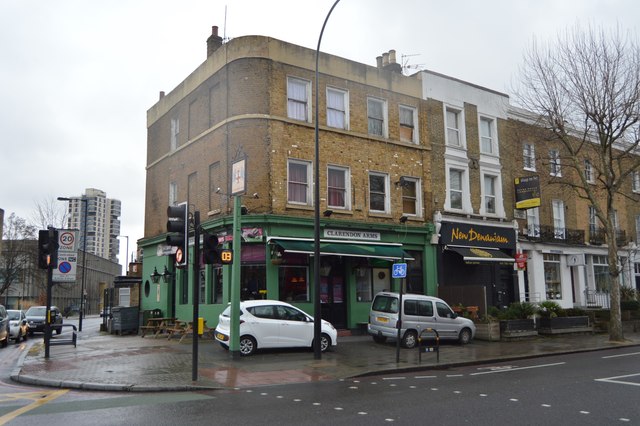
Clarendon Arms — near Camberwell New Road
Geograph · CC BY-SA 2.0

The road now carries the A202, the red-route arterial that threads south London from New Cross Gate to Victoria. Buses, cyclists on Cycle Superhighway 5, and lorries share a road that Regency developers imagined lined with genteel villas. The name itself carries the whole story of how it came to exist — and why it needed the word “New” at all.

✦   ✦   ✦
Name Origin

New Road to an Old Village

The “New” was not modesty — it was a legal distinction. As recorded by British History Online in the Survey of London, the road was authorised as a new turnpike by Act of Parliament in 1818, opening in 1820. An older route, Camberwell Road, already ran parallel to the east; this purpose-built replacement needed a name that separated it from its predecessor. “Camberwell” itself is an ancient Surrey place-name, most likely derived from the Old English cran-burna-wielle — a spring or well frequented by cranes — though the exact etymology remains debated by scholars. The “New Road” designation was a standard Georgian formula applied to dozens of similar turnpike improvements across London, always indicating a purpose-engineered carriageway rather than a widened ancient lane.

On early maps the road appears as The New Road to Camberwell — the full description used in the Act itself, which authorised "a New Road from Kennington Lane to Camberwell Green." The shortened form, Camberwell New Road, came into common use as the road became established and familiar. There was no earlier road on this alignment to shorten its name from; what came before was open common and marsh.

How the name evolved
pre-1818 (open common)
1818–c.1830 The New Road to Camberwell
c.1830–present Camberwell New Road
✦   ✦   ✦
History

From Gallows Common to Georgian Suburb

The land the road crosses was, before 1818, partly Kennington Common — ground where Surrey held its public executions. According to British History Online’s Survey of London, a part of the Common was surrendered specifically for the formation of Camberwell New Road. Scottish Jacobite rebels were hanged at this common in 1746, and when St Mark’s Church was built nearby in 1824, the foundations disturbed the site of the old gibbet — a piece of iron believed to be a swivel from a criminal’s cage was found a foot below the surface.

Key Dates
1746
Gallows Common
Scottish Jacobite rebels executed on Kennington Common, the open ground later cut through by the road.
1818
Act of Parliament
Turnpike road authorised by Act of Parliament; construction begins on the new route to Vauxhall Bridge.
1820
Road Opens
Camberwell New Road opens, providing a direct carriageway from Camberwell northward to Vauxhall Bridge.
1825
First Terraces
Georgian stock-brick terraces begin lining the road; Nos 64–76 dated 1825 on their parapet, now Grade II listed.
c. 1840
Thomas Hood Arrives
Poet and humorist Thomas Hood takes up residence at what is now No. 181, bringing literary prestige to the road.
1862
Railway Station Opens
London, Chatham and Dover Railway opens Camberwell station; renamed Camberwell New Road on 1 May 1863.
1916
Station Closes
Camberwell New Road station closed ‘temporarily’ due to First World War shortages. It never reopened.

The 1818 Act and its associated book of reference — a document listing every affected landowner and tenant along the proposed route — reveal the rural character of the land at the time. The total estimated cost was £12,000: £6,500 for land purchase, £4,500 for construction (forming the carriageway, two footpaths, levelling, gravel, gates and fences), £350 for arching over the South London Water Works aqueduct, and £650 as contingency. Among the landowners were the Prince Regent, as Duke of Cornwall and Lord of the Manor of Kennington, and the Archbishop of Canterbury. The land that would later become the Kia Oval appears in the documents as The Nursery Ground known as The Oval. Every landowner along the route assented to the proposal — and to their share of the £6,500 purchase fund. The route ran from the junction of Harleyford Road with the Vauxhall gyratory, curved around what is now the Oval, then ran in a straight line to Camberwell Green. These details were uncovered by Ray Wells of the Camberwell Society, whose research into the original Act documents is published in Camberwell Quarterly.

“The Act specifies that no person shall play at Football, fly any kite, or trundle any Hoop on the road. Camberwell New Road was, therefore, one of the very first LTNs — a Low Trundelling Neighbourhood.”
Ray Wells, Camberwell Quarterly, on the 1818 Turnpike Act
Did You Know?

Camberwell New Road is believed to be the longest Georgian road in England. Almost its entire length was built within a single twenty-year window after the 1818 Act, giving the streetscape an unusual architectural unity that most London roads — built piecemeal over centuries — simply do not have.

Building came quickly. The Survey of London records that houses on the south side between Vassall and Lothian Roads were erected between 1824 and 1830, with a further run completed before 1840. The flat, low-lying ground north of Coldharbour Lane had not attracted prosperous suburb-seekers before the road existed; the road itself created the demand for housing rather than responding to it. By the time Victoria came to the throne, the terraces were essentially complete.

The railway arrived in 1862. The London, Chatham and Dover Railway opened a station on the viaduct at street level, initially called Camberwell and renamed Camberwell New Road in 1863. It served frequent trains between Moorgate and Victoria. But trams undercut it: electric services drew away passengers, the station dwindled, and wartime economy closed it in April 1916 — “temporarily”, the authorities promised. Studies as recent as 2014 and 2017 have examined reopening it; none has proceeded.

✦   ✦   ✦
Culture

Brick, Butterfly, and the Song of the Shirt

Thomas Hood — poet, parodist, and author of “The Song of the Shirt” — arrived at what is now No. 181 Camberwell New Road towards the close of 1840. As documented by British History Online in Old and New London, Hood brought his family to No. 8, South Place — subsequently renumbered 181 — before moving on to the High Street. He found the neighbourhood lively, amused by the annual fair that still ran riot at Camberwell Green each August. The road in Hood’s time was still suburban enough to feel like countryside at its edges, yet close enough to London to receive the omnibuses that ran constantly past his door.

Grade II Listed Terrace
Nos 64–76 Camberwell New Road: Dated in Stone

The parapet of the terrace at Nos 64–76 carries the date 1825 in its stonework — one of the earliest surviving sections of the road’s original fabric. Listed Grade II by Historic England, each house runs to three storeys and a basement with a stock brick front, stucco frieze, and blocking course. The date in the parapet places the terrace squarely in the first flush of building that followed the road’s opening in 1820.

The Camberwell Beauty butterfly — the area’s adopted symbol — appears on the railway bridge abutment beside Camberwell New Road as a large, vivid mural. The species, Nymphalis antiopa, was first recorded in Britain at Coldharbour Lane in 1748, just before the road existed. Its name long pre-dates the new turnpike; but the mural, painted on the bridge wall that crosses the road, makes the connection unavoidable for anyone passing beneath.

✦   ✦   ✦
People

The Wit Who Lived at Number 181

Thomas Hood (1798–1845) was the road’s most distinguished early resident. Born in London, the son of a Scottish bookseller, he was by 1840 one of the most widely read comic and satirical writers in England. His time at No. 181 Camberwell New Road was brief — he soon moved to the High Street — but his residency gives the road a literary claim that its builders, who imagined prosperous clerks rather than celebrated poets, could not have planned. His “Song of the Shirt,” a protest poem about the conditions of seamstresses, was published in 1843 and became one of the most reprinted works of the Victorian era.

The road also lent its name to a railway station renamed in its honour in May 1863. Before that, the London, Chatham and Dover Railway’s Camberwell station had opened in October 1862 on a viaduct above street level — an early example of urban railway architecture in south London, its signal box at the northern end of the island platform still carrying a Grade II listing of its own.

“The 'busses pass the door constantly, being in the high road, fifty or a hundred yards townwards of the Red Cap, at the Green.”
Thomas Hood, letter from Camberwell, c. 1840 — recorded in Old and New London
✦   ✦   ✦
Recent Times

Red Routes and Reopening Debates

Transport for London designates Camberwell New Road a London Red Route — a primary arterial on which stopping is prohibited in order to maintain traffic flow. The full length forms part of the A202, managed by TfL, which runs from New Cross Gate to Victoria. In 2014, TfL commissioned a feasibility study into reopening the long-closed Camberwell station on the viaduct above the road. The study concluded that an eight- or twelve-car station was technically possible but that no scenario produced a net transport benefit; the project did not advance. A further study in 2017 reached similar conclusions.

Cycle Superhighway 5 runs alongside the road between Kennington and Westminster, providing a largely traffic-free route for cyclists heading north. Sections of the road have been included within a conservation area covering Nos 225–293 and 230–296, protecting the Georgian terrace character that remains largely intact along its length. As reported by SE1 Direct, the wider Southwark and Camberwell corridor continues to attract regeneration interest given its proximity to central London.

✦   ✦   ✦
Today

A Georgian Spine, Still Moving

The road today carries the contradictions of its two centuries intact. The listed terraces — their Greek Doric porches, arched recesses, and anthemion-ornamented iron railings still present in many cases — stand alongside bus shelters and cycle lanes. King’s College Hospital at the Camberwell Green end anchors the road to the medical life of the borough. The railway viaduct still crosses overhead, its arches occupied by workshops and garages, the signal box above them still listed but carrying no trains.

The nearest green spaces offer relief from the road’s density. Burgess Park to the east is south London’s largest open space, a legacy of post-war slum clearance. Kennington Park at the road’s northern end occupies ground that was once Kennington Common, the very land surrendered two centuries ago to build this road.

10 min walk
Burgess Park
South London’s largest park, with a lake, athletics track, and the Butterfly Gates bearing the Camberwell Beauty emblem.
12 min walk
Kennington Park
Victorian park on the former Kennington Common — the execution ground partly surrendered to form the road in 1818.
8 min walk
Camberwell Green
The remnant of the ancient village green, reopened with new Camberwell Beauty butterfly gates in 2016.
15 min walk
Myatt’s Fields Park
Quiet Victorian park in the heart of the Minet Estate, whose history is closely bound with the road’s development.
✦   ✦   ✦
On the Map

Camberwell New Road Then & Now

National Library of Scotland — Ordnance Survey 6-inch, c. 1888. Hosted by MapTiler. Modern: © OpenStreetMap contributors.

✦   ✦   ✦

Frequently Asked Questions

Why is it called Camberwell New Road?
The road takes its name from Camberwell, the ancient Surrey parish it connects to the north, combined with “New Road” — the standard Georgian-era designation for a purpose-built turnpike. It was authorised by Act of Parliament in 1818 and opened in 1820, providing a direct route from Camberwell to Vauxhall Bridge. The “New” distinguished it from the older Camberwell Road running parallel to the east, which already carried the village’s name.
What was on the site before Camberwell New Road was built?
Before the road was laid out in 1818–20, the land was open common and low-lying marshy ground. Part of Kennington Common — used for centuries as the County of Surrey’s place of execution — was surrendered to make way for the new turnpike. Scottish Jacobite rebels were hanged on the common in 1746, and the site of the gallows was encountered again when St Mark’s Church, Kennington, was built in 1824: the foundations disturbed what is believed to have been the gibbet’s iron swivel.
What is Camberwell New Road known for?
Camberwell New Road is believed to be the longest Georgian road in England, its stock-brick terraces raised almost entirely between 1820 and 1840. Several groups are listed by Historic England. The road is part of the A202, one of London’s key cross-south arteries, and carries Cycle Superhighway 5. Poet and humorist Thomas Hood lived at what is now No. 181 in the early 1840s. The road also gave its name to a Victorian railway station that closed in 1916 and has never reopened.