Southwark London England About Methodology
Southwark · SE1 · Rotherhithe

Bergen Square

Named for a Norwegian city whose timber ships once crowded the docks at Rotherhithe—a reminder that this corner of London was, for two centuries, Scandinavia’s most important trading foothold in Britain.

Name Meaning
Bergen (Norse: “mountains”)
First Recorded
c. 1980s (post-docks)
Borough
Southwark
Character
Post-industrial residential
Last Updated
Time Walk

Where Fjords Met the Thames

Bergen Square sits within a neighbourhood that still carries the unmistakable signature of its Scandinavian past. The streets immediately around it bear names from a Norse atlas: Finland Street, Norway Gate, Oslo Square, Helsinki Square. Jamaica Road is just minutes west, and the old dock water—now repurposed as Canada Water—glints a short walk to the east. The square itself is part of the residential landscape that replaced the Surrey Commercial Docks after their closure in 1969.

Historical image not found
Today
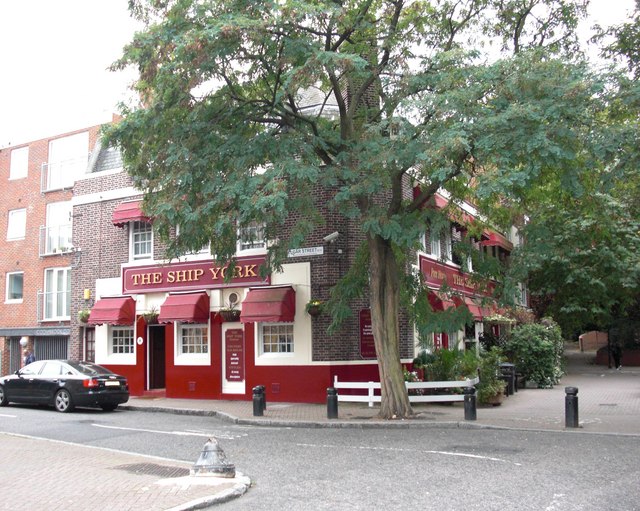
Ship York pub 15-16, Redriff Road, Rotherhithe, London, SE16 — near Bergen Square
Geograph · CC BY-SA 2.0

The docks are gone, but their memory is everywhere in Rotherhithe. As noted by SE1 Direct, the relationship between this part of Southwark and Scandinavia goes far deeper than street names alone—it is embedded in the churches, the community centres, and the very layout of the redeveloped streets. Bergen Square, modest and residential, is part of that deliberate act of toponymic memory. And the name points straight back to Norway.

✦   ✦   ✦
Name Origin

Bergen: A City of Mountains and Merchants

The name Bergen most likely derives from the Norwegian port city of Bergen—itself named from the Old Norse Bjørgvin, meaning “the meadow among the mountains.” Bergen the city was founded c. 1070 and served for centuries as Norway’s principal trading port. Its connection to London’s docklands was direct and commercial: Norwegian timber, arriving in vast quantities at the Surrey Commercial Docks throughout the nineteenth and early twentieth centuries, was the lifeblood of Rotherhithe’s economy. When the dockland was redeveloped from the 1980s onwards, planners named the new streets and squares to reflect that heritage.

The pattern is consistent across the whole neighbourhood. As British History Online records, Rotherhithe was for generations a district defined by its maritime and mercantile identity—a community of seafarers, dock workers, and the trades that served them. The Scandinavian street names are a twentieth-century acknowledgement of a relationship that had been built over two hundred years of trade. Bergen Square sits firmly within that tradition.

How the name evolved
c. 1070 Bjørgvin (Bergen city founded)
19th century Bergen (timber trade association)
c. 1980s Bergen Square
✦   ✦   ✦
History

From Marshland to Timber Empire

The land now occupied by Bergen Square was, for most of its history, industrial water. The Rotherhithe peninsula was originally wet marshland, ill-suited to farming but perfectly placed for docking. The Surrey Commercial Docks—operating in one form or another from 1696 to 1969—gradually transformed the entire area into an extraordinary complex of enclosed water, timber ponds, and warehouses. By the 1870s, as chronicled by MOLA (Museum of London Archaeology) in its investigations of the docklands landscape, the Surrey Commercial Docks were handling over 80% of the Port of London’s timber imports.

Key Dates
1696
Howland Great Dock
The first enclosed dock at Rotherhithe is established, beginning the transformation of the marshland peninsula into a commercial dock complex.
1807
Commercial Dock Company
The newly formed Commercial Dock Company purchases Greenland Dock and begins developing the timber-handling infrastructure that will dominate the peninsula.
1811
Norway Dock opened
Norway Dock is completed—the first of several docks named after the nations supplying Rotherhithe with timber. The Baltic trade now shapes the landscape.
1927
Norwegian Church consecrated
St Olav’s Norwegian Church opens on Albion Street, built to serve the Scandinavian community that had grown around the docks.
1940–45
Norwegian Government-in-Exile
King Haakon VII and the Norwegian Government-in-Exile shelter in Rotherhithe. The King broadcasts to occupied Norway from the Albion Street church.
1969
Docks close
The Surrey Commercial Docks cease operations. Containerisation has made the old dock system redundant, ending nearly three centuries of maritime trade.
1981
LDDC takes over
The London Docklands Development Corporation acquires the former dock land and begins the large-scale residential and commercial redevelopment of Rotherhithe.
c. 1980s–90s
Bergen Square named
Bergen Square is laid out and named as part of the post-docks housing development, joining Finland Street, Norway Gate and Oslo Square in commemorating Rotherhithe’s Scandinavian heritage.
Did You Know?

During the Second World War, Rotherhithe housed the Norwegian Government-in-Exile. King Haakon VII made defiant radio broadcasts to his occupied nation from St Olav’s Norwegian Church on nearby Albion Street—a church that was subsequently awarded Grade II listed status in recognition of its wartime significance.

The timber trade was the engine of this Scandinavian connection. Norwegian softwood arrived at the Surrey docks in such quantities that by the mid-nineteenth century entire ponds and docks were named after the countries supplying them: Norway Dock, Russia Dock, Canada Dock, Quebec Dock. Workers known as “deal porters”—specialists in handling the softwood baulks called deal—developed a distinct and dangerous trade. Some of the Norwegian and Swedish sailors who arrived with the timber cargoes stayed, married, and settled, building a lasting community around their seamen’s missions.

The Second World War devastated Rotherhithe. On 7 September 1940—the first day of the London Blitz—the deal yards of the Surrey Docks were set ablaze, and the fires burned for days. The docks were rebuilt and resumed operation, but the era of containerisation proved fatal: the last vessels left in 1969. The docklands that remained were largely derelict through the 1970s until the London Docklands Development Corporation arrived in 1981. Bergen Square emerged from this redevelopment—a quiet residential address on ground that had once echoed with the sound of timber rafts and Nordic voices.
✦   ✦   ✦
Culture

A Nordic Parish in South London

The Scandinavian presence in Rotherhithe is not merely historical. St Olav’s Norwegian Church on nearby Albion Street—consecrated in 1927 and Grade II listed—still functions as a place of worship and community for Norwegians across London. The Finnish Church, built in 1958, stands beside it on the same street. Both were established originally as seamen’s missions: places where Norwegian and Finnish sailors, arriving with Baltic timber cargoes, could find a congregation, a meal, and a roof. As some of those sailors settled, the churches took on a wider community role that persists to this day. A Scandinavian Christmas market is held annually at the Norwegian Church.

Wartime Sanctuary
St Olav’s Norwegian Church & the Government-in-Exile

After Nazi Germany occupied Norway in April 1940, King Haakon VII and the Norwegian Government fled to London. Rotherhithe became their base, and St Olav’s Church on Albion Street became their spiritual home. Historic England’s listing record for the church notes its exceptional significance as a centre of Norwegian resistance: the King broadcast defiantly to his occupied people from this building throughout the war, and the church was rewarded with listed status in recognition of that role.

The wider cultural imprint of Scandinavia on this part of Rotherhithe is visible in its architecture as much as its nomenclature. Some of the post-docks housing around the former dock basins was designed by Nordic architects—the Greenland Passage development, for instance, was the work of Danish company Kjær & Richter. Bergen Square sits within a streetscape that was, in part, consciously shaped to recall the communities and trade routes that made this peninsula so distinctive.

✦   ✦   ✦
People

Deal Porters and Exiled Kings

Bergen Square has no single individual attached to its naming—it commemorates a city and a trade, not a person. But the wider community it belongs to produced extraordinary figures. King Haakon VII of Norway became one of the most famous residents of wartime Rotherhithe, making radio broadcasts from St Olav’s Church that sustained Norwegian morale under occupation. Thomas Coram, the philanthropic sea captain who campaigned for the founding of London’s Foundling Hospital, retired to Rotherhithe after a lifetime at sea. The actor Michael Caine was born Maurice Joseph Micklewhite in Rotherhithe in 1933.

“The region has a spaciousness and an atmosphere such as no other London dock area can equal.”
A.G. Linney, Peepshow of the Port of London (1929)

Less celebrated but equally central to the story of this neighbourhood were the deal porters: specialist dock workers who handled the softwood baulks arriving from Norway, Sweden and the Baltic. The work was dangerous and demanding—timber baulks were heavy, unstable, and often handled from rafts on open water. These men, many of them the sons and grandsons of earlier dockers, defined the daily life of the streets around what is now Bergen Square for the better part of two centuries.

✦   ✦   ✦
Recent Times

The Docklands Reborn

Bergen Square took its current form as part of the sweeping post-docks regeneration that transformed Rotherhithe from the 1980s onwards. The London Docklands Development Corporation acquired the former dock estate in 1981, and over the following two decades the filled-in basins and cleared wharves became residential streets and housing estates. The Jubilee line arrived at Canada Water in 1999, and the London Overground extended through Rotherhithe in 2010—ending the relative isolation that had kept the area unfashionable despite its proximity to the City.

Southwark Council and the Greater London Authority have since announced a further large-scale regeneration project centred on Canada Water, proposing thousands of additional homes, a new high street, and improved green space across the peninsula over the coming decades. Bergen Square sits within a neighbourhood still in active transformation—its post-docks housing now itself approaching middle age, surrounded by new development pushing the area’s character further upmarket.

✦   ✦   ✦
Today

Green Water and Nordic Echoes

Bergen Square is a quiet residential address in Rotherhithe, surrounded by the post-docks housing and waterside paths that now define the peninsula. Canada Water—the former dock basin retained as an ornamental lake and transport hub—is minutes away. The Norwegian and Finnish churches on Albion Street remain active. And the Scandinavian Christmas market returns each year to the garden of St Olav’s, drawing a neighbourhood that still feels, in places, more Nordic than English.

5 min walk
Russia Dock Woodland
A 9-acre woodland on the filled-in site of Russia Dock, with wetland habitats and a rich understorey. One of Rotherhithe’s most biodiverse green spaces.
8 min walk
Stave Hill Ecological Park
A 5.2-acre nature area on the site of Stave Dock, topped by a conical hill with panoramic views across the former docklands landscape.
10 min walk
Southwark Park
Opened in 1869, this 63-acre park has a boating lake, bandstand, bowling green, and gallery—and the hill formed from Thames Tunnel spoil at its eastern edge.
12 min walk
Greenland Dock
The last surviving large dock basin from the Surrey Commercial Docks complex, now a water sports centre and marina, with houseboats moored along its quays.

The name Bergen Square rewards the attentive visitor willing to read the landscape around it. Finland Street lies to the east, Norway Gate to the south, Oslo Square nearby. Each name is a fragment of a two-hundred-year commercial relationship—one that brought Norwegian sailors to Rotherhithe, left a church and a community in their wake, and sheltered a king in exile when his country needed it most. A street name is rarely just a label. Here, it is a memorial.

✦   ✦   ✦
On the Map

Bergen Square Then & Now

National Library of Scotland — Ordnance Survey 6-inch, c. 1888. Hosted by MapTiler. Modern: © OpenStreetMap contributors.

✦   ✦   ✦

Frequently Asked Questions

Why is it called Bergen Square?
Bergen Square most likely takes its name from Bergen, the major port city on the west coast of Norway. Rotherhithe’s Surrey Commercial Docks traded heavily with Scandinavia and the Baltic throughout the nineteenth and early twentieth centuries, handling vast quantities of Norwegian timber. When the former dock land was redeveloped from the 1980s onwards, streets and squares were named to reflect this Scandinavian heritage — a pattern found across the neighbourhood in names such as Finland Street, Norway Gate, Helsinki Square and Oslo Square. Bergen in Norwegian derives from Old Norse meaning “the mountains” or “the meadow among the mountains.”
What was the Surrey Commercial Docks and how does it relate to Bergen Square?
The Surrey Commercial Docks were a large group of enclosed docks and timber ponds in Rotherhithe that operated from 1696 to 1969. By the 1870s they handled over 80% of the Port of London’s timber imports, with enormous quantities arriving from Norway, Sweden, Finland, Russia and Canada. Individual docks and ponds were named after the nations supplying them — Norway Dock, Russia Dock, Canada Dock, Quebec Dock. Bergen Square was laid out on land that formed part of this former dockland estate during the residential redevelopment of the 1980s and 1990s, and its name continues that tradition of Scandinavian commemoration.
What is Bergen Square known for?
Bergen Square is known as part of Rotherhithe’s post-docks residential landscape, sitting within a neighbourhood whose street names — Finland Street, Norway Gate, Helsinki Square — reflect centuries of Scandinavian maritime trade. The wider area housed the Norwegian Government-in-Exile during the Second World War, and St Olav’s Norwegian Church on nearby Albion Street remains active, complete with an annual Scandinavian Christmas market. The square sits close to Russia Dock Woodland, Stave Hill Ecological Park, and the retained waters of Greenland Dock — all reminders of the extraordinary dock system that shaped this peninsula.