Southwark London England About Methodology
The Borough · SE1

Angel Place

A narrow passage whose history is written in its surviving prison wall—Angel Place once held the notorious Marshalsea, where hundreds were imprisoned for debt.

Named After
Angel Inn
Character
Passage
Borough
Southwark
Last Updated
Time Walk

From Prison Boundary to Passage

Angel Place is a long, narrow alleyway connecting the present residential area of Tennis Street at its east end with the historic Borough High Street at the western end. The passage has little traffic today—mostly foot traffic connecting the Borough neighbourhood with the library and local archive.

2007
Angel Place Southwark
Wikimedia Commons · CC BY-SA 2.0
2010
Angel Place
Angel Place
Wikimedia Commons · CC BY-SA 2.0
Historical image not found
Today
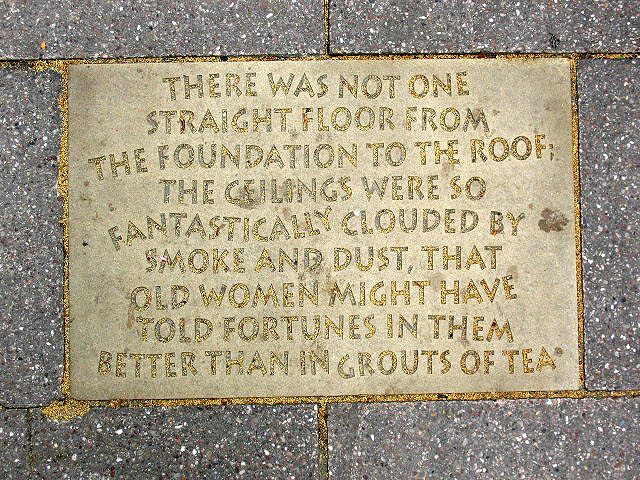
Inscription in Angel Place (2)
Geograph · CC BY-SA 2.0

But this quiet alley carries the weight of one of London’s darkest chapters. Angel Place was the site of the Marshalsea Prison between 1811 and 1842. The prison site is now occupied by the library and local studies centre though the boundary wall remains. That surviving wall is the most visible reminder of what happened here during the 19th century—and the name itself points to something far older.

✦   ✦   ✦
Name Origin

The Sign That Stayed

Angel Place was formerly Angel Alley and is named after a former inn here of this name. The name carries no religious meaning—it is simply the legacy of a tavern that stood in this location. Like many London lanes, the street inherited the sign of its most prominent building and kept it even after the inn itself had vanished. The earlier forms—Angel Alley and Angel Court—show how the name evolved as the street’s character changed from residential lane to prison complex and eventually to the passage it is today.

The word “Angel” itself comes from the Latin angelus, meaning messenger, but in this context it was purely a business matter. Inns adopted such names to be memorable to travellers and to signal respectable hospitality. The Angel’s sign hung here for long enough that when the building was gone, the name remained—a ghost sign outlasting the ghost inn.

How the name evolved
Pre-1811 Angel Alley / Angel Court
1811 onwards Angel Place
✦   ✦   ✦
History

Prison, Walls, and Memory

The Angel Place we know today took shape in 1811, when the Marshalsea Prison was relocated to this site between 1811 and 1842. This was the second building to bear the Marshalsea name—the first prison had stood on Borough High Street itself since the 14th century. The new building replaced a structure that had grown increasingly unstable and overcrowded. By moving south, the authorities hoped to separate the prison from the busy commercial heart of the borough, though this brought it no closer to reform.

Key Dates
Pre-1811
Angel Alley
A residential lane named after a local inn, part of the gradual growth of Southwark beyond the high street.
1811
Marshalsea Relocated
The second Marshalsea Prison opened on this site, housing debtors and those accused of crimes at sea under the jurisdiction of the Knight Marshal.
1842
Prison Closes
The Marshalsea closed permanently. The building was demolished in stages; parts were repurposed as shops and accommodation into the 20th century.
20th cent.
Redevelopment
The site underwent gradual redevelopment. John Harvard Library was eventually built on the former prison grounds, with the boundary wall preserved as a historical marker.
Did You Know?

The local history library had its public entrance in Angel Place as before its renovation. A library devoted to Southwark’s local history stood where a prison once held hundreds of the borough’s poorest residents—a symbolic closure to one chapter and opening of another.

The Marshalsea’s thirty years on this site represented the final phase of a prison system increasingly seen as barbaric and economically indefensible. The transition from inn-lined lane to prison compound to library passage reflects Southwark’s own transformation—from a place of transit and hospitality to one of confinement and poverty, and eventually to heritage and remembrance. The boundary wall remains, the only structure from the prison era still standing, a tangible link to the suffering that took place within.

✦   ✦   ✦
Culture

The Wall That Speaks

Surviving Prison Boundary
The Marshalsea Wall

The prison site is now occupied by the library and local studies centre though the boundary wall remains. This long brick wall, running along Angel Place, is the physical remnant of the Marshalsea’s southern perimeter. It stands not as a monument but as archaeology—a wall that once divided confinement from freedom, poverty from the borough beyond.

Angel Place today functions as a cultural gateway. At the corner of Angel Place there is a new display of archaeological finds from Roman Southwark held by the Cuming Museum collection, including the statue of a Roman Warrior God found in the crypt of Southwark Cathedral in 1977. The passage thus connects two historical narratives—Roman Southwark and the Victorian prison era—in a single walk from Borough High Street to the library’s main entrance.

📖 Literature
Little Dorrit
Charles Dickens · 1855-1857
Set partly at Marshalsea Prison; Dickens visited Angel Court (now Place) in 1857.
✦   ✦   ✦
Today

A Passage Remembered

Angel Place remains what it has been since the 1840s—a passage rather than a street, a connection rather than a destination. It is narrow, quiet, and easily overlooked. Yet every visitor to John Harvard Library or the local studies centre walks through or past it, and the surviving wall is visible from multiple angles, a constant presence that insists on remembrance.

The street’s character is defined by its relationship to what came before. The passage itself, the wall, the library building—all are part of a continuous site. For those who know the history, the name “Angel Place” carries irony. No angels stood guard at the Marshalsea; the name is simply that of a long-vanished inn. Yet today, in its quiet functionality and in the care taken to preserve the wall, Angel Place serves as a kind of memorial—not to the inn, but to the thousands of ordinary people whose names are forgotten, imprisoned here for the crime of debt.

5 min walk
Borough Market
Historic food market and public space on Borough High Street, busiest at weekends.
8 min walk
Potters Fields Park
Riverside green space with views of Tower Bridge and London Bridge, dog-friendly.
10 min walk
Jubilee Gardens
Open parkland on the Thames Path, south side of London Bridge.
12 min walk
Southwark Park
Large green space in Bermondsey with sports facilities, playgrounds, and tree-lined avenues.
✦   ✦   ✦
On the Map

Angel Place Then & Now

National Library of Scotland — Ordnance Survey 6-inch, c. 1888. Hosted by MapTiler. Modern: © OpenStreetMap contributors.

✦   ✦   ✦

Frequently Asked Questions

Why is it called Angel Place?
Angel Place takes its name from a former inn that once stood in this location. The street was previously known as Angel Alley and Angel Court before adopting its current name. The name appears to derive directly from the inn's sign rather than any religious or spiritual significance—a common pattern in London street naming where lanes inherited the names of their most prominent buildings.
What happened at Angel Place during the 19th century?
Between 1811 and 1842, Angel Place was the site of the second Marshalsea Prison, one of London's most notorious debtors' prisons. The prison held hundreds of inmates, many imprisoned for trivial debts. The surviving boundary wall still stands today, a physical reminder of the suffering that took place within. The prison closed permanently in 1842, and the site was eventually redeveloped for public use, including the building of John Harvard Library.
What is Angel Place known for today?
Angel Place is a narrow passage connecting Borough High Street with Tennis Street, functioning primarily as a pedestrian route to John Harvard Library and Southwark's local studies centre. It is chiefly known for its connection to the former Marshalsea Prison site and the surviving boundary wall, which remains visible and serves as a historical marker. The passage also features archaeological displays relating to Roman Southwark, making it a point of historical interest for visitors to the borough.