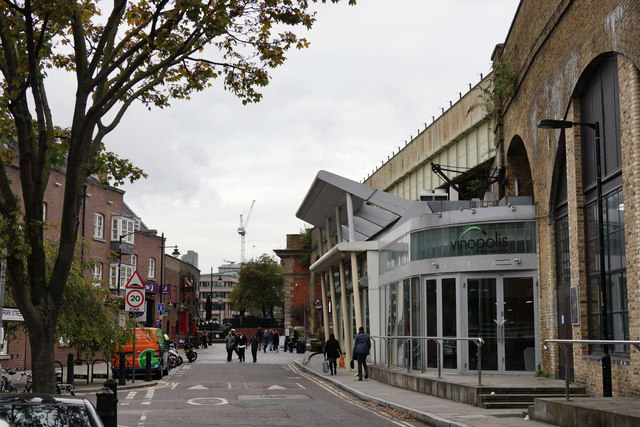
Before the brewery, this ground belonged to the theatre. The site between Deadman’s Place and Globe Alley — now the footprint of Anchor Street and the surrounding block — formed part of the estate owned by Sir Matthew Brend that included the Globe Playhouse itself. It was a few years after the first Globe burned down in 1613 that James Monger, a citizen and cloth-worker of London, started a brewhouse on the adjoining land. British History Online’s Survey of London records that this site was formally leased to Monger in 1620 and first appears in the Token Books in 1634.
1613
Globe Burns
The first Globe Theatre, with its thatched roof, is destroyed by fire — clearing the site for the brewhouse to come.
1620
Monger’s Lease
James Monger leases the land between Deadman’s Place and Globe Alley from Sir John Bodley to establish his brewhouse.
1665
Childs Names the Anchor
Josiah Childs takes ownership; his naval supply business most likely gives the brewery — and eventually the street — its distinctive name.
1676
Great Fire of Southwark
A catastrophic fire on 26 May destroys nearly 500 houses across Bankside in 20 hours, devastating the neighbourhood around the brewery.
1787
Barclay & Perkins
Robert Barclay and John Perkins purchase the brewery from the Thrale estate; their partnership turns it into one of London’s largest industrial operations.
1834
Anchor Terrace Built
Eight terraced houses are erected for senior brewery employees on Southwark Bridge Road; beneath their car park lie the foundations of the original Globe.
1981
Brewery Closes
After more than 350 years of continuous brewing on the site, the Anchor Brewery (by then part of Courage) ceases production. The buildings are subsequently demolished.
Did You Know?
In September 1666, diarist Samuel Pepys took refuge in a small alehouse on Bankside — widely identified with the Anchor’s site, yards from today’s Anchor Street — and from there watched the Great Fire of London consume the City across the Thames.
The brewery changed hands several times through the eighteenth century. Henry Thrale, MP and brewer, acquired it in 1764 and became a friend and patron of Dr Samuel Johnson, who was a frequent visitor to the Bankside premises. When Thrale died in 1781, his wife Hester oversaw the sale of the brewery to Robert Barclay and John Perkins for £135,000 — a sum then considered remarkable. Under Barclay Perkins, the enterprise expanded to become one of the largest in the world, drawing over fifty thousand visitors in a single year by the mid-Victorian period.
The neighbourhood around Anchor Street bears visible traces of this industrial past. MOLA (Museum of London Archaeology) has been involved in investigations across the Bankside area, and it was archaeological work that confirmed in 1989 that the car park behind Anchor Terrace — the 1834 building named for the brewery — overlies the foundations of the original Globe Theatre itself. Because Anchor Terrace holds Grade II listed status, full excavation has never been possible, meaning the most celebrated archaeological find of this entire block remains largely underground.