Peckham spent much of its history feeding London rather than housing it. As recorded by British History Online, the area maintained extensive market gardens and orchards supplying the capital’s markets well into the 18th century, producing melons, figs and grapes for nearby London. The land around what is now Albert Way formed part of this productive hinterland—fields and smallholdings that stretched south of the old village centre and yielded steadily to brick and mortar as the century turned.
1805
Albert Way born
Albert Way FSA born in Bath, Somerset, on 23 June 1805 — the man after whom the street is most likely named.
1828
Cambridge friendship
Way at Trinity College, Cambridge alongside Charles Darwin. The two were close friends; Way encouraged Darwin’s insect collecting.
1839
Fellow of Antiquaries
Way elected Fellow of the Society of Antiquaries of London; became its Director in 1842.
1843
Camden Society edition
First volume of Way’s edition of the Promptorium Parvulorum published for the Camden Society — his principal scholarly work.
1845
RAI founded
Way founds the Archaeological Institute (later the Royal Archaeological Institute) as a rival to the British Archaeological Association.
1874
Way dies
Albert Way dies at Cannes, France, on 22 March 1874. His widow presents 150 volumes of dictionaries and a collection of medieval seal impressions to the Society of Antiquaries.
c. 1880s
Street laid out
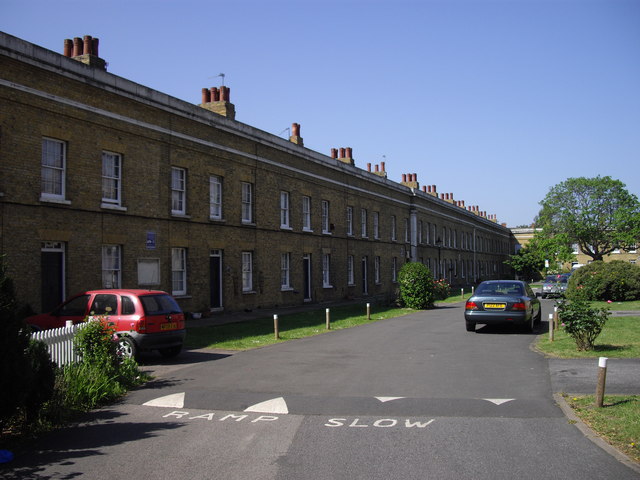
Albert Way most likely laid out during Peckham’s rapid Victorian suburban expansion, when Peckham’s market gardens were giving way to terraced housing.
1965
Southwark created
The Metropolitan Borough of Camberwell (which had administered Peckham) was abolished; the area fell within the newly created London Borough of Southwark.
Did You Know?
Albert Way coined the term “palimpsest brass” in a paper published in Archaeologia in 1844 — a term still used today by archaeologists and historians to describe engraved memorial brasses that have been reused or re-engraved over an earlier inscription.
The Victorian suburbanisation that created Albert Way came in waves. Peckham had served as both a stopping-point for cattle drovers heading to London and a resort for wealthier Londoners seeking the countryside. By the 1860s the railway had arrived, making the district accessible to a new class of commuter. SE1 Direct’s coverage of Southwark’s neighbourhood histories reflects how these Victorian expansion years permanently remade south London’s suburban character.
The land archaeology of Peckham’s Victorian build-out has been studied by MOLA (Museum of London Archaeology), whose excavations across Southwark have documented the transition from agricultural to residential use throughout the borough. Earlier Roman occupation has been detected in the Peckham area, though the identity of the specific settlement is lost. The streets laid out in the 1870s and 1880s—Albert Way among them—sit atop a landscape that had already been farmed, grazed, and market-gardened for many centuries before the first brick terrace rose.