Lambeth London England About Methodology
Lambeth · SE24

Sunray Avenue

Built on a Georgian mansion’s grounds, this cottage estate was named after the gardens that preserved its legacy—a monument to postwar hope.

Name Meaning
Ray of Light
First Recorded
c. 1920s
Borough
Lambeth
Character
Garden Suburb
Last Updated
Time Walk

The Street Over Time

2018
Sunray Avenue
Sunray Avenue
Wikimedia Commons · CC BY-SA 2.0
Today
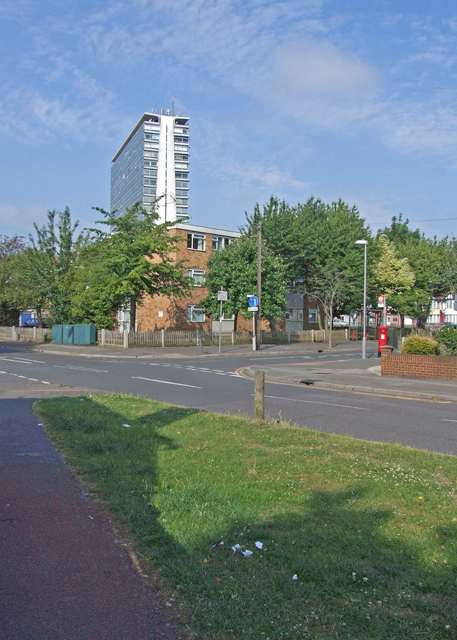
Barnsbury Lane — near Sunray Avenue
Geograph · CC BY-SA 2.0
Today

Cottage Terraces and Garden Spaces

Sunray Avenue preserves the form and character of a 1920s garden suburb. The street runs through a carefully planned estate of tile-hung cottages and short terraces, arranged around wide verges planted with mature trees and generous communal green spaces. Unlike the dense Victorian terraces that dominate much of south London, Sunray Avenue reflects an aspirational moment when postwar housing policy embraced open air, light, and the garden city ideal.

The buildings retain many original details—curved tile work on chimneys, timber picket fencing, and broad bay windows. What makes this avenue distinctive is not the individual houses but their collective arrangement: a planned landscape rather than incremental street growth. The Dulwich Estate controlled the design, and this shows in the estate’s spatial cohesion and its preservation of trees. That cohesion comes from a deliberate choice to name the place after something beautiful.

✦   ✦   ✦
Name Origin

From Casino to Sunray

The estate lies on the south slopes of Herne Hill, which is one of the most celebrated estates of the ‘Homes for Heroes’ campaign following WWI. By 1920 Casina was empty and the Dulwich Estate released the land to Camberwell Borough Council for much needed social housing. A clause in the plans enabled an area of open space to be preserved for recreational purposes and the area around the lake was chosen and laid out, initially called Casino Open Space, renamed Sunray Gardens in 1923. The street itself derives its name from this garden space—Sunray Gardens—which in turn took its name from the newly opened park. The name “Sunray” carried symbolic weight: it evoked brightness and renewal after the devastation of the First World War.

The word “ray” dates to the early modern period, while “sunray” as a poetic compound became established in the nineteenth century. The choice to name a public garden “Sunray” rather than retain “Casino” reflected the values of the age—an emphasis on light, hope, and the democratization of leisure, not gambling or aristocratic pleasure. The street inherited this hopeful nomenclature.

How the name evolved
c. 1796–1906 Casina (the house)
1920–1923 Casino Open Space
1923 onwards Sunray Avenue
✦   ✦   ✦
History

From Repton’s Landscape to Postwar Housing

Sunray Gardens is a remnant of the landscaped grounds of Casina, a late eighteenth-century house on the Dulwich Estate. The grounds were designed by Humphry Repton, including a large lake that survives as the sole remnant from the earlier landscape. Casina was built by the architect John Nash in 1796 for Richard Shawe, a lawyer to Warren Hastings. Other residents of the Casina estate included Joseph Buonaparte, Napoleon’s brother, and from 1875 it was the home of William Stone, MP for Portsmouth, a garden enthusiast who allowed the Surrey Horticultural Society Flower Show to take place in the grounds.

Key Dates
1796
Casina Built
John Nash designs Casina House for Richard Shawe on the Dulwich Estate.
1875
Stone Residency
William Stone, MP for Portsmouth, takes residence and hosts Surrey Horticultural Society shows.
1906
Casina Demolished
The mansion is demolished; its grounds lie empty.
1920
Homes for Heroes
Camberwell Borough Council acquires the land from the Dulwich Estate for postwar housing.
1923–1935
Estate Built
Sunray Estate constructed as garden suburb. Streets including Sunray Avenue nearing completion by 1935.
1923
Gardens Renamed
Casino Open Space officially renamed Sunray Gardens.
Did You Know?

When Repton’s lake was transformed into the public park, a small girl fell in and was luckily rescued by a local postman; the lake was then made more shallow and given shelving banks as a safety measure.

The estate developed after 1920 as one of London’s earliest “Homes for Heroes” schemes, built to house returning soldiers from World War I. Woodland Way, Sunray Avenue and Vincent Avenue were nearing completion by the end of 1935. The estate was laid out using “garden suburb” principles which involved a planned layout around generous green spaces. Unlike the traditional Victorian street terraces, this estate embodied new thinking about working-class housing: light, air, and communal greenery rather than density and profit.

The Friends of Sunray Gardens was formed in 1997 to preserve the park and Sunray Gardens was refurbished in 2001. Today the pond from Repton’s original design remains, ducks still visit, and the mature trees frame the estate—a rare survival from the Georgian landscape beneath layers of twentieth-century housing.

✦   ✦   ✦
Character & Culture

A Model Estate

Sunray Avenue embodies the “garden suburb” aesthetic that emerged in early twentieth-century Britain, inspired by Ebenezer Howard’s ideas about planned, humane communities. The Sunray Estate was one of the first municipal applications of these principles after the First World War. Unlike later estates built with economy in mind, Sunray retained qualities that earned it recognition as a distinctly planned community: the coherence of design, the survival of front boundaries and hedges, the proportion of space to building.

Architectural Heritage
Tile-Hung Cottages & Curved Chimneys

The buildings retain distinctive detailing from the 1920s–30s: tile-hanging on facades, curved clay-tile chimneys with decorative details, timber picket fencing, and broad bay windows. These domestic elements gave the estate a cottage character—aspirational hominess for working families rather than institutional housing.

The estate preserves the lake from Humphry Repton’s original landscape design for Casina (c. 1796). This remnant, now within Sunray Gardens, is one of the most direct continuities between the Georgian estate and the postwar suburb. The water feature anchors the public realm and connects residents to a history most will never know.

✦   ✦   ✦
Notable People

Residents & Legacy

The estate was designed for returning soldiers and their families, but the historical record on individual residents is sparse. The gardens and park, rather than the street itself, are more extensively documented. Two notable figures connected to the broader SE24 postcode area bear mention: Richard Church (1893–1972), writer and poet, lived here as a teenager and went to school locally. He published his first poem in 1917 and wrote no less than 16 novels and three volumes of autobiography over a career which spanned more than 50 years. Church’s presence in Herne Hill during his formative years places him near the Sunray Estate during its construction period.

The estate itself commemorates the many unknown soldiers for whom it was built. No single figure dominates the street’s narrative; instead, Sunray Avenue represents a collective endeavour to provide decent housing to those who had served. The street’s name memorializes not a person but an ideal: the brightness and renewal promised to a generation returning from war.

✦   ✦   ✦
Recent Times

Preservation & Change

The Sunray Estate has undergone selective modernization over the decades while retaining its essential character. The late twentieth century saw pressure on the original green boundaries as residents added driveways and removed front walls for parking. Yet amazingly the hedges have survived and the front gardens have not been lost to parking to a notable degree, particularly on Sunray Avenue itself. Many householders have chosen to respect the original planning philosophy, retaining verges and trees even as adjacent areas intensified.

The refurbishment of Sunray Gardens in 2001 marked a renewed commitment to the public realm. The Friends of Sunray Gardens, established in 1997, has stewarded the park and its historic lake. The street remains sought-after by families drawn to its garden-suburb character and its trees, and property values reflect the estate’s enduring appeal. In a borough increasingly defined by modernist housing and urban intensification, Sunray Avenue preserves a quieter, more spacious vision of London living.

✦   ✦   ✦
Today

A Leafy Quarter

Sunray Avenue today is a quiet residential street in the North Dulwich Triangle, one of south London’s most desirable neighbourhoods. Victorian conversion flats and family homes dominate the postcode, but Sunray Avenue itself remains defined by the 1920s–30s cottage terraces and the broad treatment of street space. The proximity to North Dulwich railway station (roughly 10–15 minutes’ walk) has made the area accessible to commuters, yet the estate’s design insulates it from traffic: there is no through-route to neighbouring areas, a deliberate planning choice that preserves tranquility.

Sunray Gardens, the public park from which the street takes its name, remains a focal point. The lake at its heart draws families and wildlife. Mature oaks, chestnuts, and other trees planted in the 1920s–30s are now over a century old and define the quarter’s character. The street itself is lined with these trees, and residents and visitors continue to value the spaciousness and greenery that the Camberwell Borough Council and the Dulwich Estate agreed to preserve over a century ago.

5 min walk
Sunray Gardens
Historic park with Repton-designed lake, mature trees, and open spaces. Central to the estate’s character.
10 min walk
Brockwell Park
122-acre Victorian park with woodland, historic temple, and views across south London.
12 min walk
Dulwich Park
Grade II listed landscape garden with lake, woodland, and open grassland.
Local flora
Mature Street Trees
Original plantings from the 1920s–30s estate remain; oaks, chestnuts, and other species define the boulevard effect.
✦   ✦   ✦
On the Map

Sunray Avenue Then & Now

National Library of Scotland — Ordnance Survey 6-inch, c. 1888. Hosted by MapTiler. Modern: © OpenStreetMap contributors.

✦   ✦   ✦

Frequently Asked Questions

Why is it called Sunray Avenue?
Sunray Avenue takes its name from Sunray Gardens, a public park created within the estate in the 1920s. The gardens were originally called Casino Open Space (after the former mansion) but were renamed Sunray Gardens in 1923, evoking brightness and renewal after World War I. The street inherited this hopeful name from the park.
What does the Sunray Estate commemorate?
The Sunray Estate was one of London’s first “Homes for Heroes” housing developments, built immediately after World War I by Camberwell Borough Council to provide decent housing for returning soldiers and their families. It exemplifies the garden suburb ideal of planned, spacious, humanely-scaled communities with generous green space.
What is Sunray Avenue known for?
Sunray Avenue is known for its 1920s–30s cottage terraces, mature trees, and preservation of the garden suburb aesthetic. The street is part of a distinctly planned estate that retains many original period features—tile-hung facades, decorative chimneys, timber fencing—and benefits from generous verges and communal green spaces. It remains one of south London’s most sought-after residential neighbourhoods, valued for its greenery and tranquility.