Lambeth London England About Methodology
Hanwell · SW9

Electric Avenue

The world’s first market street lit by electricity—a Victorian innovation born from engineering brilliance and remembered by a global hit song.

Named For
Electric Lighting
Built
1888
Borough
Lambeth
Character
Market Street
Last Updated
Time Walk

A Neon Sign Over a Market

Electric Avenue is a street in Brixton, London, built in 1888, and was the first market street to be lit by electric lights. Today it remains a pedestrianised shopping street at the heart of Brixton’s market, where national retail chains sit alongside various local food and housewares retailers, and the street hosts part of Brixton Market, which specialises in selling African, Caribbean, South American, and South Asian products.

1895
Electric Avenue by Baron Corvo, The Sketch, 1895
Wikimedia Commons · Public domain
2009
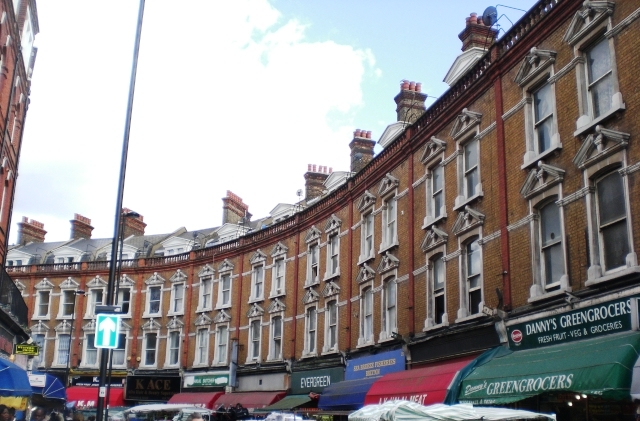
Electric Avenue SW9
Electric Avenue SW9
Wikimedia Commons · CC BY-SA 2.0
Historical image not found
Today
B452 — near Electric Avenue
Geograph · CC BY-SA 2.0

Electric Avenue is a pedestrian street in the heart of Brixton's shopping district, and at night, a multicolored neon sign hangs over the street, alerting passersby to its existence. But the neon is modern embellishment; the street’s real fame comes from an act of inspiration born from civil unrest.

✦   ✦   ✦
Name Origin

Light Without Fire

This road was the first market street in the world to be lit by electricity in the late 1800s—hence its name. The innovation was the work of Alexander Leslie Fyfe and John Martin, who patented the lighting system that lit up the street, using a coal-fired generator behind one of the shops. Together as the Fyfe-Main Electric Lighting and Construction Company, they had exhibited the lighting system at Crystal Palace in 1882.

The street was the first electrified market in the country with the lamps suspended from the sweeping glazed cast-iron and glass canopies over the pavements in front of the shops. Visitors came to Brixton as much for the sight of those glowing canopies as for the goods sold beneath them. The area became a popular shopping destination due to the lights and covered iron canopy but also the array of shops—including London's first department store: Bon Marché on Brixton Road—and street entertainers.

How the name evolved
1888 Electric Avenue
1910s The Electric
present Electric Avenue
✦   ✦   ✦
History

From Gas to Glory to Ghosts

Brixton Market began in the 1870s as the area was becoming one of London's rapidly expanding Victorian middle-class suburbs following the railway station opening in 1862. When Electric Avenue opened with its electric lights in 1888, the street transformed into a shopping destination that drew crowds across London. Electric Avenue was once a noted shopping destination, famous across London. With its nearby large department stores of Bon Marche and rival drapery store Quin & Axtens complementing the sheltered walkways of Electric Avenue, Brixton was the place to go for shopping, and was reputedly known as the 'Oxford Street of the south' right up until the immediate post-war era.

Key Dates
1862
Railway Station
Brixton station opens, triggering suburban expansion and the emergence of the market district.
1882
Crystal Palace Demo
Fyfe-Main Electric Lighting Company exhibits their lighting system at Crystal Palace exhibition.
1888
Electric Avenue Opens
The first market street in Britain to be lit by electricity opens, with cast-iron canopies protecting the lamps and shopfronts.
1940–45
War Damage
World War II bombing damages sections of the Victorian canopy structure. Post-war neglect follows.
1981
Brixton Riot
Civil unrest erupts in Brixton over racism and policing, events that inspire Eddy Grant's songwriting.
1982–83
Eddy Grant's Hit
"Electric Avenue" released and becomes a global smash, reaching No. 2 in UK and US charts.
1989
Canopies Removed
The last Victorian canopies come down. Lambeth Council's plan to replace them proves unaffordable.
Did You Know?

The street was home to London's first department store, Bon Marché, on nearby Brixton Road. Electric Avenue’s neighbours, the rival drapery house Quin & Axtens, made the district the shopping mecca of South London in the Victorian and Edwardian eras.

World War II took its toll, with war damage leaving the street neglected. Later, the introduction of street traders' barrows wore away at the remaining gloss. The last of the canopies was removed in 1989, and Lambeth Council had intended to replace them but miscalculated the costs. What remained was a ghost of Victorian elegance, used by fewer shoppers and remembered by fewer Londoners—until one song changed everything.

✦   ✦   ✦
Culture

A Song That Ignited a Street

Electric Avenue is a song by Guyanese-British musician Eddy Grant, written and produced by Grant, and released on his 1982 studio album Killer on the Rampage. Grant first became aware of the existence of the street during a stint acting at the Black Theatre of Brixton. At the beginning of the 1980s, tensions over unemployment, racism and poverty exacerbated by racist policing culminated in the street events now known as the 1981 Brixton riot. Horrified by what he witnessed, Grant returned to Barbados and wrote "Electric Avenue" as a response to the violence and the conditions that sparked it.

Global Chart Success
Eddy Grant's "Electric Avenue"

Grant initially released it as a single in 1983, and it reached No. 2 on the UK Singles Chart. In the US, it spent five weeks at number two on Billboard magazine's Hot 100 chart and hit number one on Cash Box magazine's chart.

The song brought Electric Avenue to international consciousness—not as a shopping destination, but as a symbol of struggle and resilience. In 2016, Eddy Grant was invited to switch on a new illuminated street sign installed as part of a £1 million refurbishment. Afterwards, Grant was given one of the previous signs as a keepsake. The street that lost its Victorian canopies gained a second life through art.

🎵 Music
Electric Avenue
Eddy Grant · 1982
Song written in response to the 1981 Brixton riots, referencing the street
· Art
Brixton Speaks
Will Self · 2009
Light installation on Iceland supermarket side wall celebrating Brixton residents' speech
Foxes and Cherries
Lucy Casson · 2010
Sculpture at corner of Electric Avenue and Electric Lane, unveiled 2010
✦   ✦   ✦
People

Engineers and Artists

Alexander Leslie Fyfe and John Martin patented the lighting system that lit up the street, using a coal-fired generator behind one of the shops. Little else is known of these ingenious engineers, yet their innovation transformed a market street into a marvel of Victorian technology. They belong to that history of brilliant makers whose names have dissolved but whose works remain.

Eddy Grant, by contrast, is globally remembered. A musician and producer of Guyanese heritage who had performed in Brixton theatres, Grant witnessed the 1981 riots and channelled his anger and grief into a song. That song reached millions, carrying the name of an obscure South London street into pop history and, more importantly, carrying with it the testimony of a moment of social rupture. Grant's "Electric Avenue" ensured the street would never be forgotten—not for its lights, but for its people.

✦   ✦   ✦
Recent Times

From Neglect to Regeneration

By the 1990s and 2000s, Electric Avenue had become a casualty of post-war decline and urban change. The Windrush generation (named after the Empire Windrush, the first ship bringing migrants) began arriving from the West Indies in the 1940s, and have since shaped the culture and diversity of the area. The market developed a more notorious reputation towards the 1970s and 80s as Brixton gradually became more impoverished. After the 1981 Brixton Riots, central government put money into the area and matters improved.

By the early 2010s, the street remained a working market, but the glamour of its Victorian origins seemed permanently lost. Then, in 2016, Lambeth Council launched a £1 million refurbishment scheme, including the installation of a striking neon sign and improved street infrastructure. Eddy Grant himself returned to Brixton to ceremonially switch on the new lights—a poetic full circle from the days when the Fyfe brothers first electrified the street.

✦   ✦   ✦
Today

The Market Continues

Electric Avenue is the main outdoor component of a more extensive Brixton Market complex, and the now pedestrianised street is widely recognised as the first street in the UK to get public electric lighting. It is lined with independent shops selling household goods, hair and beauty products and services, cheap clothing, wigs, fishmongers, butchers, and bakers. In the street itself are stalls selling flowers, and a myriad of fresh fruit and vegetables.

5 min walk
Brockwell Park
A Victorian pleasure ground with meadows, a boating lake, and open grassland in the heart of South London.
10 min walk
Windrush Square
A recently renovated public square with seating and a water feature, honouring the Caribbean heritage of Brixton.
12 min walk
Archbishop Park
A green space with playing fields and recreation facilities serving the local community.
8 min walk
Brixton Windmill
A 18th-century smock mill, the only surviving windmill in South London and now a heritage museum.

The street reflects cultural diversity, though there is a notable African and Caribbean focus due to a local community that has grown from the first influx from the West Indies in the late 1940s. The street no longer glows with Victorian lamps, but it glows with the vitality of a market that continues to serve, adapt, and attract. The song is older now, but it never stops playing.

✦   ✦   ✦
On the Map

Electric Avenue Then & Now

National Library of Scotland — Ordnance Survey 6-inch, c. 1888. Hosted by MapTiler. Modern: © OpenStreetMap contributors.

✦   ✦   ✦

Frequently Asked Questions

Why is it called Electric Avenue?
The street takes its name from being the first market street in Britain to be lit by electric light in 1888, an innovation by engineers Alexander Leslie Fyfe and John Martin. The name has remained unchanged ever since.
Who invented the electric lighting system?
Alexander Leslie Fyfe and John Martin, working as the Fyfe-Main Electric Lighting and Construction Company, patented the system. They operated it using a coal-fired generator concealed behind one of the shops on the street. They had previously demonstrated the technology at the Crystal Palace exhibition in 1882.
What is Electric Avenue known for today?
Electric Avenue is world-famous thanks to Eddy Grant's 1983 hit single of the same name, which reached number two on both UK and US charts. Today, it remains a vibrant pedestrianised market street at the heart of Brixton, selling African and Caribbean produce, and forms part of the broader Brixton Market complex that attracts thousands of visitors weekly.