Lambeth London England About Methodology
Lambeth · SE11 · Oval

Albert Embankment

The mile of Thames riverfront opposite Westminster was built on reclaimed mud in 1868 — and the street it replaced, Fore Street, vanished so completely that almost no one remembers it existed.

Name Meaning
Prince Albert
First Recorded
1868
Borough
Lambeth
Character
Riverside promenade
Last Updated
Time Walk

Granite Wall, River Views, Secret Services

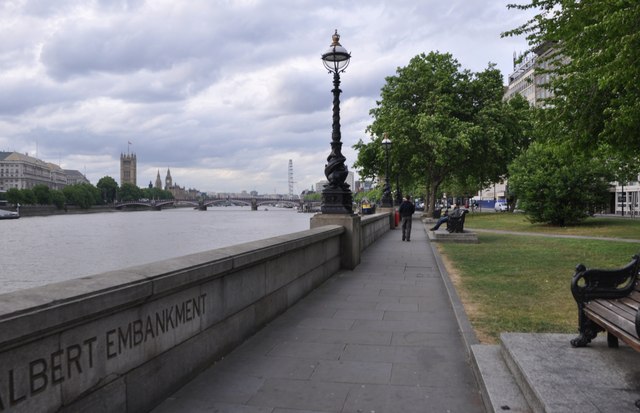
The most famous building on Albert Embankment was built to look like it doesn’t officially exist. The postmodern ziggurat of the SIS Building — headquarters of MI6 — looms at the Vauxhall end, its cream and green façade reflected in the river. Further north, past the International Maritime Organization and the art deco former London Fire Brigade headquarters, the promenade opens into a pedestrian walkway in front of St Thomas’ Hospital, where Victorian cast-iron dolphin lamp standards still line the granite wall.

2011
London - Albert Embankment path - Lambeth Palace Road - South Bank - Jubilee Walkway - View SSW towards Lambeth Bridg...
London - Albert Embankment path - Lambeth Palace Road - South Bank - Jubilee Walkway - ...
Wikimedia Commons · CC BY-SA 4.0
2019
K6 Telephone Kiosk, Lambeth Palace Road Albert Embankment 01
Wikimedia Commons · CC BY-SA 4.0
Historical image not found
Today
London : Lambeth - Albert Embankment
Geograph · CC BY-SA 2.0

The benches along this stretch bear swan motifs in their cast-iron arms — fifteen of them, Grade II listed since 1981, and quite distinct from the sphinxes and camels of the Victoria Embankment opposite. On a clear day the view across to the Houses of Parliament is as fine as any in London. The name of this embankment was chosen to match that view — but the choice was more deliberate than it first appears.

✦   ✦   ✦
Name Origin

A Royal Pair Across the Water

The choice to name this embankment “Albert” was no accident of geography. Records confirm it was named in honour of Prince Albert, the Prince Consort, who had died in December 1861. The Metropolitan Board of Works named the Victoria and Albert Embankments as a deliberate pair — Victoria on the Middlesex north bank, Albert on the Surrey south — so that the two monarchical names would face each other across the Thames. As documented by British History Online in the Survey of London (Volume 23, 1951), the embankment on the Surrey side replaced a series of industrial streets including Fore Street, which was effectively erased by the new works.

Before 1868, the riverfront here had no unified name. The old route was known variously as Fore Street and, at its southern end, simply as “Vauxhall.” The new embankment gave the entire mile a single identity — and a royal one. The name “Albert Embankment” appears in Dickens’s Dictionary of the Thames as early as 1881, by which point the name had fully settled.

How the name evolved
pre-1868 Fore Street
pre-1868 (south) Vauxhall Street
1868 Albert Embankment
present Albert Embankment
✦   ✦   ✦
History

Mud, Potteries and a Mile of Granite

The riverfront that Albert Embankment replaced was one of Victorian London’s grimmer industrial strips. As British History Online records in the Survey of London, the population and industries of Lambeth — potteries, glassworks, timber yards, and barge houses — had been concentrated along this river strip for centuries, with clay and finished goods transported entirely by water. The foreshore was prone to flooding at high tide, and the mud that accumulated in the bends of the river made the riverfront both malodorous and hazardous.

Key Dates
14th C
White Hart Draw Dock
Origins of the riverside slipway later known as White Hart Draw Dock, the oldest documented feature on this stretch of the Thames foreshore.
1809
Vauxhall Bridge opens
Construction of the approach road cut through riverside properties; the Old Royal Oak Tavern was demolished. The foreshore remained a mix of industrial wharves and potteries.
1865
Construction begins
Work on the Albert Embankment commenced in September 1865 under engineer John Grant for the Metropolitan Board of Works. Contractor was William Webster.
1868
Embankment opens
The Albert Embankment opened in May 1868. Fore Street and its courts and alleys south of Lambeth Bridge were swept away. Land reclaimed from the river was sold to the trustees of St Thomas’ Hospital.
1871
St Thomas’ Hospital moves
St Thomas’ Hospital relocated from Southwark to its new riverside site on reclaimed embankment land, paying approximately £100,000 for eight to nine acres.
1937
Fire Brigade HQ opens
The London Fire Brigade headquarters, designed in art deco style and opened by King George V, was built on Albert Embankment, remaining operational until 2007.
1994
MI6 moves in
The SIS Building, designed by Terry Farrell & Partners, became the publicly acknowledged home of Britain’s Secret Intelligence Service at the Vauxhall end of the embankment.
Did You Know?

The Albert Embankment was built on arches specifically to allow boats to continue reaching riverside businesses through draw docks. It does not contain major interceptor sewers — unlike Bazalgette’s Victoria and Chelsea Embankments on the north bank — meaning those older riverside commercial connections were preserved beneath the new granite wall.

The embankment was built for the Metropolitan Board of Works under the immediate direction of engineer John Grant — not Sir Joseph Bazalgette, as is commonly stated. Bazalgette was the Board’s chief engineer and oversaw the scheme, but Grant supervised construction on the ground. The works involved damming sections of the Thames with cofferdams, dredging the riverbed, and driving timber piles deep below high-water mark. During construction, pieces of pottery were found dating to Elizabethan times, remnants of the potteries that had defined this stretch for generations.

The decision to site the southern embankment here, as British History Online notes, was driven partly by Members of Parliament wanting to improve the view from the newly completed Palace of Westminster across the river — and partly by the chronic flooding of old Lambeth at every exceptionally high tide. The embankment itself cost over £1,000,000. Part of that cost was offset by selling 8.5 acres of reclaimed land to St Thomas’ Hospital, which had been displaced from Southwark by railway works.

✦   ✦   ✦
Culture

Dolphins, Swans and a Dock From the 14th Century

The street furniture of Albert Embankment was designed by George John Vulliamy, the Metropolitan Board of Works’ superintending architect, whose dolphin lamp standards appear on both the Albert and Victoria Embankments. As noted by SE1 Direct, the embankment is an austere riverside street whose Victorian ironwork remains its most distinctive decorative inheritance. The 28 cast-iron lamp standards have entwined dolphins wrapping a fluted column, their bases stamped with the arms and monogram of the Metropolitan Board of Works. On the stretch between Lambeth and Westminster Bridges, 15 benches bear swan motifs rather than the sphinxes of the north bank — listed Grade II in 1981 and formally protected within Lambeth’s Conservation Area.

Hidden Survivor
White Hart Draw Dock — a 14th-Century Slipway Beneath the Granite

Because the Albert Embankment was built on arches rather than solid fill, the southern section near Lambeth Bridge preserves a pair of tunnels leading to a small riverside slipway: White Hart Draw Dock. Its origins can be traced to the 14th century, making it the oldest documented feature on this stretch of foreshore. It is sometimes said the dock was built by Royal Doulton to transport pottery — a claim that is a myth. From 2009, Lambeth Council commenced a refurbishment of the dock as part of a public art project.

The embankment also carries an unexpected memorial. Tucked to the north of Lambeth Bridge is the SOE Memorial — a larger-than-life bust of Violette Szabo atop a plinth honouring the 117 Special Operations Executive agents who did not return from wartime missions to France. Sculpted by Karen Newman and unveiled in 2009, Szabo gazes across the Thames: a South Londoner who volunteered as an undercover agent, was captured behind German lines after D-Day, and was executed in early 1945.

📺 TV
Slow Horses
Gary Oldman (series creator) · 2025
Season 5: characters discuss life on Albert Embankment at sunset.
Doctor Who
BBC · 1964
Multiple episodes filmed at the embankment, Daleks pursuing characters.
🎵 Music
Waterloo Sunset
Ray Davies / The Kinks · 1967
Inspired by Davies' time at St Thomas' Hospital overlooking Thames.
· Art
Self & Other
Random International · 2018
Permanent kinetic sculpture installation on Albert Embankment.
Gallery
Damien Hirst · 2015
Contemporary art gallery opened on Albert Embankment.
✦   ✦   ✦
People

The Prince, the Engineer and the Distiller

Prince Albert, the Prince Consort, never set foot on this embankment — it was completed seven years after his death in December 1861. But the naming was a deliberate tribute, mirroring the Victoria Embankment opposite and reflecting the Board of Works’ instinct to pair civic improvements with royal commemoration. The engineer directly responsible for the Albert Embankment’s construction was John Grant, Bazalgette’s assistant engineer, whose role has long been overshadowed by the fame of his chief. Grant supervised the day-to-day works from 1865 until opening in 1868.

The site of No. 85 Albert Embankment has a longer residential history. As the Survey of London records, it stood on or near a property once occupied by a distillery established on the site of the old Vine Inn. Sir Robert Burnett built a residence there, and the firm of Burnetts remained in possession until 1928, when the business was taken over by the Distillers Company. The riverside plot had previously — before the embankment existed — been associated with the Marquess of Worcester and his assistant Caspar Kaltoff, who conducted mechanical experiments at the house then known as Copthall.

“That part of the Thames known as Stangate Bank, where the hospital now stands, had long borne an ill repute — ill-looking, ill-smelling, and of evil associations.”
Old and New London, Vol. 6, describing the foreshore before the Albert Embankment was built
✦   ✦   ✦
Recent Times

From Wharves to Luxury Towers

The southern stretch of the embankment — below Tinworth Street, beyond Vulliamy’s ornamental zone — remained occupied by industrial wharf premises until after the Second World War. Redevelopment came slowly, first as office blocks, then as riverside residential towers. Public pedestrian access to this section was only secured in the 1990s. Lambeth Council designated the Albert Embankment riverfront a Conservation Area in 2001, though that designation has not halted development pressure. The Corniche Building, designed by Foster & Partners, was completed in spring 2020 and — alongside the adjacent Dumont and Merano blocks — added 472 luxury apartments to the riverside.

Parts of the southern section still carry what planners call a “provisional appearance,” as landowners retain hopes of pushing the embankment line further into the river. Lambeth’s planning policies presently oppose encroachment on the tidal riverbed habitat, leaving an ongoing tension between redevelopment ambition and the conservation of the Thames foreshore that the Victorian engineers first reclaimed.

✦   ✦   ✦
Today

The Oval’s Thames Frontage

The northern promenade, in front of St Thomas’ Hospital, remains one of the quieter Thames-side walks in central London — less trafficked than the South Bank upstream, with direct sightlines to the Houses of Parliament and Westminster Bridge. The Victorian lamp standards and swan benches are protected and well-maintained. The road itself carries the A3036, and the pavement broadens where the hospital grounds push traffic back behind Lambeth Palace Road. In the Thames opposite, London’s only river fire station operates two fireboats, a working reminder of the emergency infrastructure that this stretch has hosted since 1937.

5 min walk
Archbishop’s Park
A quiet green space behind Lambeth Palace, historically the Archbishop of Canterbury’s grounds. Tennis courts and a children’s area.
8 min walk
Lambeth Palace Garden
One of the oldest private gardens in London, the palace grounds date to the medieval period. Occasional open days.
10 min walk
Vauxhall Pleasure Gardens (site)
The famous Georgian pleasure grounds are now Spring Gardens, a public park near Vauxhall station preserving the name of their storied predecessor.
Thames foreshore
Tidal River Habitat
The riverbed exposed at low tide along this stretch is a protected intertidal habitat, one reason why Lambeth resists further embankment encroachment.

The embankment’s dual identity — grand Victorian promenade to the north, provisional post-industrial edge to the south — has never fully resolved itself. The Oval neighbourhood’s best-known modern tenant, MI6, occupies the far end of the road behind what the agency itself still does not confirm as its own address. That combination of transparency and secrecy feels appropriate for a street that buried an entire neighbourhood beneath a mile of reclaimed river.

✦   ✦   ✦
On the Map

Albert Embankment Then & Now

National Library of Scotland — Ordnance Survey 6-inch, c. 1888. Hosted by MapTiler. Modern: © OpenStreetMap contributors.

✦   ✦   ✦

Frequently Asked Questions

Why is it called Albert Embankment?
The embankment was named in honour of Prince Albert, the Prince Consort and husband of Queen Victoria, who died in December 1861. The Metropolitan Board of Works named the Victoria and Albert Embankments as a matching pair — Victoria on the north bank, Albert on the south — so that the two names would face each other across the Thames. The Albert Embankment was completed in 1868, seven years after the Prince Consort’s death.
Who actually built Albert Embankment — was it Bazalgette?
Joseph Bazalgette is commonly credited and was the Metropolitan Board of Works’ chief engineer who oversaw the overall scheme. However, the engineer directly responsible for on-site direction was John Grant, Bazalgette’s assistant. The contractor was William Webster. Unlike Bazalgette’s Victoria and Chelsea Embankments on the north bank, the Albert Embankment does not incorporate major interceptor sewers — it was built on arches to preserve boat access to riverside businesses.
What is Albert Embankment known for?
Albert Embankment is known today as the home of the SIS Building (MI6 headquarters) at Vauxhall, the International Maritime Organization, and the former London Fire Brigade headquarters (opened 1937, now Grade II listed). Its northern promenade offers some of the finest unobstructed views of the Houses of Parliament. The Victorian dolphin lamp standards by George Vulliamy and the 15 swan-motif benches between Lambeth and Westminster Bridges are Grade II listed heritage features.