Hackney London England About Methodology
Hackney · Stamford Hill · E5

Bakers Hill

Named after a dyer who spread cloth to dry on the slopes above the River Lea, this short Stamford Hill cul-de-sac carries a forgotten industrial world in its name.

Name Meaning
Baker’s drying ground
First Recorded
c. 1826
Borough
Hackney
Character
Residential cul-de-sac
Last Updated
Time Walk

Where the Drying Grounds Were

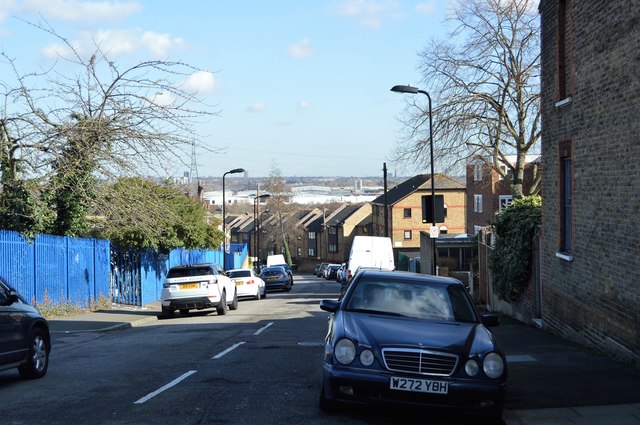
Bakers Hill is a cul-de-sac off Mount Pleasant Lane in the Stamford Hill neighbourhood of Hackney, running roughly eastward towards the former floodplain of the River Lea. The street is short — barely 200 metres — but it sits on ground that was once the industrial edge of the parish, where the open land between Clapton’s lanes and the river was given over to the wet trades that needed both space and running water.

Today the street is predominantly residential, a mix of Victorian and Edwardian terraces alongside later twentieth-century housing. Its character is quiet and self-contained. But the name reaches back nearly two centuries to a man who made his living dyeing and dressing cloth on this hillside — and that name is exactly what it sounds like.

1820
The Robbery of the Baker at Hackney (BM 1927,1126.1.25.55)
Wikimedia Commons · Public domain
2018
Bakers Hill
Bakers Hill
Wikimedia Commons · CC BY-SA 2.0
2026
Riverside path near Bakers Hill
Wikimedia Commons · CC BY-SA 2.0
Today
Bakers Hill
Bakers Hill
Geograph · CC BY-SA 2.0
✦   ✦   ✦
Name Origin

The Dyer’s Hill

The name most likely derives from George Baker, a dyer who occupied industrial premises at High Hill Ferry — the River Lea crossing near this spot — from at least 1826. As recorded by British History Online in the Victoria County History of Middlesex, Baker and his neighbour William Burch ran intermingled buildings backed by extensive drying grounds on this hillside, with Baker styled as a dyer and Burch as a calico printer. The ground rising from the ferry landing to the lane above was used for stretching and drying the processed cloth — the hill, in effect, was his workplace.

By the 1850s the firm appears in records as Baker & Hudden, calenderers — finishers who pressed and glazed cloth. The occupational surname “Baker” and its attachment to this specific slope became the street’s identity. The apostrophe dropped from common usage over time. “Baker’s Hill” became “Bakers Hill” without ceremony, as happened with many London streets whose possessive origins faded into simple description.

How the name evolved
c. 1826 Baker’s Hill
c. 1855–1880 Baker’s Hill
present Bakers Hill
✦   ✦   ✦
History

Dye-Works, Model Dwellings and a Changing Parish

The land around what became Bakers Hill was agricultural and semi-industrial well into the nineteenth century. The route from Upper Clapton towards High Hill Ferry — the Lea crossing near today’s Springfield — passed through fields and market gardens. The river and its tributaries made this stretch of Hackney a natural home for trades that needed water: bleaching, dyeing, and calico printing all clustered along the Lea’s western bank.

Key Dates
1826
Baker at High Hill Ferry
George Baker, dyer, and William Burch, calico printer, recorded at intermingled buildings with drying grounds at the foot of the hill.
c. 1855
Baker & Hudden
The firm is recorded as Baker & Hudden, calenderers, representing the continued operation of cloth-finishing on the site.
1866
Workers’ Dwellings
Land at Baker’s Hill leased to the London Labourers’ Association for model dwellings — one of Hackney’s earliest philanthropic housing experiments.
c. 1880
Lea Valley Works
Baker’s Hill contains the Lea Valley bleaching and dyeing works of William Connell & Co., successor to the earlier dye operations.
1960s
Laundry Takeover
Connell’s Lea Valley laundry taken over by Initial Services — the last echo of the street’s industrial origins.
1985
Private Rebuilding
A national firm builds middle-class housing at Baker’s Hill, marking the final transition to a wholly residential street.
Did You Know?

In 1866, land at Bakers Hill was leased to the London Labourers’ Association for model dwellings — making it one of the first streets in Hackney to receive purpose-built philanthropic housing, decades before municipal council estates became common.

The 1866 leasing of land here to the London Labourers’ Association was part of a broader movement in mid-Victorian Hackney. As recorded by British History Online, model dwellings became a philanthropic cause in the parish from the 1840s onwards, though they arrived in the south of the parish first. Bakers Hill was therefore an early northern example of the type. The proximity to the Lea — and to the working population drawn by the dye-works and laundries — made the site a logical choice for labourers’ housing.

By 1880 the street’s industrial identity was consolidated under William Connell & Co.’s Lea Valley bleaching and dyeing works. The operation survived well into the twentieth century before being absorbed by Initial Services in the 1960s. Archaeological surveys along the Lea corridor by MOLA (Museum of London Archaeology) have documented how extensively this stretch of the Lea Valley was exploited for textile processing from the post-medieval period onwards, providing essential context for the industrial character of streets like Bakers Hill.

✦   ✦   ✦
Culture

Thread, Water and the Lea Valley Trades

Bakers Hill sits within a landscape shaped entirely by the River Lea. The calico printing, bleaching and dyeing industries that gave the street its name were part of a broader Lea Valley textile belt that stretched north through Hackney Wick and beyond. These were not cottage industries: the drying grounds behind Baker and Burch’s premises were large enough to be recorded on maps, and the later Connell operation was substantial enough to survive into the era of industrial laundries. The Stamford Hill neighbourhood has been extensively documented by Historic England, whose records of the wider Hackney conservation landscape note the survival of late-Victorian terrace typologies throughout the area.

Industrial Survival
The Lea Valley Laundry Lineage

The Lea Valley bleaching and dyeing works of William Connell & Co., recorded at Bakers Hill by 1880, represent the longest industrial thread in the street’s history. When the firm’s successor laundry was taken over by Initial Services in the 1960s, it marked the end of nearly 140 years of continuous wet-trade operation on the same site — from George Baker’s drying grounds to a modern commercial laundry chain.

The broader Stamford Hill neighbourhood today is best known for its Hasidic Jewish community — the largest concentration of Haredi Jews in Europe. That community’s presence, which deepened from the 1880s onwards and accelerated in the 1930s as refugees fled Nazi persecution, sits alongside Bakers Hill’s much older industrial story. The street itself carries no visible trace of either the dye-works or the model dwellings. What remains is the name, and the slight topography of the hill on which the cloth once dried.

✦   ✦   ✦
People

The Dyer Who Left His Name

George Baker was a dyer recorded at High Hill Ferry from 1826, working alongside the calico printer William Burch. Their premises at the foot of what became Bakers Hill included intermingled buildings and extensive drying grounds — the physical spread of their operation explaining why the name attached to the hill rather than to a building or a lane. Baker’s name persisted in the firm’s successor, Baker & Hudden, calenderers, recorded c. 1855. No further biographical detail about George Baker has been found in available sources.

The London Labourers’ Association, which took a lease of land here in 1866 for model dwellings, was one of several philanthropic bodies active in mid-Victorian Hackney. No individual associated specifically with the Bakers Hill scheme has been identified in available records. The street’s later history — the Connell laundry, the 1985 rebuilding — belongs to institutions and firms rather than named individuals whose connection to the street can be verified.

✦   ✦   ✦
Recent Times

Regeneration and the Loss of Industry

The Connell Lea Valley laundry’s takeover by Initial Services in the 1960s was the last industrial event in Bakers Hill’s recorded history. The broader Hackney context is important: the decades after the Second World War saw widespread municipal housing replace the Victorian terraces in many parts of the borough, though British History Online records that Bakers Hill specifically saw private rather than council rebuilding when its turn came.

By 1985, a national housebuilder had constructed middle-class housing at Baker’s Hill — at a moment when Hackney was beginning its long turn from post-industrial decline towards gentrification. That timing placed Bakers Hill ahead of the wider curve: the street was being rebuilt for owner-occupation when much of surrounding Stamford Hill remained social housing and private rental. The postcode (E5 9HL) confirms a predominantly flat-and-terrace residential character, with property values that reflect the neighbourhood’s renewed desirability.

✦   ✦   ✦
Today

A Quiet Cul-de-Sac on an Industrial Memory

Bakers Hill is a short residential dead-end, the kind of Hackney street that holds its history in its name alone. Nothing visible announces the dye-works or the drying grounds. The street’s properties — a mix of Victorian terraces, post-war conversions and 1980s-built houses — face one another across a narrow carriageway that ends abruptly, as cul-de-sacs do, without ceremony. The elevated position relative to the Lea floodplain to the east is still perceptible; the hill that gave the dyers their drying space is still there.

The nearest green spaces offer a contrast to the street’s enclosed character. Springfield Park, opened in 1905 from former private grounds, lies within a short walk to the north-east, overlooking the Lea. Clissold Park is reachable to the west. Both speak to the transformation of the Lea corridor from an industrial river-margin into a public amenity — the same shift, at a larger scale, that turned Baker’s drying ground into a quiet terrace.

~10 min walk
Springfield Park
Victorian park opened 1905 on the former Lea floodplain; views over the River Lea and Walthamstow Marshes.
~15 min walk
Clissold Park
Stoke Newington’s large Victorian park with lake, deer enclosure and tennis courts; a local landmark since 1889.
~12 min walk
Millfields Park
Open riverside common on the Lea, popular for walking and informal sport, with views to Hackney Marshes.
~20 min walk
Walthamstow Marshes
A rare surviving fragment of Thames-side marshland, designated a Site of Special Scientific Interest for its ecology.
✦   ✦   ✦
On the Map

Bakers Hill Then & Now

National Library of Scotland — Ordnance Survey 6-inch, c. 1888. Hosted by MapTiler. Modern: © OpenStreetMap contributors.

✦   ✦   ✦

Frequently Asked Questions

Why is it called Bakers Hill?
The name most likely derives from George Baker, a dyer who occupied industrial premises at High Hill Ferry — the River Lea crossing near this spot — from at least 1826. Baker and his neighbour William Burch ran intermingled buildings backed by drying grounds on this hillside. The ground rising from the ferry landing was used for stretching and drying processed cloth, and the name “Baker’s Hill” attached to the slope above their works. The apostrophe was lost from common usage over time.
What industry was Bakers Hill known for in the 19th century?
Bakers Hill was part of Hackney’s textile-processing belt along the River Lea. George Baker operated a dye works from at least 1826, and by 1880 the street contained the Lea Valley bleaching and dyeing works of William Connell & Co. The Lea provided both water and a transport route for the calico-printing, bleaching, and dyeing trades that clustered here from the early nineteenth century. The Connell laundry survived until the 1960s, when it was taken over by Initial Services.
What is Bakers Hill known for?
Bakers Hill is a quiet residential cul-de-sac in the Stamford Hill neighbourhood of Hackney, off Mount Pleasant Lane near the former course of the River Lea. It carries a layered history: a nineteenth-century dye works that gave it its name, an 1866 philanthropic housing experiment by the London Labourers’ Association, and 1980s private rebuilding that anticipated the area’s broader gentrification. Today it is wholly residential, its industrial past preserved only in its name.